Spec-verified review
Husqvarna Automower 420 iQ
By MowScout EditorialUpdated 2026-07-01How we scoreHow we test
Husqvarna's mature Automower reliability, finally wire-free: EPOS satellite navigation with an RS1 reference station skips the boundary wire. You pay a premium — ~$3,500 plus likely install — for basic radar obstacle handling and RWD, but you get a dealer network and track record newer brands can't match.
Last verified 2026-07-01
MowScout verdict
The short version
Husqvarna's mature Automower reliability, finally wire-free: EPOS satellite navigation with an RS1 reference station skips the boundary wire. You pay a premium — ~$3,500 plus likely install — for basic radar obstacle handling and RWD, but you get a dealer network and track record newer brands can't match.
Buy if
- You want a proven, dealer-supported brand without a boundary wire
- Your lawn is up to ~1 acre with a clear-sky spot
- Long-term reliability and service matter more than price
Skip if
- You want the most capability per dollar (LUBA 3 / Navimow X do more for less)
- You want AI-vision obstacle avoidance
- Your antenna spot is shaded or you dislike a premium install
Pros
- Wire-free EPOS satellite navigation (RS1 station)
- Mature Automower reliability + dealer network
- 4G GPS anti-theft, 1-4 in cut range
- Quiet (~62 dB) and light (~38 lb)
Cons
- Premium ~$3,499 (plus ~$300-500 install)
- Radar obstacle avoidance is basic (no AI vision)
- RWD; antenna needs clear sky
- Weak value for the money
Fit check
What to verify before buying
Husqvarna Automower 420 iQ is a $3,499 mower rated for 1 acre, 0.8 acres of daily coverage, 45% slopes, and 5 mapped zones. Treat those as fit limits, not marketing decoration: mowable grass, wet turns, separate zones, and spring growth should all leave enough headroom for the mower to run without repeated rescues.
Navigation is RTK and drive is RWD. This model needs careful antenna or base-station placement, so buyers should plan for open sky, clean power, and a dock location that does not force the mower through a weak-signal corridor every day. Basic obstacle handling can help with larger objects, but buyers should still clean up hoses, toys, branches, and repeated stuck points before relying on an automated schedule.If your hardest constraint is slope or rough turf, compare the terrain guide; if setup simplicity is the priority, compare similar no-wire picks before choosing by price.
Before checkout, confirm the exact SKU, included dock or base hardware, return window, warranty path, and current price at one of the listed retailers: Husqvarna dealers, Amazon, Tractor Supply, Lowe's. Robot mower bundles change quickly, so the retailer page should match this review's capacity, model name, and last-verified source trail.
In the current catalog, this model sits in the premium price tier with 9 other verified mowers nearby. Its rough price-per-rated-acre is $3,499, which is useful when comparing against a larger mower that may look expensive upfront but cheaper per acre. Dreame A3 AWD Pro 3500 is the closest lower-priced comparison point at $2,999.
The capacity math is 0.8 acres per day against a 1 acre max rating. That matters when the lawn is close to the published limit, because a mower that can only cover the whole yard under ideal conditions has less margin after rain delays, fast spring growth, dull blades, or separated zones. If your measured turf is close to 1 acre, compare Mammotion LUBA 3 AWD 5000H for more headroom before buying.
The tags attached to this record are dealer support, wire-free Husqvarna, 1 acre, reliability. Use those as a sanity check: if your yard does not match at least two of those tags, the MowScout Score is less important than fit. A high-scoring mower in the wrong category still creates rescue trips, missed strips, and support friction.
Its current MowScout Score is 67, which should be read beside the hard specs rather than treated as a standalone verdict. The strongest reasons to keep this mower on a shortlist are its RTKnavigation, RWD drive, 45% slope rating, and 5zone support. The biggest reason to remove it is any yard fact that directly conflicts with those numbers.
Cutting fit is also specific: this deck is 9.4 inches wide and adjusts from 1 to 4 inches. Edge behavior is rated "ok", so expect some trim work around fences, walls, beds, curbs, and tight hardscape. That is normal for robot mowers, but it matters more if your lawn has a lot of border length relative to open grass.
Ownership details point to 3 years of warranty coverage, app quality rated 4out of 5, connectivity through wifi, bt, 4g, 62 dB of listed noise, and 38 lb of chassis weight. Those are practical details for storage, night schedules, support expectations, and whether the mower will be easy to lift, clean, or move between areas.
The source trail for this record was last checked on 2026-07-01 and includes Husqvarna Automower 420 iQ product page. Use those sources to resolve any mismatch between this review, a retailer title, and a bundled accessory listing. If the source page changes the area rating, slope rating, included hardware, or warranty terms, update the shortlist before clicking through. Keep a screenshot of the retailer specs for returns.
Yard-fit read
Best for up to ~1 acre, moderate slopes, with a clear-sky antenna spot.
Alternative: Husqvarna Automower 430X - the wired 430X saves ~$1,500 if you don't mind a boundary wireScore breakdown
For years the honest answer to "I want a Husqvarna, but I don't want to bury a wire" was a shrug. Husqvarna built the most reliable robot mowers in the business — and kept navigating them with a perimeter wire while the rest of the category went wire-free. The Automower 420 iQ is Husqvarna's answer: the mature brand, the dealer network, the track record, finally paired with EPOS satellite navigation so there's no boundary wire to trench. On our spec-verified scoring it lands at a middling 65/100, and that number tells the real story. This is a well-supported, genuinely wire-free Husqvarna that asks a premium price and gives up some modern capability to get there. This is a data-driven review, not a hands-on one: MowScout scores are computed from verified manufacturer and retailer specifications and cross-checked against professional and owner reviews. We have not run this unit ourselves, and we won't pretend otherwise.
### MowScout Score: 65/100 — Best for brand-trust buyers who want Husqvarna without the wire The verdict, in three lines: The 420 iQ is for the buyer who wants a mature, dealer-backed Husqvarna and is done with boundary wire. EPOS satellite navigation drops the wire, the 45% slope rating and ~1-acre capacity are solid, and 4G anti-theft plus a real service network are genuine strengths. But you pay a flagship price for mid-tier tech: radar-only obstacle avoidance (no AI vision), rear-wheel drive, and a satellite antenna that needs clear sky. Match it to an open, brand-loyal buyer and it delivers; shop on capability-per-dollar and rivals give you more. Street price: about \$3,499 (plus a common \$300–\$500 professional install) as of mid-2026 — verify current price. → Find the mower that fits your yard
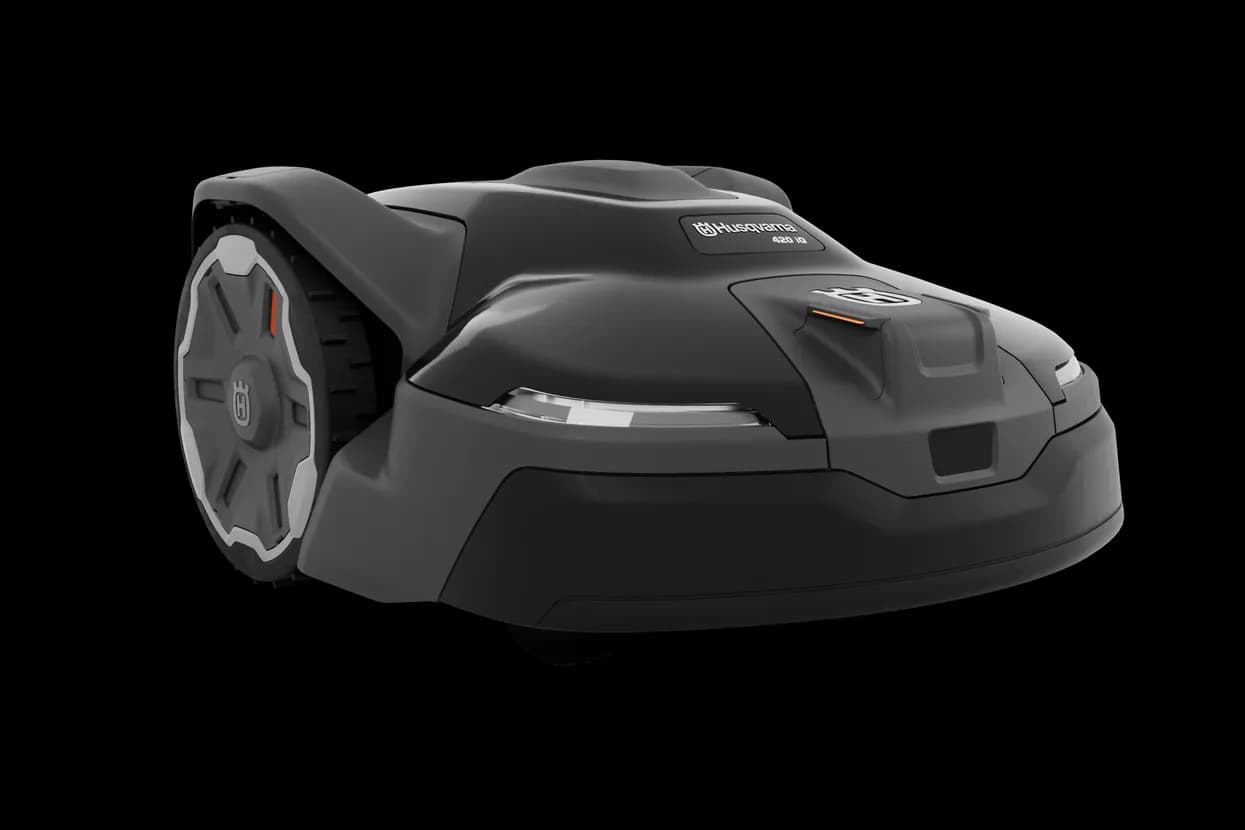
Image: Husqvarna official product photography. MowScout does not shoot original hardware photos; this is the manufacturer's image, used to illustrate the product.
Reasons to buy / reasons to skip
Reasons to buy
- ✅ Genuinely wire-free, at last. EPOS satellite navigation draws your boundaries in software — no perimeter wire to trench, and re-bounding is an app edit, not a dig.
- ✅ Husqvarna reliability and a real dealer network. The most proven robot-mower platform in the business, sold and serviced through dealers who can install, repair, and stock parts.
- ✅ Solid terrain and capacity for the class. A 45% slope rating and up to ~1 acre of coverage put it ahead of most vision-only wire-free mowers.
- ✅ Full 4G anti-theft and GPS tracking. Cellular theft tracking, geofencing, and remote alerts on a machine that lives outdoors, backed by the Automower Connect app.
Reasons to skip
- ❌ A flagship price for mid-tier tech. At ~\$3,499 (plus install) it's one of the priciest ways to cover an acre wire-free.
- ❌ Radar-only obstacle avoidance. Basic detection, not the AI camera vision rivals use to recognize and plan around pets, toys, and hoses.
- ❌ Rear-wheel drive. Capable, but with less wet-grass and slick-slope margin than the AWD machines it's priced against.
- ❌ Needs clear sky. The EPOS reference station and antenna want an open view — heavy tree cover or a hemmed-in lot degrades the fix.
The weighted scorecard: why it earns 65/100
The MowScout Score is computed from verified specs across seven weighted pillars (see how we score). Here is exactly where the 420 iQ's points come from — and where they leak away.
| Pillar | Score | Why it lands here |
|---|---|---|
| Navigation reliability | 17 / 25 | EPOS RTK is precise on open ground — satellite correction from the RS1 reference station holds tight, repeatable boundaries. It loses points for being a single-layer, sky-dependent system with no LiDAR or vision backup, and for radar-only obstacle avoidance that detects rather than recognizes objects. Redundant, camera-fused rivals score higher here. |
| Terrain capability | 13 / 20 | A 45% slope rating is genuinely good and matches the wired 430X. The ceiling is the rear-wheel drive — capable on grade, but with less traction margin on wet or loose ground than AWD machines rated the same or higher, several of which cost less. |
| Coverage & speed | 9 / 15 | Up to ~1 acre (Husqvarna's "up to 1 acre ±20%," so plan around ~0.8 acre typical) is respectable, but a narrow 9.4-inch deck means more passes and longer runtimes per acre than wider-deck rivals. Mid-pack against the field. |
| Setup & ease | 9 / 15 | Dropping the wire is the win. But EPOS isn't plug-and-play: you site an RS1 reference station under open sky, set reference points, and many buyers pay a \$300–\$500 dealer install. That's easier than trenching wire, harder than a five-minute vision mower. |
| Cutting quality & edges | 8 / 10 | A wide, practical 1.0–4.0-inch height range covers low cool-season turf up to tall warm-season grass, and edge cutting is rated "ok." It leaves the usual border strip, so not a perfect mark. |
| Value | 4 / 10 | The weakest pillar and the clearest signal of the trade. At ~\$3,499 plus install, price-per-acre is among the highest in the class for the capability delivered — you're paying for the badge and the network, not the spec sheet. |
| Reliability & support | 5 / 5 | Full marks, and the reason to buy. The deepest reliability record in the category, a nationwide dealer network for install and service, and a long warranty (3 years in our data — verify, as Husqvarna's listing may state more for registered owners). |
| Total | 65 / 100 | A well-supported, genuinely wire-free Husqvarna whose premium price and mid-tier smarts keep it out of the top tier. |
The scorecard is honest about the trade-off: Reliability & support (5/5) is maxed and Value (4/10) is the lowest pillar on the card. That gap is the 420 iQ in one line — you buy it for the brand, the dealer, and the wire-free convenience, and you accept that the raw capability-per-dollar trails newer rivals.
Who it's for — and who should skip it
Buy it if you specifically want a Husqvarna and you're done with boundary wire. If a mature brand, a local dealer who can install and service the machine, and a long track record matter more to you than squeezing the most spec out of every dollar, the 420 iQ is built for you — provided your lawn has reasonably open sky for EPOS, runs up to about an acre, and has slopes within 45%. It's also a natural upgrade path for an existing Husqvarna owner who liked the reliability but never wanted to bury or re-route wire.
Skip it if you optimize on capability per dollar, your lot is heavily wooded (EPOS needs sky), or you want modern AI-vision obstacle avoidance and all-wheel drive. For those priorities, a Mammotion LUBA 3 AWD or a Segway Navimow X350 gives you more mower for less money. Not sure which camp you're in? Our configurator narrows the field to models that actually fit your yard, and the buyer's guide and pillar guide explain the navigation trade-offs in plain English.
How EPOS satellite navigation works
EPOS is Husqvarna's Exact Positioning Operating System — a wire-free, satellite-based navigation system that replaces the boundary wire with software. Instead of sensing a signal in a buried loop, the mower knows precisely where it is on a map you've defined, and stays inside virtual boundaries you draw. The precision comes from RTK (real-time kinematic) satellite correction: a stationary RS1 reference station sits at a known point on your property, receives the same satellite signals as the mower, and computes the tiny corrections needed to sharpen a raw GPS fix from meters of error down to centimeters. The mower carries its own satellite antenna and applies those corrections in real time.
The upside is real: no wire to trench, and when your yard changes — a new flowerbed, a moved play set, a fresh no-go zone — you edit the map rather than dig up copper. Boundaries are repeatable and don't drift, and setup is cleaner than a wired install once the reference station is placed.
The catch is equally real, and it's the single most important thing to understand before buying: EPOS depends on a clear view of the sky. Both the RS1 station and the mower need an open enough sky to hold an accurate satellite fix. Under dense tree canopy, beside tall buildings, or in a narrow yard hemmed in by structures, the signal weakens and the mower can pause, slow, or drift. This is the exact inverse of the wired Automower 430X, which ignores the sky entirely because the wire does the navigating — a real, underrated advantage on shaded lots that EPOS gives up. It's also why EPOS sits in a different class from LiDAR or vision systems that map the yard visually and don't care about satellite signal. If your lot is heavily wooded, believe this limitation and shop a different navigation type; if it's reasonably open, EPOS is precise and stable.
One more honest note: because the 420 iQ is a satellite-only navigator with radar for obstacles, it has no redundant positioning layer. Flagship wire-free rivals fuse RTK with LiDAR and cameras so a briefly blocked satellite lock doesn't stop them. The 420 iQ has no such fallback — when it can't see the sky, it can't self-correct from a second sensor.
Terrain and slopes: a solid 45%, on rear-wheel drive
Terrain is one of the 420 iQ's stronger suits. Husqvarna rates it for a 45% slope (about 24°) on open ground, tapering to roughly 15% at a boundary, where the mower needs enough traction to turn cleanly without crossing the virtual line. That 45% open-ground figure is genuinely good — it matches the wired 430X and clears the modest 30–35% ceilings of most vision-only wire-free mowers. For a typical suburban lot with banks, swales, or a terraced section, that's real hill capability.
The honest caveat is the drivetrain: the 420 iQ is rear-wheel drive, not all-wheel drive. RWD is perfectly capable on flat-to-moderate ground and gentle-to-firm slopes, and Husqvarna's chassis have earned a good hill reputation over many seasons. But on slick uphill starts, wet grass, dew, or loose ground, an RWD mower can spin its drive wheels where an AWD machine keeps climbing. That matters here because the 420 iQ is priced against rivals — the LUBA 3 AWD, the Navimow X-series — that put torque to all four wheels and, in some cases, rate to steeper grades for less money. So the 45% number is a dry-condition ceiling: measure your steepest grade, leave 10–20% of headroom, and if your slopes are wet-prone or genuinely severe, an AWD machine is the safer buy. For gentle-to-moderate suburban terrain, the 420 iQ's RWD 45% rating is more than enough.
Capacity and coverage: about an acre, ±20%
The 420 iQ is rated for up to 1.0 acre of coverage — with an important asterisk. Husqvarna's own framing is "up to 1 acre ±20%," which means the honest planning number is closer to ~0.8 acre for a typical lawn, and the full acre only on easy, open, obstacle-light ground. We log that manufacturer range in our verification log rather than taking the round number at face value, and you should plan around the conservative end. Apply the usual 15% headroom rule — buy a rating meaningfully above your measured lawn to absorb slopes, obstacles, and thick spring growth — and the 420 iQ is a comfortable fit for lawns up to roughly 0.7 acre, and a stretch above that.
Coverage is where the narrow deck shows up. The 420 iQ cuts a 9.4-inch swath, which is tidy and maneuverable but means more passes and longer total runtime per acre than a wider-deck rival. Like every robot mower, it cuts a little every day rather than all at once, so "keeping up" is about the mow-charge-resume cadence matching your lawn's growth, not a single marathon run. Within its rated envelope on an open lawn it keeps pace cleanly; push it toward the top of that ±20% range on a fast-growing warm-season lawn and you'll want to confirm the daily coverage keeps up. For genuinely large properties, the capacity crown belongs elsewhere — see our large-yards guide.
Cutting quality and edges
On cut quality the 420 iQ is a proper Husqvarna. It runs a 9.4-inch cutting deck with a wide, app-adjustable height range of 1.0 to 4.0 inches — one of the more useful ranges in the class. That 1.0-inch floor suits short, fine, cool-season turf better than most wire-free rivals (many start at 1.5–2.0 inches), while the 4.0-inch ceiling covers tall warm-season grasses like St. Augustine and Bahia that prefer a high cut. As a mulching mower it drops fine clippings back into the canopy rather than bagging them — normal for the category and good for the lawn, feeding nitrogen back into the soil.
MowScout rates the 420 iQ's edge cutting "ok" — mid-pack, not class-leading. Like every robot mower, the blade disc sits inboard of the outer wheel, so a thin strip of grass always remains right at walls, fences, and beds. "Ok" means it does a competent but not exceptional job of getting near borders; you'll still want an occasional string-trimmer pass along hard edges. Robot mowers that build in a dedicated edge trimmer get closer, but the 420 iQ isn't one of them. On soft ground, watch for faint wheel tracks over time, as with any repeating-pattern mower — a minor cosmetic quibble, not a cutting-quality problem.
The honest gaps: where the 420 iQ falls short
We named the strengths; here are the trade-offs stated plainly, because a ~\$3,499 mower earns tough scrutiny.
- Premium price for mid-tier capability. This is the core issue and the reason Value scores just 4/10. At about \$3,499, plus a common \$300–\$500 professional install, the 420 iQ is one of the most expensive ways to cover roughly an acre wire-free. On paper, rivals hundreds of dollars cheaper offer AWD, AI vision, and multi-sensor navigation. You are paying for the badge and the network, not the spec sheet.
- Radar-only obstacle avoidance. The 420 iQ uses radar-based detection to slow and steer around objects — it's basic, not the AI camera vision that lets rivals identify and classify a pet, a hose, or a toy and plan around it. It's better at not hitting things than at understanding what they are. Clear small objects off the lawn before a run.
- Rear-wheel drive. Capable, but with less wet-grass and slick-slope margin than the AWD machines it's priced against, as covered above.
- Satellite antenna needs sky. EPOS is single-layer and sky-dependent. Under heavy canopy or in a hemmed-in yard it degrades, with no LiDAR or vision layer to fall back on.
None of these make the 420 iQ a bad mower — they make it a specialized one. It's built for the buyer who values the Husqvarna ecosystem on an open, moderate lot, not for the buyer chasing the most capability per dollar. If you're weighing whether the platform's quirks will bother you, our Husqvarna Automower problems guide walks through the common ownership gotchas across the Automower line.
The Husqvarna upside: dealers, track record, and 4G anti-theft
Here's where the 420 iQ pushes back, and it's why Reliability & support earns a perfect 5/5. This is the platform with the deepest reliability record in the category — years of real-world seasons behind the Automower name — backed by a nationwide Husqvarna dealer network that can sell, install, service, and stock parts. If you want a professional to site the reference station, hand you a working, mapped mower, and be there when something needs a repair, that support ecosystem is a genuine, hard-to-quantify advantage that a newer direct-to-consumer brand can't fully match. The long warranty (3 years in our data — verify, as Husqvarna's official listing may state longer for registered owners) reinforces the point.
Security is well covered, too. The 420 iQ includes anti-theft with GPS tracking and the full 4G / Wi-Fi / Bluetooth connectivity stack, managed through the mature Automower Connect app. The cellular link is what makes real-world theft tracking, geofencing alerts, and remote control possible on a machine that lives outdoors — a meaningful feature on a four-figure device, and a category where Husqvarna's app and PIN/anti-theft systems have a long, refined history. Scheduling, no-go zones, and firmware updates all live in the app, which earns a solid 4/5 in our data.
Setup, app, and true cost of ownership
Setup is easier than the old wired Automowers but not as trivial as a five-minute vision mower. You place and power the RS1 reference station where it can see open sky, establish reference points, and then drive or draw your boundaries in the app. There's no wire to trench — the big win — but the reference-station siting is a real decision that determines how well EPOS performs, which is exactly why so many buyers opt for the \$300–\$500 dealer install. Factor that into the sticker: the 420 iQ's true landed cost is closer to \$3,800–\$4,000 for a professionally installed setup.
Over five years, budget:
- Blades: roughly \$60–\$200 total in replacement blades and minor wear parts — cheap and owner-replaceable.
- Electricity: pennies per mow, not a line item worth worrying about.
- The battery wildcard: the largest foreseeable repair. Lithium packs fade over years, and an out-of-warranty replacement is the biggest single cost risk on any robot mower. Here, the Husqvarna dealer network is an asset — parts and service are easier to source than for some direct-only brands.
Even at a premium sticker, the multi-year math still compares favorably to years of gas, oil, tune-ups, and either your weekends or a lawn service — the case laid out in our buyer's guide.
How it compares vs the wired Automower 430X
The most natural comparison isn't a rival brand — it's Husqvarna's own Automower 430X, the wired machine the 420 iQ is designed to move buyers beyond. They share the DNA: the same reliability pedigree, the same 45% slope rating, the same dealer network, similar 4G anti-theft. The decision is almost entirely about the wire.
The 430X navigates by a buried boundary wire. That makes it cheaper (about \$1,999 street), gives it the longest reliability record in the category, lets it ignore the sky entirely (a real edge on shaded lots), and lets it cut a touch lower. Its cost is the trenching install and the friction of re-routing copper every time your landscape changes.
The 420 iQ keeps the reliability and support but swaps the wire for EPOS satellite navigation. You gain wire-free flexibility — edit boundaries in software, no digging — but you pay more, you need clear sky for the reference station, and you accept that EPOS is a single-layer system.
In one line: the 430X is the cheaper, sky-independent, wire-based veteran; the 420 iQ is the pricier, sky-dependent, wire-free successor. Buy the 430X to save money on a shaded or stable-layout lawn where a wire is a non-issue. Buy the 420 iQ if never touching a wire is the whole point and your yard has open sky. For a deeper wired-vs-wire-free breakdown, our 430X-vs-Navimow-X350 comparison and the no-boundary-wire guide both dig in.
Alternatives: who gets more for less
The 420 iQ's premium price is its biggest vulnerability, so it's worth naming exactly who out-values it — and when it still wins.
- For steep, complicated, wooded yards → Mammotion LUBA 3 AWD. Genuine all-wheel drive to 80% slopes, tri-fusion navigation (RTK + LiDAR + AI vision) that shrugs off tree cover, and a higher MowScout Score — typically for less money than the 420 iQ. If capability per dollar is your metric, this is the tougher machine. The 420 iQ answers only with brand and dealer support.
- For a big, open, wire-free lawn → Segway Navimow X350. Up to 1.5 acres of capacity, AWD, night-capable vision, and AI-vision obstacle avoidance the 420 iQ lacks. Like EPOS it wants clear sky, but it covers far more ground per dollar. The capacity and obstacle smarts both beat the 420 iQ; Husqvarna counters with a longer track record and local service.
- On a budget, wire-and-shade tolerant → Husqvarna Automower 430X. If you don't need wire-free and your lot is shaded, the wired 430X delivers the same Husqvarna reliability for about \$1,500 less.
If none of those obviously fits, the fastest way to settle it is the configurator — it screens your measured slope, area, sky/tree cover, and budget against every model we track, so you don't overpay for a badge you'll never use, or under-buy for the acre you actually have.
Full specifications
| Spec | Husqvarna Automower 420 iQ |
|---|---|
| MowScout Score | 65 / 100 |
| Street price | ~\$3,499 (plus ~\$300–\$500 install) — as of mid-2026, verify |
| Best for | Brand-trust buyers who want Husqvarna reliability without the boundary wire |
| Max area | Up to 1.0 acre (±20%; plan ~0.8 acre typical) |
| Daily coverage | ~0.8 acre |
| Navigation | EPOS satellite RTK — wire-free (can also run wired) |
| Reference station / antenna | Included RS1 reference station; needs clear-sky siting |
| Drive | Rear-wheel drive (RWD) |
| Max slope | 45% (about 15% at a boundary) |
| Cutting width | 9.4 in |
| Cut height | 1.0 – 4.0 in |
| Zones | Up to 5 mapped zones |
| Obstacle avoidance | Basic — radar-based (no AI vision) |
| Anti-theft / GPS | Yes / Yes |
| Connectivity | Wi-Fi, Bluetooth, 4G |
| Edge cutting | OK (leaves a border strip) |
| Noise | ~62 dB (listed spec — not a MowScout measurement) |
| Weight | ~38 lb |
| App quality | 4 / 5 |
| Warranty | ~3 years (verify — official listing may state longer) |
| Retail | Husqvarna dealers, Amazon, Tractor Supply, Lowe's |
FAQ
Is the Husqvarna Automower 420 iQ really wire-free? Yes — this is the headline change. Where the older Automower 430X navigates by a buried boundary wire, the 420 iQ uses Husqvarna's EPOS satellite navigation, which draws your lawn's borders and no-go zones in software instead of copper. There's no perimeter wire to trench. The catch is that EPOS isn't hardware-free: it relies on an included RS1 reference station that has to sit where it can see open sky, and the mower carries a satellite antenna. So the honest framing is "no wire, but yes an antenna and a clear-sky reference point" — you trade the trenching chore for a siting chore. If you want a genuinely antenna-free wire-free mower, a vision or LiDAR model is the different tool.
Does the 420 iQ need a clear view of the sky to work? It does, and this is the most important thing to understand before buying. EPOS is a satellite-correction system (RTK GNSS), so both the RS1 reference station and the mower need a reasonably open view of the sky to hold an accurate fix. Dense tree canopy, tall buildings close to the lawn, or a narrow yard hemmed in by structures can weaken the signal and cause the mower to pause or drift. This is the exact opposite of the wired 430X, which ignores the sky entirely because the wire does the navigating. If your lot is heavily wooded, EPOS is the wrong navigation type — look at a LiDAR mower instead.
What slope can the Husqvarna 420 iQ handle? Husqvarna rates the 420 iQ for a 45% slope (about 24°) across open ground, dropping to about 15% right at a boundary, where it needs traction to turn without crossing the line. That 45% figure is genuinely good — it matches the wired 430X and beats most vision mowers. The caveat is that it's rear-wheel drive, not all-wheel drive, so on wet grass, slick uphill starts, or loose ground it has less margin than an AWD rival rated to the same or a higher grade. Treat 45% as a dry-condition ceiling and leave headroom over your measured steepest grade.
Why does the 420 iQ cost about \$3,499 — is it worth it over cheaper wire-free mowers? You're paying for the Husqvarna name and its dealer-and-service network, not for class-leading specs. At roughly \$3,499 (before a common \$300–\$500 professional install), the 420 iQ is one of the most expensive ways to cover about an acre wire-free, and on paper newer rivals give you more: AWD, AI-vision obstacle avoidance, and multi-sensor navigation for less money. It's worth the premium if you specifically value a mature brand, a local dealer who can install and service the machine, and a long track record. If you're optimizing capability per dollar, you can do better — see the alternatives above.
Does the 420 iQ avoid obstacles like pets, toys, and hoses? Only at a basic level. The 420 iQ uses radar-based obstacle detection to slow down and steer around objects, but it does not have the AI camera vision that rivals like the LUBA 3 or Navimow X-series use to identify and classify obstacles. In practice that means it's better at not slamming into things than at intelligently recognizing a sleeping pet or a coiled hose and planning around them. Clear small toys, hoses, and stakes off the lawn before a run, as you would with any robot mower, and don't expect the object-recognition behavior you'll see in AI-vision demos.
Should I buy the 420 iQ or the wired Automower 430X? It comes down to one question: do you want to avoid a boundary wire? The 430X is cheaper, has the longest reliability record in the category, and cuts a touch lower — but it needs a buried wire and can't be re-bounded without re-routing copper. The 420 iQ keeps Husqvarna's reliability and dealer support but swaps the wire for EPOS satellite navigation, so you edit boundaries in software and reserve a clear-sky spot for the reference station. Buy the 430X to save money on a shaded or stable-layout lawn where a wire is fine; buy the 420 iQ if wire-free flexibility is the whole point and your yard has open sky.
Still deciding? Match it to your exact yard
The 420 iQ is a specialist: the right buy for an open, moderate lot where Husqvarna's brand, dealer network, and wire-free EPOS convenience matter more than squeezing the most capability from every dollar. Whether that's you depends on your slope, area, tree cover, and budget — the exact variables worth checking before you spend \$3,499-plus.
Find your robot mower → answer a few questions about your yard and get your top matches
The configurator screens your measured slope, area, sky/tree cover, and budget against every model we track, so you don't overpay for a badge on a yard a cheaper mower would handle — or buy a sky-dependent EPOS machine for a lot that's too wooded for it. Keep reading: the pillar on how robot mower navigation works, the robot lawn mower buyer's guide, the guide to going wire-free, and the Husqvarna Automower problems guide for common ownership gotchas. Or compare directly: the wired Husqvarna Automower 430X and the big-lot Segway Navimow X350.
---
How we know what we know. MowScout is spec-verified and data-driven, not hands-on: our scores are computed from verified manufacturer and retailer specifications, and we have not tested this unit ourselves. Specs verified against the Husqvarna Automower 420 iQ product page; the "up to 1 acre ±20%" area and the 3-year warranty are manufacturer figures logged for independent verification. The ~62 dB noise figure is a listed spec, not a MowScout measurement. Prices are street estimates as of mid-2026 and exclude a common \$300–\$500 professional install; verify current pricing before buying. This review contains affiliate links — MowScout is reader-supported and may earn a commission, at no cost to you, from links on this page. See our full disclosure.
Buyer questions
FAQ
Is the Husqvarna Automower 420 iQ really wire-free?
Yes — this is the headline change. Where the older Automower 430X navigates by a buried boundary wire, the 420 iQ uses Husqvarna's EPOS satellite navigation, which draws your lawn's borders and no-go zones in software instead of copper. There's no perimeter wire to trench. The catch is that EPOS isn't hardware-free: it relies on an included RS1 reference station that has to sit where it can see open sky, and the mower carries a satellite antenna. So the honest framing is 'no wire, but yes an antenna and a clear-sky reference point' — you trade the trenching chore for a siting chore. If you want a genuinely antenna-free wire-free mower, a vision or LiDAR model is the different tool.
Does the 420 iQ need a clear view of the sky to work?
It does, and this is the most important thing to understand before buying. EPOS is a satellite-correction system (RTK GNSS), so both the RS1 reference station and the mower need a reasonably open view of the sky to hold an accurate fix. Dense tree canopy, tall buildings close to the lawn, or a narrow yard hemmed in by structures can weaken the signal and cause the mower to pause or drift. This is the exact opposite of the wired 430X, which ignores the sky entirely because the wire does the navigating. If your lot is heavily wooded, EPOS is the wrong navigation type — look at a LiDAR mower instead.
What slope can the Husqvarna 420 iQ handle?
Husqvarna rates the 420 iQ for a 45% slope (about 24°) across open ground, dropping to about 15% right at a boundary, where it needs traction to turn without crossing the line. That 45% figure is genuinely good — it matches the wired 430X and beats most vision mowers. The caveat is that it's rear-wheel drive, not all-wheel drive, so on wet grass, slick uphill starts, or loose ground it has less margin than an AWD rival rated to the same or a higher grade. Treat 45% as a dry-condition ceiling and leave headroom over your measured steepest grade.
Why does the 420 iQ cost about \\$3,499 — is it worth it over cheaper wire-free mowers?
You're paying for the Husqvarna name and its dealer-and-service network, not for class-leading specs. At roughly \\$3,499 (before a common \\$300–\\$500 professional install), the 420 iQ is one of the most expensive ways to cover about an acre wire-free, and on paper newer rivals give you more: AWD, AI-vision obstacle avoidance, and multi-sensor navigation for less money. It's worth the premium if you specifically value a mature brand, a local dealer who can install and service the machine, and a long track record. If you're optimizing capability per dollar, you can do better — see the alternatives below.
Does the 420 iQ avoid obstacles like pets, toys, and hoses?
Only at a basic level. The 420 iQ uses radar-based obstacle detection to slow down and steer around objects, but it does not have the AI camera vision that rivals like the LUBA 3 or Navimow X-series use to identify and classify obstacles. In practice that means it's better at not slamming into things than at intelligently recognizing a sleeping pet or a coiled hose and planning around them. Clear small toys, hoses, and stakes off the lawn before a run, as you would with any robot mower, and don't expect the object-recognition behavior you'll see in AI-vision demos.
Should I buy the 420 iQ or the wired Automower 430X?
It comes down to one question: do you want to avoid a boundary wire? The 430X is cheaper, has the longest reliability record in the category, and cuts a touch lower — but it needs a buried wire and can't be re-bounded without re-routing copper. The 420 iQ keeps Husqvarna's reliability and dealer support but swaps the wire for EPOS satellite navigation, so you edit boundaries in software and reserve a clear-sky spot for the reference station. Buy the 430X to save money on a shaded or stable-layout lawn where a wire is fine; buy the 420 iQ if wire-free flexibility is the whole point and your yard has open sky.
Is the Husqvarna Automower 420 iQ good for slopes?
It is rated for slopes up to 45%, but wet grass, rough terrain, and boundary placement can reduce real-world confidence.
Does the Automower 420 iQ need boundary wire?
No. This model uses wire-free navigation.
Are these hands-on test results?
This launch review is data-driven and spec-verified. MowScout will label hands-on test results separately when owned testing is complete.