Guide
Robot Lawn Mower Buyer's Guide (2026): How to Choose
How to choose a robot lawn mower in 2026: measure your yard, match slope and navigation, pick grass height and budget, then let the MowScout Score decide.
Find Matching ModelsBy MowScout EditorialUpdated 2026-07-01How we scoreHow we test
Last updated July 1, 2026 · MowScout Editorial
A robot lawn mower is one of the few home purchases that can genuinely give you back an afternoon a week — but only if you buy the right one for your yard. Buy the wrong one and you get a $1,500 lawn ornament that beaches on a slope, drifts under your oak tree, or leaves a shaggy border you end up trimming by hand every weekend. This guide is the long version of how to avoid that: a step-by-step framework that walks from measuring your grass to reading the MowScout Score and landing on the model that actually fits. It is grounded in the 17 models in our catalog, with verified US street prices and specs, and it is written to make you a better buyer — not to sell you the most expensive machine.
The one-paragraph version. Choosing a robot mower is a five-question funnel, in order: How big is the lawn you actually cut? (size the mower with 15–20% headroom.) How steep is it? (rear-wheel drive to ~30–50%, all-wheel/4WD to 80%.) How much sky does it see? (open lawn → RTK; shade → LiDAR; small and flat → vision; mixed → a hybrid.) What grass and cut height? (match the deck range to your turf.) What's the budget? (buy for your yard, not the top of the range.) Answer those five and one or two models fall out. If you want the shortcut, our data-driven matcher does the whole funnel for you: find your robot mower in six questions →.
How to read this guide. MowScout is spec-verified and data-driven, not hands-on. We have not driven these mowers across a test lawn, recorded their sound, or timed their batteries. Every pick is chosen by its MowScout Score and its verified specs; any decibel, runtime, or cutting-behavior figure is manufacturer-rated or owner-reported and labeled that way. All prices are US street estimates as of mid-2026 — verify the current price before buying, because this category discounts constantly.
Disclosure: MowScout earns a commission if you buy through some of the links on the pages we point to. It never changes a score or a ranking. See our affiliate disclosure.
Who this guide is for
This is the comprehensive "how to choose" resource. It is for you if you are shopping your first robot mower and drowning in spec sheets, or if you tried a cheap one that failed on your hill and want to understand why before you buy again. It assumes nothing: we define every term, show the trade-offs both directions, and name the models that fit each situation.
If you already know your constraints and just want ranked winners, jump straight to the best robot lawn mowers of 2026. If you want the category from first principles, start at the pillar: robot lawn mowers, explained. If you want a machine to do the thinking, the configurator returns your top three in under a minute. Everyone else: read on. We built this to be read top to bottom, and each step narrows the field.
How robot mowers work in 2026
A modern robot mower is a small, quiet, battery-powered autonomous cutter that lives in a charging dock at the edge of your lawn. On a schedule you set in an app, it rolls out, mows a mapped area, and returns to charge — then repeats. The single biggest change from a decade ago is that most of the category is now wire-free: instead of burying a perimeter wire, the mower knows where your lawn is from satellite positioning (RTK), a laser map (LiDAR), cameras (vision), or a fusion of those. We go deep on this in the navigation step below.
Three mechanical ideas matter for buying. First, mulching: robot mowers cut a tiny amount very frequently and drop the fine clippings back into the turf as free fertilizer, so there is no bag to empty (Mammotion's YUKA mini 2 is a rare exception, with an optional DropMow clipping-collection trick). Second, the dock and battery: the mower cuts until the battery runs low, docks itself, recharges, and resumes — which is why a mower's "daily coverage" can differ from the total area it can map. Third, scheduling and zones: you tell it when and where to cut, carve out no-go zones around beds and ponds, and it handles the rest. For the full mechanical walkthrough, see how do robot lawn mowers work.
Is a robot mower right for you? (an honest answer)
Robot mowers are excellent, but they are not for every yard or every buyer. Here is the honest split.
You will love one if:
- Your lawn is a defined, mostly contiguous area you are tired of mowing yourself.
- You value time and quiet — these run at manufacturer-rated noise levels in the mid-to-high 50s to mid-60s dB, quiet enough to run while you are home or asleep.
- Your yard's constraints (size, slope, shade) match an available model. That is what the rest of this guide checks.
- You want a consistently, frequently cut lawn. Little-and-often mowing genuinely improves turf density over time.
You should wait — or skip it — if:
- Your lawn is broken into many disconnected islands the mower cannot drive between, and you are not willing to carry it or run separate docks.
- You have extreme terrain beyond 80% grade, deep drainage ditches, or lots of loose debris and exposed roots the mower will strand on.
- You want zero maintenance and zero trimming. You will still edge occasionally, clear the deck, swap blades, and clean sensors.
- Your budget is genuinely tight and a $699 wired unit still doesn't pencil out against a $150 push mower you already own. Robot mowers save time, not necessarily money in year one — run the math in are robot mowers worth it in 2026?
- You rent, or expect to move soon, and can't justify docking hardware.
If you're still in, the rest of this guide is the buying framework. Work the steps in order — each one eliminates models, so by the end you have a shortlist of two or three.
Step 1 — Measure your yard (the number that sizes everything)
Everything starts with how much grass you actually cut, and this is where most buyers go wrong. Your deed might say 0.5 acre, but that number includes the house footprint, the driveway, the patio, garden beds, and mulch rings — none of which is lawn. The figure you buy against is mowable acreage: the grass only.
How to get it: walk the property and either measure the lawn sections with a measuring wheel, or trace them on a satellite tool (Google Earth's polygon measure works well) and subtract the hardscape and beds. A typical suburban "half-acre lot" often has 0.25–0.35 acre of actual turf once you remove everything that isn't grass.
Then apply the headroom rule. Buy a mower rated for 15–20% more than your mowable acreage. A mower running right at its ceiling has no margin for a growth spurt after a wet week, a missed day, or a re-run — and it will fall behind exactly when your lawn is growing fastest. If you cut 0.3 acre, shop 0.35-acre-plus models.
Max area vs. daily coverage — read both. A mower's max mapped area is the largest lawn it can hold in memory; its daily coverage is how much it actually cuts on a normal charge cycle. For most models these are the same (the LUBA 3 AWD 3000H maps and covers 0.75 acre). But some diverge: the Navimow X350 maps 1.5 acres yet covers about 1 acre per day, so a genuinely huge lawn may need it running longer or across sessions. Check both numbers against your yard.
Here is our catalog sorted by area tier so you can see where you land:
| Area tier | Mowable size | Models (max area) |
|---|---|---|
| Compact | up to ~0.25 acre | Navimow i105N (0.13), eufy E15 (0.2), Navimow i110N (0.25), Navimow i210 AWD (0.25), GOAT O1000 LiDAR PRO (0.25), YUKA mini 2 (0.25), WORX Landroid M (0.25) |
| Mid | ~0.3–0.5 acre | eufy E18 (0.3), LUBA mini AWD (0.37), GOAT A2000 LiDAR PRO (0.5) |
| Large | ~0.75–1 acre | LUBA 3 AWD 3000H (0.75), GOAT A3000 LiDAR PRO (0.75), Husqvarna 430X (0.8), Dreame A3 AWD Pro (0.87), Navimow X330 (1.0) |
| Estate | 1+ acre | LUBA 3 AWD 5000H (1.25), Navimow X350 (1.5) |
Find your tier, then carry your mowable-plus-headroom number into the next step, because size alone never picks a mower — slope and sky do just as much filtering.
Step 2 — Assess terrain and slope
Slope is where cheap robot mowers embarrass themselves, and it is the second-biggest filter after size. Robot-mower slope is quoted as a percentage grade, not degrees: a 45% slope rises 45 feet over 100 feet of run (about a 24-degree incline), and an 80% grade (about 39 degrees) is steep enough that walking it with a push mower is a chore. Find your steepest section — not your average — because that is what strands a mower.
Drivetrain is what climbs. There are three arrangements in our catalog:
- RWD (rear-wheel drive): two driven wheels. Fine on flat-to-gentle lawns; realistically tops out around 30–50% depending on the model and traction.
- AWD (all-wheel drive): all four wheels drive. This is the jump that unlocks steep yards — the AWD models here are rated to 80%.
- 4WD: the Dreame A3 AWD Pro's arrangement, also rated to 80%, built for the most demanding grades with clean edges.
Why wet slopes derate. Every slope rating is a dry-condition number. Wet grass is slick, and traction drops fast — a mower rated to 45% may spin or slide at 35% when the turf is damp. So treat the manufacturer's figure as a ceiling you never actually run at, and leave a real buffer. This is doubly true for vision mowers, which often won't run in the wet at all.
Here is the catalog by slope and drive:
| Slope band | Grade | Models (drive) |
|---|---|---|
| Gentle | ≤32% | Navimow i105N 30% (RWD), Navimow i110N 30% (RWD), WORX Landroid M 30% (RWD), eufy E15 32% (RWD), eufy E18 32% (RWD) |
| Moderate | 45–50% | GOAT O1000 45% (RWD), GOAT A2000 45% (RWD), YUKA mini 2 45% (RWD), Husqvarna 430X 45% (RWD), Navimow i210 AWD 45% (AWD), GOAT A3000 50% (RWD), Navimow X330 50% (AWD), Navimow X350 50% (AWD) |
| Steep | 80% | LUBA 3 AWD 3000H (AWD), LUBA 3 AWD 5000H (AWD), LUBA mini AWD (AWD), Dreame A3 AWD Pro (4WD) |
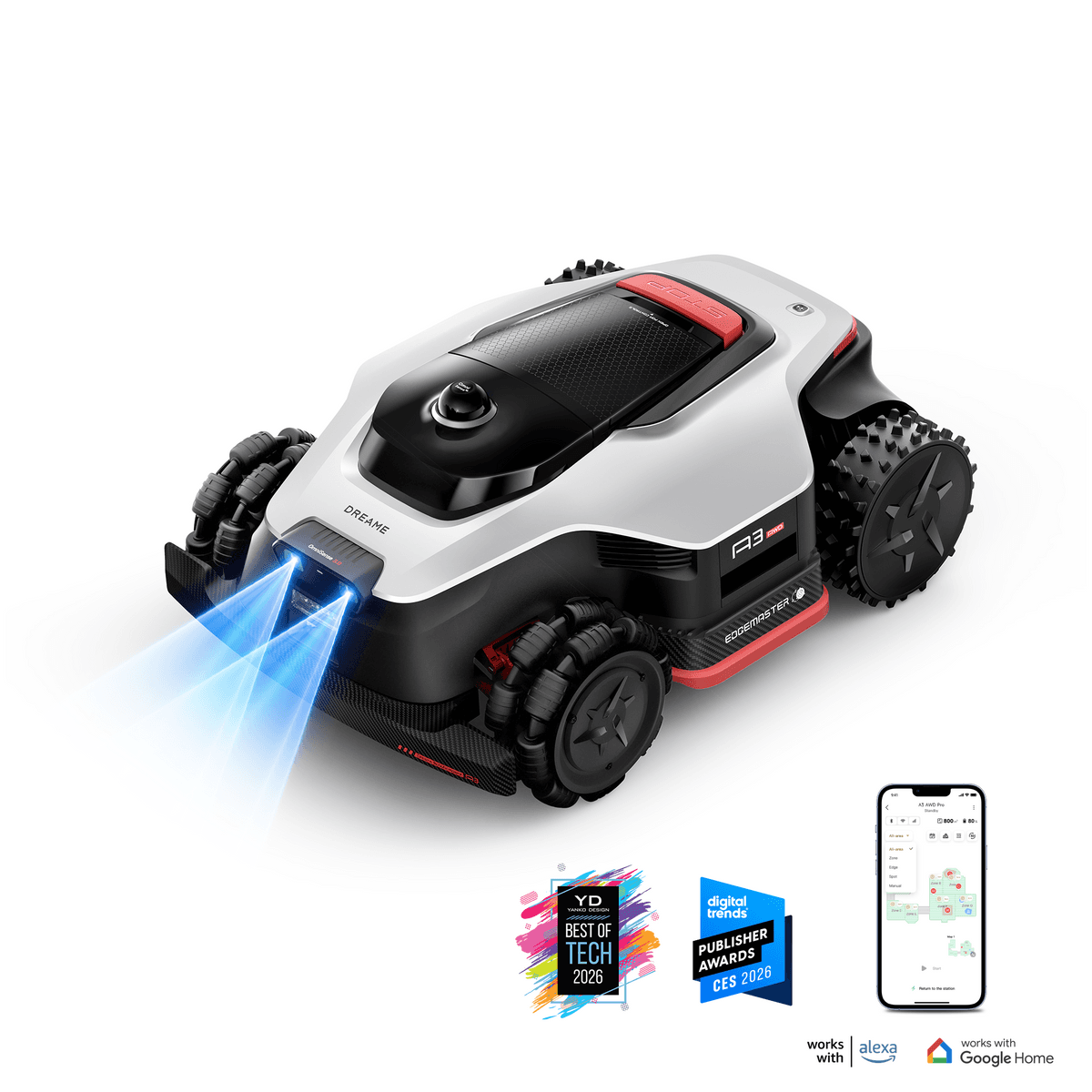
If your steepest grade is under about 30%, almost anything works and you can optimize on other factors. In the 30–50% band, step up to an AWD model like the Navimow i210 AWD. If you're above 50%, you need an 80%-rated AWD or 4WD unit — and you should expect to pay for it. For the full shortlist and the wet-grass caveats, see best robot mower for hills.
Step 3 — Sky view and obstacles → navigation (the #1 decision)
If you read only one step, read this one. Navigation is the single most important decision in the whole category — it is weighted highest in the MowScout Score (25 of 100 points) for exactly this reason. It determines which yards a mower can even handle, and almost every "my robot mower is terrible" story traces back to a navigation type that didn't suit the yard. The deciding question is deceptively simple: how much open sky does your lawn see?
Here are the five approaches, in plain terms:
- Boundary wire. A physical perimeter loop you bury or pin down; the mower senses it as an invisible fence. Sky-independent and proven, but it means an install day and a repair hunt if the wire breaks. Examples: WORX Landroid M, Husqvarna Automower 430X.
- RTK / NetRTK. Satellite positioning corrected to ~1–2 cm. RTK uses a local antenna that must see clear sky; NetRTK skips the antenna and pulls corrections over 4G. Fast and efficient on open lawns, but the signal degrades under trees or tall structures — a physics limit, not a setup mistake. Examples: Navimow i105N / i110N, Navimow i210 AWD.
- LiDAR. A spinning laser builds a live map of your surroundings and locates the mower inside it, so it needs no sky at all. This is our default for shaded lots. Examples: GOAT O1000 / A2000 / A3000 LiDAR PRO, YUKA mini 2.
- Vision. Cameras plus AI recognize grass, edges, and obstacles — the simplest setup, but it favors flat, well-lit, open yards and dislikes low light and heavy wet. Examples: eufy E15 / E18.
- Hybrid / fusion. Combines two or more of the above so one sensor covers for another. This redundancy is why fusion mowers handle the hardest yards — and why they top our rankings. Examples: LUBA 3 AWD line, LUBA mini AWD, Navimow X-series, Dreame A3.
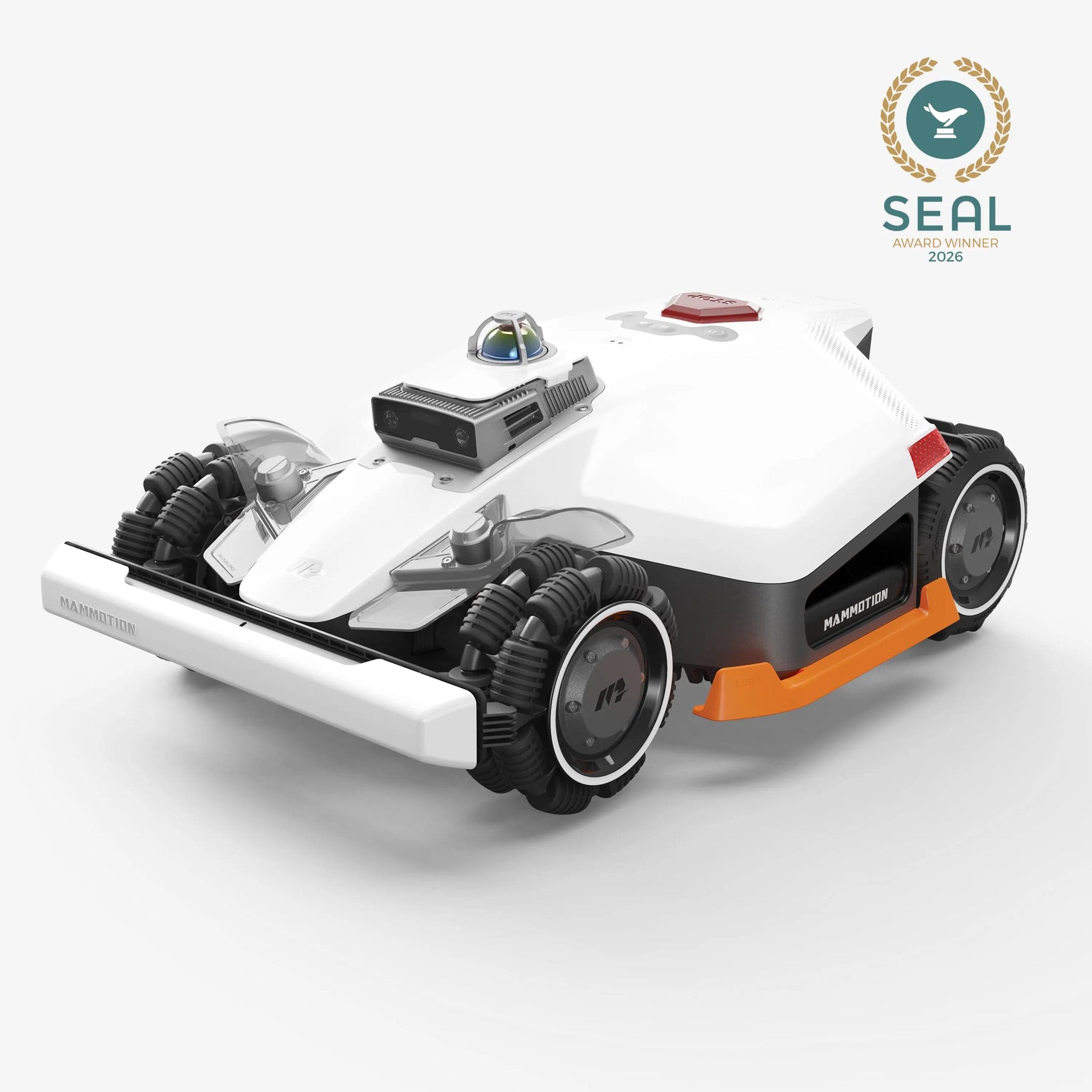
How to choose by sky:
- Mostly open sky, few trees → RTK or NetRTK is efficient and cost-effective. On a small, flat, sunny lawn, vision is even simpler.
- Meaningful tree cover or lots of overhead structure → skip pure RTK; choose LiDAR, vision, or a hybrid that includes them. Start at best robot mower for under trees.
- Mixed sun and shade → a hybrid/fusion mower gives you the fewest failure modes, which is why the tri-fusion LUBA 3 is our benchmark.
- Just want no wire → LiDAR and vision skip both the wire and the antenna; NetRTK skips the wire and the antenna too. See best robot mower for no boundary wire.
One honest caveat that applies across LiDAR and fusion: software maturity matters as much as sensors. Two mowers with similar hardware can behave very differently depending on how well the mapping and path-planning firmware is tuned, so brand track record counts. For the full technical breakdown and a navigation decision tree, read RTK vs LiDAR vs vision — it is the companion to this step.
Step 4 — Grass type and cut height (the most-missed spec)
Once size, slope, and sky have filtered your list, grass is the next screen — and cut height is the spec buyers most often overlook until it is too late.
Warm-season vs. cool-season. MowScout is US- and Sun-Belt-focused, so warm-season grasses dominate our advice. Bermuda and Zoysia are kept short and dense and respond beautifully to frequent robot mowing. St. Augustine and Bahia are taller, coarser, and thicker; they want to be cut higher and are harder on lightweight mowers — eufy explicitly warns its vision E-series is not ideal for St. Augustine or dense Zoysia. Cool-season lawns (fescue, ryegrass, Kentucky bluegrass) sit in between and are generally friendly to robot mowing at moderate heights.
The one-third rule is why frequent mowing works: never remove more than one-third of the blade in a single cut. Robot mowers nail this naturally by mowing little and often, which keeps grass healthier than a weekend scalp — but it also means you should run them on a schedule that keeps up with your growth, not once a week.
The max-cut-height trap. This is the gotcha. Many models top out around 2.4–3.15 inches, which is fine for Bermuda and Zoysia but too short for St. Augustine or Bahia, which prefer 2.5–4 inches. If you keep tall warm-season turf, you need a mower whose deck reaches 3.5–4 inches. Conversely, if you scalp Bermuda low, you need a deck that drops below 1.5 inches. Match the range to how you actually keep your lawn.
| Cut-height need | What to look for | Example models (range) |
|---|---|---|
| Very low (scalped Bermuda) | deck drops below ~1.5" | Husqvarna 430X (0.8–2.4"), eufy E18 (1.0–3.0"), GOAT LiDAR line (1.18–3.15") |
| Standard (Bermuda / Zoysia / fescue) | ~2–3.5" range | YUKA mini 2 (2.0–3.5"), WORX Landroid M (1.5–3.5"), GOAT O1000 (1.18–3.15") |
| Tall (St. Augustine / Bahia) | deck reaches 3.9–4" | LUBA 3 AWD line (2.2–4.0"), Navimow X330 / X350 (2.0–4.0"), Dreame A3 (1.2–3.9") |
Note the flip side: the LUBA 3 line starts at 2.2 inches, so it is not the pick for very low Bermuda even though it cuts tall. There is no single "best" range — only the one that matches your turf. If you keep thick, tall warm-season grass, weight your shortlist toward the tall-deck AWD models above.
Step 5 — Zones, edges, passages, pets, and kids
Real yards are not single tidy rectangles, so the fifth filter is layout and living-with-it factors.
Multi-zone mapping. If your lawn is split into a front, a back, and a side strip, you need a mower that can store multiple zones and travel between them (or that you're willing to relocate by hand). Zone counts in our catalog range from just 3 (Navimow i105N) to 50 (LUBA 3 AWD 5000H). Complex, multi-area properties should prioritize a high zone count and reliable passage navigation — see best robot mower for multi-zone yards.
Narrow passages. The strip between a house and a fence, or a gate the mower must thread, is a classic failure point. LiDAR and fusion mowers thread tight passages best because they map structure precisely; sky-dependent RTK-only mowers can lose their fix in a shaded side yard. If you have a pinch point, favor LiDAR or a hybrid and confirm the passage is wider than the mower's chassis.
Edge reality. Every robot mower leaves a small uncut strip at borders because the blade sits inboard of the wheels — physics, not a defect. Models with dedicated edge systems get much closer: the ECOVACS GOAT LiDAR line's TruEdge trimmer is the standout, and we mark the LUBA 3 line, the GOAT models, eufy E15/E18, and the Dreame A3 as good on edges versus ok for the Navimow line, WORX, Husqvarna, YUKA mini 2, and LUBA mini AWD. None eliminate hand-trimming entirely. For the shortlist, see best robot mower for edges.
Obstacle avoidance, pets, and kids. Most models here use AI-vision obstacle avoidance that detects and steers around toys, hoses, and pets; the budget WORX and the Husqvarna 430X use basic bump-and-reroute instead. On safety: blades stop when the mower is lifted or tilted, the small pivoting blades are far less aggressive than a rigid steel bar, and the sensible practice is to schedule mowing when the yard is empty, keep pets in during runs, and never let kids ride or handle a running unit. These are quiet and low-slung, so a curious child or dog can approach one — supervise accordingly.
Step 6 — Set a budget and understand the price tiers
Now put a dollar figure on it. Our verified street prices span $699 to $2,999, and they sort into three buyer-facing tiers. Every price is a US street estimate as of mid-2026 — verify the current price before buying, and never trust a fake "coupon code"; real discounts in this category come from the retailer, not a code you found on a coupon site.
Budget (under $1,000) — small-yard tools. What this buys: a capable mower for up to about a quarter acre, flat-to-moderate, often with genuinely modern navigation. The standouts are the ECOVACS GOAT O1000 LiDAR PRO (~$849, LiDAR, our value benchmark) and the Mammotion YUKA mini 2 (~$999, LiDAR + vision), with the Navimow i105N (~$799) the cheapest wire-free option and the WORX Landroid M (~$699) the wired budget floor. The eufy E15 and Navimow i110N round out the tier at ~$999.
Mid ($1,000–$2,500) — the mainstream sweet spot. This is where most buyers should shop. What it buys: real navigation, meaningful capacity (up to ~0.75 acre), AWD options, and taller decks. It runs from the Navimow i210 AWD (~$1,199) and eufy E18 (~$1,399) through the LUBA mini AWD (~$1,499), GOAT A2000 (~$1,699), Husqvarna 430X (~$1,999), GOAT A3000 (~$2,199), and the benchmark LUBA 3 AWD 3000H (~$2,299).
Premium ($2,500+) — large-yard and steep-slope flagships. What it buys: estate-scale capacity, 80% slope capability, and wide fast-cutting decks. The LUBA 3 AWD 5000H (~$2,699), Navimow X330 and X350 (~$2,799), and Dreame A3 AWD Pro (~$2,999) live here. Only buy in this tier if your yard is genuinely large, steep, or complex enough to use the capability — otherwise you are paying for headroom you'll never touch.
The honest cross-tier truth: cheaper LiDAR often beats pricier vision. Price does not equal capability. The $849 LiDAR GOAT O1000 (MowScout Score 75) out-scores the $1,399 vision eufy E18 (Score 68), because for a shaded yard LiDAR navigation is worth more than a polished vision app. Don't shop by price alone — shop by which technology fits your yard, then find the cheapest model that delivers it.
The MowScout Score, explained
Every ranking on MowScout comes from one transparent number: the MowScout Score, a 0–100 rating computed identically for all 17 models from stored, sourced specifications — so no mower can buy its way up the list. Our catalog scores from 58 (the wired WORX Landroid M) to 97 (the estate-scale LUBA 3 AWD 5000H). The score is the weighted sum of seven pillars, and the weights reflect what actually decides whether a mower fits a yard:
| Pillar | Weight | What it measures |
|---|---|---|
| Navigation | 25 | Positioning technology (wire → RTK → NetRTK → vision → LiDAR → hybrid) plus obstacle avoidance. |
| Terrain | 20 | Rated slope grade and drivetrain (RWD vs AWD vs 4WD). |
| Coverage | 15 | Max mapped area, daily-coverage speed, and capacity for the tier. |
| Setup | 15 | Wire-free vs wired, whether it needs a base station or antenna, and app quality. |
| Cutting | 10 | Edge quality, cut width, and cut-height range. |
| Value | 10 | Street price per acre of capacity, with a discount bonus. |
| Support | 5 | Warranty length, retail availability, and brand track record. |
Why navigation and terrain dominate. Together they are 45 of the 100 points, and deliberately so: navigation determines whether a mower can handle your yard at all, and terrain determines whether it can physically climb it. A mower can have a lovely app and a keen price, but if it can't hold a map under your trees or climb your hill, none of the rest matters. That is why our top-scored models are the fusion-navigation, AWD flagships — and why a well-priced LiDAR unit can out-score a more expensive vision one. The full formula, with every sub-weight, is published on how we score. It is the same math on every review page's score bar.
Cutting quality, edges, and wet grass — realistic expectations
Set expectations honestly, because no marketing page will. Overall cut quality from a robot mower is excellent by consistency: because it cuts a little every day, a well-matched mower keeps your lawn more uniformly trimmed than a weekly push mow ever could, and mulched clippings feed the turf. What it is not is a one-pass, stripe-perfect finish on demand — it gets there through frequency, not a single dramatic cut.
Edges are the honest weak spot across the entire category. Every model leaves a border strip because the blade can't reach past the wheels. Dedicated edge systems shrink it a lot (the ECOVACS TruEdge trimmer is the best example), and our good-rated models get meaningfully closer than ok-rated ones — but plan on occasional hand-trimming along fences, walls, and beds regardless of what you buy.
Wet grass is the other reality. Traction and cut cleanliness both drop when the lawn is wet, and slope ratings are dry-day numbers. Most of our catalog is rated to run in wet conditions, but the vision-based eufy E15 and E18 are the exceptions — they pause and return to the dock in rain or low light, by design. If you live somewhere that rains often, factor that in and lean toward wet-rated, non-vision navigation.
Smart features that matter (and the ones that don't)
Feature lists are long; only some of it changes your daily experience.
Matters a lot:
- Obstacle avoidance. AI-vision avoidance (most of our catalog) meaningfully reduces the toys, hoses, and pet messes a mower runs over. Basic bump-and-reroute (WORX, Husqvarna 430X) works but is cruder.
- Anti-theft and GPS tracking. These live outdoors in plain view. Every model here has anti-theft; most add GPS tracking, a PIN lock, and a motion alarm. This is genuinely important — use it.
- App quality. You'll live in the app for scheduling, zones, and no-go areas. Most models here rate 4 of 5 in our data; the budget WORX rates 3. A mature, stable app is worth more than a flashy feature count.
Matters sometimes:
- 4G / cellular. Lets the mower phone home for tracking and alerts even off Wi-Fi, and is standard on most premium models — but note the GOAT O1000, GOAT A2000, WORX, and Navimow i105N are Wi-Fi/Bluetooth only. Some brands charge a subscription for cellular service after year one; confirm before you rely on it.
- OTA updates. Over-the-air firmware updates genuinely improve LiDAR and fusion mowers over time, so an actively supported brand is worth favoring.
Matters least: voice-assistant gimmicks, decorative lighting, and spec-sheet superlatives that don't map to your yard. Buy the navigation and drivetrain first; treat the rest as tie-breakers.
Total cost of ownership (the 5-year picture)
The sticker price is not the whole cost — but robot mowers are cheap to run, and the five-year math usually favors them against the alternatives.
Ongoing costs over five years:
- Blades. Small pivoting blades wear and are cheap to replace — typically a few sets a year at roughly $15–$40 per set depending on brand. Budget maybe $30–$120 a year.
- Battery. Lithium packs last several seasons; plan on one eventual replacement within five years on a heavily used unit.
- Electricity. These sip power. Charging is usually a few dollars a month — trivial next to a gas mower's fuel.
- Accessories and service. Optional 4G subscriptions on some brands, replacement wheels or sensors, and the occasional part. Wired models (WORX, Husqvarna) add possible boundary-wire repairs.
Add it up and a typical five-year running cost lands in the low hundreds of dollars on top of purchase — versus a lawn service that can run $1,500–$3,000+ over the same period, or a gas mower's fuel, oil, tune-ups, and your weekend hours. The robot's real payoff is time, but the running economics hold up too. Plug your own prices, yard size, and local labor rates into the robot lawn mower cost calculator to see your break-even, and read the full argument in are robot mowers worth it in 2026?
Warranty, support, and where to buy
Warranty. Most of our catalog carries a 2-year warranty; the Mammotion LUBA 3 line and the WORX Landroid M extend to 3 years per our data. Warranty terms change, so confirm the current coverage and what it excludes (batteries and wear items are often treated separately) before you buy.
Support and track record. The Support pillar in our score rewards established brands and broad retail availability. Husqvarna has the longest reliability record and a real dealer network, which is its main draw even though its 430X still uses a boundary wire. Newer brands (Mammotion, ECOVACS, Segway Navimow, eufy, Dreame) compete on features and price; favor the ones with active firmware support and multiple retail channels, because that's a proxy for how well you'll be looked after in year three.
Where and when to buy. Buying through a major retailer (Amazon, Best Buy, Lowe's, Home Depot, or the brand's own store) makes returns and warranty claims easier — several models here are sold at big-box stores for exactly that reason. On timing: genuine discounts cluster around spring lawn-care season, Amazon Prime Day, and the November–December holiday events. Prices in this category move weekly, so it's worth watching for a sale — but ignore any site promising a secret coupon code. There are no MowScout coupon codes, and legitimate deals come straight from the retailer's listed price.
The decision framework — start here
Pull it all together into a repeatable sequence. Work these in order and stop when a model falls out:
- Size it. Measure your mowable acreage, add 15–20% headroom, and pick your area tier from Step 1. This sets the field.
- Slope-gate it. Find your steepest grade. Under ~30%, keep everything; 30–50%, require AWD; over 50%, require an 80%-rated AWD/4WD. (Step 2.)
- Sky-gate it. Judge your tree cover. Open → RTK/NetRTK; shaded → LiDAR; small and flat → vision; mixed → hybrid. This usually cuts the list to a handful. (Step 3.)
- Grass-check it. Confirm the deck reaches your preferred cut height for your turf — especially tall St. Augustine or low Bermuda. (Step 4.)
- Layout-check it. Confirm enough zones for your separated areas and adequate passage/edge handling. (Step 5.)
- Budget-fit it. Within the survivors, pick the cheapest model that clears every gate above — not the most expensive you can afford. (Step 6.)
- Sanity-check with the Score. Compare the finalists' MowScout Scores and per-pillar breakdowns to confirm you're not overpaying for capability you won't use.
If that's more steps than you want to run, our matcher does all seven from six quick questions and returns your top three, scored and filtered for your exact conditions: find your robot mower →.
Our top picks by category
Full details and the complete 17-model ranking live in the best robot lawn mowers of 2026 — this is the quick map. Each winner is the best model for that specific job, by MowScout Score plus the specs that matter for the use case.
| Category | Pick | Score | Street price | Why |
|---|---|---|---|---|
| Best overall | LUBA 3 AWD 3000H | 91 | ~$2,299 | Tri-fusion nav + AWD to 80%; the do-everything benchmark. |
| Best value | GOAT O1000 LiDAR PRO | 75 | ~$849 | LiDAR under tree cover for under $900. |
| Best for hills | Dreame A3 AWD Pro | 90 | ~$2,999 | 4WD to 80% with LiDAR and a wide, precise deck. |
| Best for trees | GOAT A3000 LiDAR PRO | 80 | ~$2,199 | Dual-LiDAR maps under canopy, with a real edge trimmer. |
| Best budget | YUKA mini 2 | 73 | ~$999 | LiDAR + vision small-yard mower for well under $1,000. |
| Best large-yard | LUBA 3 AWD 5000H | 97 | ~$2,699 | Same platform, stretched to 1.25 acres and 50 zones. |
Category-specific shortlists: hills, under trees, large yards, edges, and multi-zone yards.
Common buyer mistakes
Avoid these and you'll skip most of the regret in this category:
- Buying by deed acreage instead of mowable acreage. You'll oversize and overspend. Measure the grass only.
- Ignoring the headroom rule. A mower running at its ceiling falls behind exactly when the lawn is growing fastest. Add 15–20%.
- Choosing RTK for a shaded yard. Dense canopy defeats satellite positioning no matter how you set it up. Shade means LiDAR, vision, or a hybrid.
- Underestimating slope — and forgetting wet. Ratings are dry-day ceilings. Match drivetrain to your steepest grade and leave a buffer.
- Overlooking cut height. Many decks max around 2.4–3.15 inches — too short for St. Augustine or Bahia. Check the range against your turf.
- Assuming zero edging. Every mower leaves a border strip. Budget for occasional hand-trimming, and prioritize a good edge system if it bothers you.
- Shopping by price alone. A cheaper LiDAR mower can beat a pricier vision one for your yard. Match the technology first, then find the cheapest model that delivers it.
- Skipping the anti-theft setup. These sit outdoors. Set the PIN, enable GPS tracking, and register the serial on day one.
Frequently asked questions
How do I measure my yard for a robot lawn mower? Measure the grass you actually cut, not your deed acreage. Subtract the house, driveway, patio, beds, and mulch rings — those are not lawn. Then add 15–20% headroom and buy a mower rated for that larger number. A 0.25-acre mower on a 0.25-acre lawn has no margin for growth spurts, missed days, or re-runs after rain. If you'd rather not do the math, our configurator sizes it for you.
How big a yard can a robot mower handle in 2026? Our 17-model catalog spans about 0.13 acre (Navimow i105N) to 1.5 acres (Navimow X350). Small-yard models cover up to ~0.25 acre, the mainstream tier does 0.3–0.75 acre, and large-lot flagships like the LUBA 3 AWD 5000H (1.25 acres) reach estate sizes. Watch the difference between max mapped area and daily coverage — the X350 maps 1.5 acres but cuts about 1 acre per day.
Can a robot mower handle hills and steep slopes? Yes, if you match the drivetrain to the grade. Rear-wheel-drive models top out around 30–50%; AWD and 4WD models — the LUBA 3 line, LUBA mini AWD, and Dreame A3 AWD Pro — are rated to 80%. Ratings are dry-condition limits, so leave headroom because wet grass cuts traction. See best robot mower for hills.
Do robot lawn mowers work under trees or without a strong GPS signal? LiDAR and vision mowers do; pure satellite/RTK positioning does not. Dense canopy blocks the sky the mower needs, so for shaded lots we favor LiDAR picks like the GOAT A3000 LiDAR PRO or the value GOAT O1000, or a hybrid that includes LiDAR. Sky-dependent large-lot mowers like the Navimow X-series are open-lawn tools.
Do I still need a boundary wire in 2026? Usually not. Most of the category is wire-free now. Boundary wire survives at the budget floor (WORX Landroid M) and in proven premium lines (Husqvarna Automower 430X). Wire is reliable and sky-independent, but it means an install day and a repair hunt if it breaks — weigh that against a no-wire model on best robot mower for no boundary wire.
Will a robot mower cut my grass at the right height? Check the deck range against your grass first — it's the most-missed spec. Many models max around 2.4–3.15 inches, fine for Bermuda and Zoysia but too short for St. Augustine or Bahia (which prefer 2.5–4 inches). Tall warm-season turf needs a taller-cutting model (the LUBA 3 line and Navimow X-series reach 4 inches); scalped Bermuda needs a deck below 1.5 inches.
Are robot mowers good for warm-season grass like Bermuda, St. Augustine, or Zoysia? They can be, but grass type drives the model. Frequent light cutting suits Bermuda and Zoysia well. St. Augustine and dense Zoysia are thick and tall — eufy warns its vision E-series isn't ideal for them — so favor a heavier AWD mower with a taller deck. Match the max cut height to how tall you keep the lawn, then confirm the mower is rated for thick turf.
How much does a robot mower cost to own over five years? Beyond purchase, budget for blades (a few sets a year, ~$15–$40 each), an eventual battery, a little electricity (a few dollars a month), and optional 4G service on some brands. Five-year running cost is usually a few hundred dollars — far below a weekly lawn service. Run your numbers in the robot mower cost calculator.
Can a robot lawn mower cut wet grass? Most can, with caveats — not all. Every model in our catalog is rated for wet conditions except the vision-based eufy E15 and E18, which pause and dock in rain or low light. Even wet-rated mowers cut less cleanly and lose slope traction when wet, so treat slope ratings as dry-day numbers.
Will my robot mower get stolen? It's a real risk — these sit outdoors — which is why every model in our catalog includes anti-theft. Most add GPS tracking, a PIN lock, and a motion alarm; several offer 4G so the mower phones home off Wi-Fi. Use every layer: set the PIN, enable tracking, register the serial.
Do robot mowers cut clean edges, or do I still have to trim? You'll still trim occasionally. Every robot mower leaves a border strip because the blade sits inboard of the wheels. Dedicated systems (ECOVACS TruEdge on the GOAT LiDAR line) shrink it dramatically, and models we mark good on edges get closer than ok ones — but none eliminate hand-trimming. See best robot mower for edges.
Are robot mowers safe around kids and pets? Modern models are designed to be, but supervise anyway. Blades stop when the mower is lifted or tilted, most use small pivoting blades rather than a rigid bar, and AI-vision avoidance detects pets and toys. Best practice: mow when the yard is empty, keep pets indoors during runs, and never let children handle a running unit.
Bottom line
Choosing a robot mower isn't about finding the "best" machine — it's about finding the one that matches your yard. Work the funnel in order: size with headroom, slope-gate by drivetrain, sky-gate by navigation, then check grass, layout, and budget. Do that and the disappointment stories — the beached mower, the drifting map, the shaggy edge — mostly disappear, because you bought for your conditions instead of a headline. Navigation and terrain do most of the deciding, which is exactly why they carry the most weight in the MowScout Score.
When you're ready, don't run the whole framework by hand. Answer six quick questions and our data-driven matcher returns your top three — scored, filtered, and sized for your exact yard:
Find your robot mower → get your top 3 in under a minute
Keep going: the category overview at robot lawn mowers, the ranked winners in the best robot lawn mowers of 2026, the navigation deep-dive in RTK vs LiDAR vs vision, and the honest cost case in are robot mowers worth it in 2026?
Recommended next step
Use this guide to understand the buying issue, then run the configurator with your exact acreage, slope, tree cover, zones, terrain, obstacles, and budget. The best recommendation should survive both the guide logic and the yard-fit filters. If a brand claim or retailer listing conflicts with the guidance here, trust the measured yard constraints first and recheck the exact model page before buying. Document the final assumptions.
Buyer questions
FAQ
How do I measure my yard for a robot lawn mower?
Measure the grass you actually cut, not your deed acreage. Subtract the house, driveway, patio, beds, and mulch rings — those are not lawn. Then add 15–20% headroom and buy a mower rated for that larger number. A 0.25-acre mower on a 0.25-acre lawn has no margin for growth spurts, missed days, or re-runs after rain. If you would rather not do the math, our configurator sizes it for you.
How big a yard can a robot mower handle in 2026?
Our 17-model catalog spans about 0.13 acre (Segway Navimow i105N) to 1.5 acres (Navimow X350). Small-yard models cover up to ~0.25 acre, the mainstream tier does 0.3–0.75 acre, and large-lot flagships like the Mammotion LUBA 3 AWD 5000H (1.25 acres) and the Navimow X350 reach true estate sizes. Watch the difference between max mapped area and daily coverage — the X350 maps 1.5 acres but cuts about 1 acre per day.
Can a robot mower handle hills and steep slopes?
Yes, if you match the drivetrain to the grade. Rear-wheel-drive models top out around 30–50% on paper; all-wheel-drive and 4WD models — the Mammotion LUBA 3 line, the LUBA mini AWD, and the Dreame A3 AWD Pro — are rated to 80%. Slope ratings are dry-condition limits, so leave headroom because wet grass cuts traction. See our best robot mower for hills page for the shortlist.
Do robot lawn mowers work under trees or without a strong GPS signal?
LiDAR and vision mowers do; pure satellite/RTK positioning does not. Dense canopy blocks the sky the mower needs to fix its position, so for shaded lots we favor LiDAR picks like the ECOVACS GOAT A3000 LiDAR PRO or the value GOAT O1000, or a hybrid that includes LiDAR. Sky-dependent large-lot mowers like the Navimow X-series are open-lawn tools, not wooded-yard tools.
Do I still need a boundary wire in 2026?
Usually not. Most of the category is now wire-free, using RTK, LiDAR, vision, or a hybrid to map your lawn without burying anything. Boundary wire survives at the budget floor (WORX Landroid M) and in proven premium lines (Husqvarna Automower 430X). Wire is reliable and sky-independent, but it means an install day and a repair hunt if it breaks, so weigh that against a no-wire model.
Will a robot mower cut my grass at the right height?
Check the deck range against your grass before you buy — it is the most-missed spec. Many popular models max out around 2.4–3.15 inches, which is fine for Bermuda and Zoysia but too short for St. Augustine or Bahia, which prefer 2.5–4 inches. If you keep tall warm-season turf, prioritize a taller-cutting model (the LUBA 3 line and Navimow X-series reach 4 inches). If you scalp Bermuda low, you need a deck that drops below 1.5 inches.
Are robot mowers good for warm-season grass like Bermuda, St. Augustine, or Zoysia?
They can be, but grass type drives the model. Frequent light cutting suits Bermuda and Zoysia well. St. Augustine and dense Zoysia are thick and tall — eufy explicitly warns its vision E-series is not ideal for them — so favor a heavier AWD mower with a taller deck and higher torque. Match the maximum cut height to how tall you keep the lawn, then confirm the mower is rated for thick turf.
How much does a robot mower cost to own over five years?
Beyond the purchase price, budget for replacement blades (a few sets a year, typically $15–$40 each), an eventual battery, a little electricity (these sip power — often a few dollars a month), and optional 4G tracking service on some brands. Total five-year running cost is usually a few hundred dollars — far below a weekly lawn service. Run your own numbers in our robot mower cost calculator.
Can a robot lawn mower cut wet grass?
Most can, with caveats — but not all. In our catalog every model is rated to run in wet conditions except the vision-based eufy E15 and E18, which pause and return to the dock in rain or low light. Even wet-rated mowers cut less cleanly and lose traction on slopes when it is wet, so treat manufacturer slope ratings as dry-day numbers and leave a buffer.
Will my robot mower get stolen?
It is a real risk — these sit outdoors in view — which is why every model in our catalog includes anti-theft. Most add GPS tracking, a PIN lock, and a motion alarm; several offer 4G so the mower phones home even off Wi-Fi. Use every layer: set the PIN, enable tracking, and register the serial. Theft protection is standard now, but only if you turn it on.
Do robot mowers cut clean edges, or do I still have to trim?
You will still trim occasionally. Every robot mower leaves a small border strip because the blade sits inboard of the wheels, so it cannot reach the very edge along a fence or wall. Dedicated edge systems (ECOVACS TruEdge on the GOAT LiDAR line) shrink that strip dramatically, and models we mark good on edges get closer than models marked ok — but none eliminate hand-trimming entirely.
Are robot mowers safe around kids and pets?
Modern models are designed to be, but supervise anyway. Blades stop when the mower is lifted or tilted, most run small pivoting blades rather than a rigid steel bar, and AI-vision obstacle avoidance is built to detect and steer around pets and toys. Best practice: schedule mowing when the yard is empty, keep pets indoors during runs, and never let children ride or handle a running unit.
How much should I spend on a robot mower?
Buy for your yard, not for the top of the range. Under $1,000 gets a capable small-yard mower (the ECOVACS GOAT O1000 LiDAR PRO at ~$849 is our value benchmark). Most buyers should shop the $1,000–$2,500 mainstream tier, where you get real navigation, AWD options, and meaningful capacity. Spend $2,500+ only if your lot is genuinely large, steep, or complex enough to use the extra capability.
Does MowScout test these mowers by hand?
No, and we say so plainly. MowScout is spec-verified and data-driven: we score every model with the MowScout Score from manufacturer and retailer specifications, verified US street prices, and owner-reported behavior, each traceable to a source. We have not run these units, measured their decibels, or timed their batteries ourselves. Every noise or runtime figure we cite is manufacturer-rated or owner-reported and labeled that way.