Spec-verified review
ECOVACS GOAT GX-600
By MowScout EditorialUpdated 2026-07-01How we scoreHow we test
ECOVACS' easiest-setup GOAT: a camera-based SmartEdge boundary means no wire and no RTK antenna, so you mow in minutes. But it's a small-yard machine — ~0.15 acre, an 8.66-inch deck, RWD — and the cheaper LiDAR O1000 covers more ground and handles shade.
Last verified 2026-07-01
MowScout verdict
The short version
ECOVACS' easiest-setup GOAT: a camera-based SmartEdge boundary means no wire and no RTK antenna, so you mow in minutes. But it's a small-yard machine — ~0.15 acre, an 8.66-inch deck, RWD — and the cheaper LiDAR O1000 covers more ground and handles shade.
Buy if
- You have a small (~0.15 acre), flat, bright yard
- You want the simplest wire-free, antenna-free setup
- An obstacle-heavy yard where vision avoidance helps
Skip if
- Your lawn is bigger than ~0.15 acre
- You have slopes over ~40% or heavy shade
- You want the lowest cost per acre
Pros
- SmartEdge vision boundary — no wire, no RTK, fast setup
- AIVI 3D + ToF obstacle avoidance
- IPX6 weatherproof, quiet (~60 dB)
- Affordable at ~$999
Cons
- Only ~0.15 acre — high cost per acre
- Small 8.66-inch deck, RWD
- Vision can miss small objects and struggles in low light
- No 4G or GPS tracking
Fit check
What to verify before buying
ECOVACS GOAT GX-600 is a $999 mower rated for 0.15 acres, 0.15 acres of daily coverage, 40% slopes, and 1 mapped zones. Treat those as fit limits, not marketing decoration: mowable grass, wet turns, separate zones, and spring growth should all leave enough headroom for the mower to run without repeated rescues.
Navigation is VISION and drive is RWD. This model avoids a separate antenna requirement, which lowers one common setup hurdle, but dock location, mapping quality, and first-week no-go-zone tuning still matter. AI vision obstacle avoidance is useful around toys, furniture, pets, and landscaping clutter, but it should be treated as a risk reducer rather than a safety guarantee.If your hardest constraint is slope or rough turf, compare the terrain guide; if setup simplicity is the priority, compare similar no-wire picks before choosing by price.
Before checkout, confirm the exact SKU, included dock or base hardware, return window, warranty path, and current price at one of the listed retailers: ECOVACS, Amazon. Robot mower bundles change quickly, so the retailer page should match this review's capacity, model name, and last-verified source trail.
In the current catalog, this model sits in the mid price tier with 5 other verified mowers nearby. Its rough price-per-rated-acre is $6,660, which is useful when comparing against a larger mower that may look expensive upfront but cheaper per acre. ECOVACS GOAT O1000 LiDAR PRO is the closest lower-priced comparison point at $849.
The capacity math is 0.15 acres per day, matching its max-area rating. That matters when the lawn is close to the published limit, because a mower that can only cover the whole yard under ideal conditions has less margin after rain delays, fast spring growth, dull blades, or separated zones. If your measured turf is close to 0.15 acres, compare eufy Robot Lawn Mower E15 for more headroom before buying.
The tags attached to this record are small yards, simple setup, no boundary wire, flat yards. Use those as a sanity check: if your yard does not match at least two of those tags, the MowScout Score is less important than fit. A high-scoring mower in the wrong category still creates rescue trips, missed strips, and support friction.
Its current MowScout Score is 62, which should be read beside the hard specs rather than treated as a standalone verdict. The strongest reasons to keep this mower on a shortlist are its VISIONnavigation, RWD drive, 40% slope rating, and 1zone support. The biggest reason to remove it is any yard fact that directly conflicts with those numbers.
Cutting fit is also specific: this deck is 8.66 inches wide and adjusts from 1.18 to 2.36 inches. Edge behavior is rated "ok", so expect some trim work around fences, walls, beds, curbs, and tight hardscape. That is normal for robot mowers, but it matters more if your lawn has a lot of border length relative to open grass.
Ownership details point to 2 years of warranty coverage, app quality rated 4out of 5, connectivity through wifi, bt, 60 dB of listed noise, and an unpublished weight of chassis weight. Those are practical details for storage, night schedules, support expectations, and whether the mower will be easy to lift, clean, or move between areas.
The source trail for this record was last checked on 2026-07-01 and includes ECOVACS GOAT GX-600 product page, Android Police GX-600 review. Use those sources to resolve any mismatch between this review, a retailer title, and a bundled accessory listing. If the source page changes the area rating, slope rating, included hardware, or warranty terms, update the shortlist before clicking through. Keep a screenshot of the retailer specs for returns.
Yard-fit read
Best for a small, flat, sunny yard under ~0.15 acre.
Alternative: ECOVACS GOAT O1000 LiDAR PRO - the LiDAR O1000 is cheaper, covers more area and slope, and handles shadeScore breakdown
The ECOVACS GOAT GX-600 is the mower you buy when the entire appeal is not having to think about it. No boundary wire to trench in around the lawn, no RTK antenna to mount and aim at the sky, no satellite fix to lose under a tree — just a camera that watches the edge of your grass and a base station that recharges the machine. ECOVACS built the GX-600 as the vision entry to its GOAT family, distinct from the LiDAR-navigating O1000, A2000, and A3000, and it is aimed squarely at one buyer: someone with a small, flat lawn who wants the simplest possible setup. On our spec-verified scoring it lands at 62/100 — a middling number that tells the truth about a likeable, easy, genuinely small-yard machine that trades capability and value for setup simplicity. This is a data-driven review, not a hands-on one: MowScout scores are computed from verified manufacturer and retailer specifications and cross-checked against professional coverage. We have not run this unit in a yard, and we won't pretend otherwise.
### MowScout Score: 62/100 — Best for the easiest wire-free setup on a tiny flat yard The verdict, in three lines: The GX-600 is one of the easiest robot mowers to buy and start — SmartEdge camera vision means no wire, no antenna, and a setup measured in minutes, backed by a rich obstacle-avoidance sensor suite. But it's built for a genuinely small (0.15-acre), flat-to-moderate lawn and nothing more, and at ~\$999 it costs more than the LiDAR GOAT O1000 that covers a bigger yard. Match it to a tiny, flat, obstacle-heavy lot and it's a delight; ask it to cover ground, climb, or mow in shade and a sibling serves you better for less. Street price: about \$999 (MSRP \$1,299) as of mid-2026 — verify current price (affiliate link; see disclosure). → Find your best-fit robot mower with the configurator
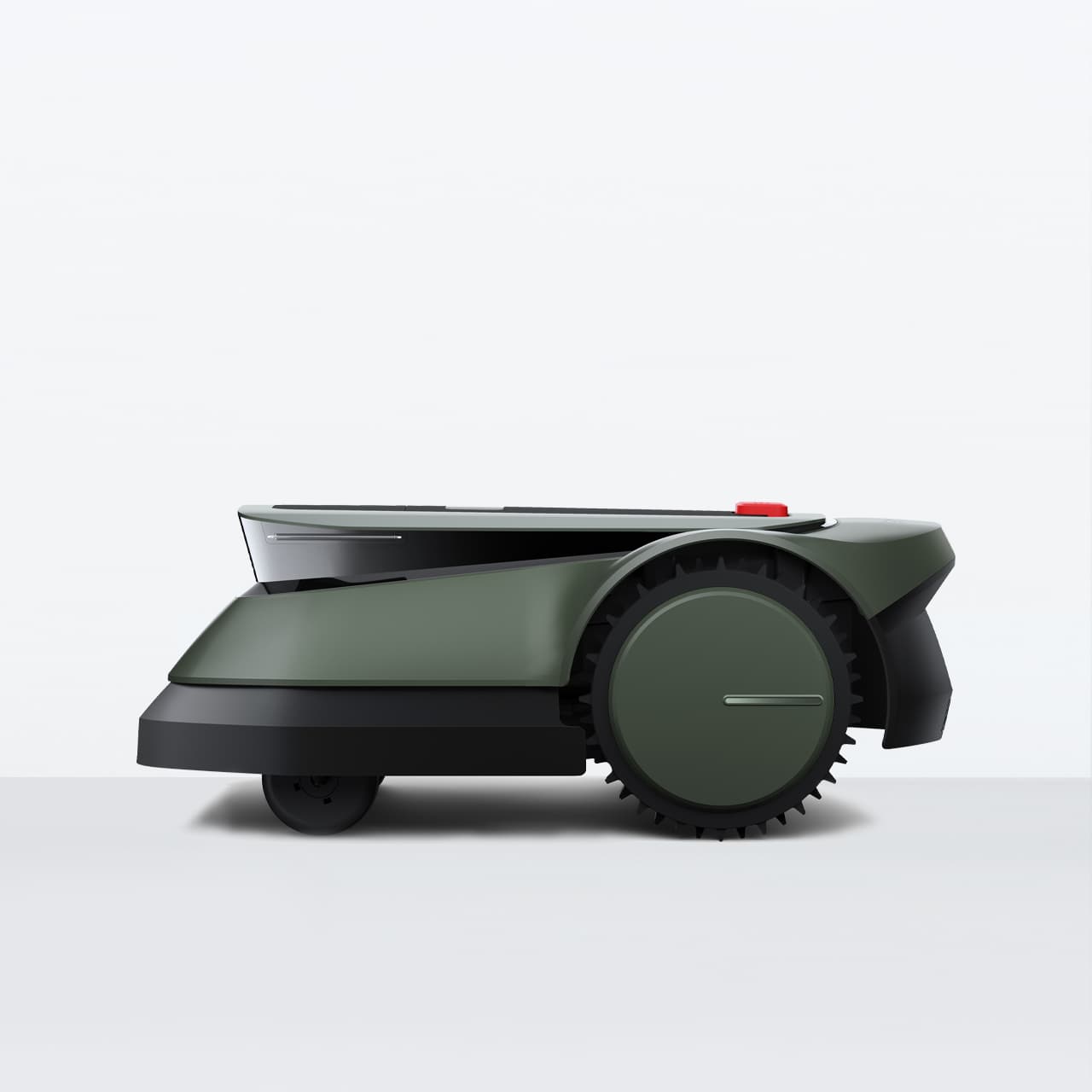
Image: ECOVACS official product photography. MowScout does not shoot original hardware photos; this is the manufacturer's image, used to illustrate the product.
Reasons to buy / reasons to skip
Reasons to buy
- ✅ The simplest setup in the GOAT family. SmartEdge camera vision means no perimeter wire to bury and no RTK antenna to mount or aim — ECOVACS claims up to 93% faster setup than wire installation. You map the yard by driving the border once, then press start.
- ✅ A rich obstacle-avoidance sensor stack. A 150° fisheye camera plus AIVI 3D recognition and a ToF (time-of-flight) sensor — carried over from ECOVACS' robot-vacuum expertise — is a genuinely strong perception suite for seeing and steering around toys, hoses, pets, and furniture.
- ✅ Quiet, weather-tolerant, and small. A ≤60 dB spec figure, an IPX6-rated chassis, and manufacturer-rated wet-grass operation make it an unobtrusive machine for a tucked-in urban or suburban lot.
- ✅ Right-sized for a truly small lawn. At 0.15 acre it's honestly scoped — you're not paying for capacity you'll never touch, if your yard actually is this small.
Reasons to skip
- ❌ Tiny capacity for the price. 0.15 acre at ~\$999 is a high cost per acre — the LiDAR O1000 covers a larger yard for less money.
- ❌ Vision's inherent limits. It needs daylight (no night mowing), dislikes sun glare, and — like all cameras — reads big obstacles far better than small ones.
- ❌ Flat-to-moderate only. A 40% slope ceiling on rear-wheel drive rules out real hills, and it's a dry-condition number.
- ❌ No GPS/cellular theft recovery. Wi-Fi and Bluetooth only; anti-theft is an alarm and PIN, not a locate-and-recover system. Cut height also tops out at a modest 2.36 inches.
How SmartEdge vision maps your yard — no wire, no RTK
The headline reason to consider the GX-600 is SmartEdge, ECOVACS' camera-based boundary system, and understanding it is understanding the whole mower. Instead of a buried perimeter wire (the old generation's biggest chore) or an RTK antenna that needs a clear view of the sky, the GX-600 defines your lawn's edge visually. During setup you drive the mower once around the perimeter while its 150° fisheye camera watches the transition between turf and everything else — the flower bed, the driveway, the fence, the mulch. That boundary becomes the map, and from then on the camera keeps the machine inside it.
The appeal is real and worth stating plainly. There is no wire to trench in, so you skip the single most-hated part of legacy robot mowing. There is no antenna to site under open sky, so the setup that trips up RTK owners — finding a spot with satellite visibility, mounting a mast — simply doesn't exist. And because vision reads the world directly rather than triangulating from satellites, there is no signal to lose beside a roofline or under a tree. ECOVACS markets SmartEdge as up to 93% faster to set up than a boundary wire; treat the exact percentage as a manufacturer claim, but the shape of it is honest — your hands-on effort drops from an afternoon of wire-laying to a few minutes of driving the border.
The honest caveat is that a visually defined boundary is only as good as the visual contrast at your lawn's edge. Where turf meets a clean hardscape, a mulched bed, or a fence, the camera has a crisp line to lock onto. Where lawn fades into a meadow, an untrimmed shrub line, or a low-contrast dirt edge, the boundary is harder for the camera to hold precisely. This is the same trade every vision mower makes, and it's why the GX-600 shines on tidy, well-bordered small yards and gets fussier on ambiguous ones.
Navigation & obstacle avoidance — and the honest vision limits
Once the boundary is set, the GX-600 navigates and avoids obstacles with a vision-first sensor suite that's genuinely one of its strengths: the 150° fisheye camera for scene awareness, AIVI 3D object recognition (ECOVACS' AI-visual-interpretation system, matured across its vacuum line), and a ToF sensor for close-range depth. In practice that means it's built to see toys, hoses, pet waste, garden furniture, and pets and steer around them rather than bumping them — a meaningfully richer perception stack than the basic bump-and-turn systems still shipping on cheaper mowers.
But vision is a single navigation philosophy with no second layer to fall back on, and its limits are predictable rather than surprising:
- It needs light. The cameras can't navigate in darkness, so there's no night mowing, and direct sun glare into the lens can degrade performance. LiDAR mowers like the O1000 don't share this limit because they map with a laser, not ambient light.
- Small objects are the hard case. Every vision system reads large obstacles more reliably than tiny ones. Thin cables, low tent stakes, small toys, and pet waste are exactly the things a camera can miss or misjudge — so clear the lawn of small debris before a run.
- Shade and canopy reduce contrast. Dappled or dense tree cover both dims the scene and muddies the edges the camera relies on. The GX-600 is an open-lawn machine; a genuinely wooded lot favors LiDAR.
- No redundancy. With vision as the only positioning method, there's no RTK or LiDAR backup to catch it when the camera struggles — the flip side of the radical simplicity that makes setup so easy.
None of this makes the GX-600 a bad navigator; it makes it a specialized one. On a bright, dry, cleanly bordered small lawn, its perception is a strength. Push it into darkness, glare, deep shade, or a field of small clutter and, with no second sensor to catch it, it falls off faster than a redundant multi-sensor mower.
Terrain & slopes: 40% RWD, flat-to-moderate
The GX-600 is rear-wheel drive and rated to a 40% grade — a touch better than some vision rivals, but still firmly a flat-to-moderate spec. Gentle undulations, shallow banks, and a mild slope to the street are within its comfort zone; a genuine hill is not. And as with every mower, the rated figure is a dry-condition number: rear-wheel drive gives up traction on wet, dewy, or slick grass, so treat 40% as a ceiling you shouldn't push toward on damp turf.
The honest read is that terrain simply isn't where this mower competes. If your lawn has real grade, you want all-wheel drive — rivals in 2026 are rated anywhere from 45% up past 80% — and no amount of vision cleverness substitutes for drivetrain traction. For a flat-to-moderate small lot, though, 40% is ample headroom, and the GX-600's light chassis is easy to place and reposition. Match the tool to the yard: this is a mower for level ground, and the buyer's guide walks through how to judge your slope before you commit.
The 0.15-acre reality: this is a small-yard mower
Here is the section to read twice, because it's where most bad GX-600 purchases would happen. The mower is rated for about 0.15 acre — roughly 600 square meters, which is literally what the "600" in the name means. That is genuinely small: a compact city lot, a townhome lawn, a single front or back area. It is not a "starter size you'll grow into." It's the whole envelope.
Don't oversize it. On a lawn meaningfully larger than 0.15 acre, the GX-600 has to run longer and more often to keep up, and you've paid a premium for a machine working at the top of its range. The math is unforgiving: at ~\$999 for 0.15 acre, you're paying on the order of \$6,600 per acre of capacity — roughly double the LiDAR GOAT O1000's cost per acre, which covers 0.25 acre for about \$849. If your yard is a quarter acre or more, the GX-600 is the wrong GOAT; if it's a hill of any size, it's the wrong family entirely. This is a small-yard mower, honestly scoped, and it only makes sense inside its size class. Our best robot mowers for small yards guide puts it in context against the other compact options.
Cutting quality & edges: the 8.66-inch deck
The GX-600 runs an 8.66-inch cutting deck — the same narrow deck as the entry LiDAR O1000 — with a cut-height range of 1.18 to 2.36 inches adjustable in the app. Two honest observations follow from those numbers. First, the narrow deck means more passes and longer runtimes per unit of area than a wider mower; that's fine within a 0.15-acre yard and part of why you shouldn't oversize it. Second, and more limiting, the maximum cut height of 2.36 inches is modest — the LiDAR GOATs reach 3.15 inches. If you keep a taller lawn, or you run warm-season turf like St. Augustine that prefers a higher mow, the GX-600's ceiling may be too low for you. It's well-suited to shorter, tidily kept lawns and less so to tall-cut preferences.
On edges, MowScout rates the GX-600's edge cutting OK — not the "good" we give the TruEdge-equipped LiDAR GOATs. As with every robot mower, the blade disc sits inboard of the outer wheel, so a thin strip of grass always remains right at walls, fences, and beds; on the GX-600 that strip is a touch more pronounced than on the trimmer-equipped models. Plan on an occasional string-trimmer pass along hard borders. As a mulching mower it drops fine clippings back into the canopy rather than bagging, which is normal for the category and good for the lawn.
Setup & app: the headline strength
If the 0.15-acre reality is the GX-600's honest weakness, setup is its marquee strength and the single best reason to choose it. The wire-free, antenna-free experience is the real deal: no perimeter wire to bury, no clear-sky antenna to mount, and no satellite handshake to configure. Your hands-on effort is essentially place the base station, connect to Wi-Fi in the ECOVACS app, drive the boundary once, and press start. For a first-time robot-mower buyer who's been scared off by talk of trenching wire or aiming antennas, the GX-600 removes those steps entirely — which is exactly why it belongs on any simple-setup shortlist. The one honest asterisk: the initial boundary mapping drive still takes real (mostly guided) time, so "minutes to set up" describes your effort, not a fully mapped lawn from a standing start.
The ECOVACS app is a genuine asset and earns a solid 4/5 in our data — the same mature platform ECOVACS uses across its robot-vacuum line, with scheduling, no-go zones, cut-height control, live status, and firmware updates in one place. As with any connected mower, expect a short learning curve on your first mapping session and the usual early-firmware settling, but the platform feels finished rather than beta. One connectivity note to set expectations: the GX-600 is Wi-Fi and Bluetooth only — there's no 4G — so remote status depends on your home network reaching the mower.
Value vs the LiDAR GOATs: when is vision worth it?
This is the comparison that decides most GX-600 purchases, so we'll be direct. Inside its own family, the GX-600 is out-specced by the cheaper GOAT O1000 LiDAR PRO on nearly every axis that matters:
| GX-600 (vision) | O1000 (LiDAR) | |
|---|---|---|
| Street price | ~\$999 | ~\$849 |
| Max area | 0.15 acre | 0.25 acre |
| Max slope | 40% | 45% |
| Max cut height | 2.36 in | 3.15 in |
| Navigation | Vision (needs light) | LiDAR (works in dark/shade) |
| Edge cutting | OK | Good (TruEdge-style) |
| MowScout Score | 62 | 75 |
The O1000 is cheaper, bigger, climbs more, cuts taller, edges cleaner, and navigates in the dark and under trees — and it is also wire-free and antenna-free. That last point is the crux: the GX-600's "no wire, no RTK" appeal is a genuine advantage over RTK and boundary-wire mowers, but it is not an advantage over the O1000, because the O1000's LiDAR needs no wire and no antenna either. So the honest question is narrow: when is the GX-600's vision worth choosing over the LiDAR O1000?
The defensible answers are specific. Choose the GX-600 if your yard is truly tiny and flat (so the O1000's extra area and slope are wasted on you), obstacle-heavy (kids' toys, pets, furniture — where the 150° fisheye + AIVI 3D + ToF perception suite is a real draw), bright and open (so vision's light dependence never bites), and you value the SmartEdge camera setup experience specifically. You might also catch the GX-600 at a discount that closes the price gap. Outside that narrow profile, the O1000 is the smarter spend, and we'd rather tell you that than sell you the pricier badge. For the full family picture, see our ECOVACS GOAT brand breakdown.
The MowScout Score breakdown: why 62
The MowScout Score is computed from verified specs across seven weighted pillars. Here's exactly where the GX-600's points come from — and where they leak away.
| Pillar | Score | Why it lands here |
|---|---|---|
| Navigation reliability | 18 / 25 | Solid but not top-tier. The perception suite (150° fisheye + AIVI 3D + ToF) is strong for obstacle avoidance, and SmartEdge is a clean wire-free boundary. It loses points because vision is a single method with no redundancy and real failure modes — darkness, glare, low-contrast edges — that a LiDAR or RTK layer would backstop. |
| Terrain capability | 9 / 20 | A 40% ceiling on rear-wheel drive is flat-to-moderate only. Fine for level lots, but well short of the 45–80% AWD field, and a dry-condition number at that. |
| Coverage & speed | 5 / 15 | The weakest pillar and the clearest signal of who this is for. 0.15 acre on an 8.66-inch deck is a genuinely small envelope — the lowest capacity in the GOAT line. |
| Setup & ease | 14 / 15 | The headline strength — near full marks. No wire, no antenna, no clear-sky siting; SmartEdge maps by a single boundary drive. The point off reflects that first mapping drive still taking real time. |
| Cutting quality & edges | 7 / 10 | A capable narrow deck, but a modest 2.36-inch max height and only "OK" edges (no TruEdge trimmer) keep it below the LiDAR GOATs. |
| Value | 5 / 10 | Middling-to-weak. At ~\$999 for 0.15 acre it's a high cost per acre, and the cheaper O1000 out-specs it — you're paying for the vision setup and the sensor suite, not raw capability. |
| Reliability & support | 4 / 5 | An established brand with a mature app and a 2-year warranty (1-year on the battery). Trails 3-year-warranty rivals by a point. |
| Total | 62 / 100 | An easy, likeable, genuinely small-yard mower whose tiny capacity and soft value keep it out of the mid-tier. |
The scorecard tells the story in one gap: Setup (14/15) is best-in-class while Coverage (5/15) and Value (5/10) are the lowest pillars on the card. That is the GX-600 — you buy it for the easiest possible start on a tiny lawn, and you accept that it can't cover ground and doesn't lead on value.
Full specifications
| Spec | ECOVACS GOAT GX-600 |
|---|---|
| MowScout Score | 62 / 100 |
| Street price | ~\$999 (MSRP \$1,299) — as of mid-2026, verify |
| Best for | Tiny, flat-to-moderate yards; easiest wire-free vision setup |
| Max area | 0.15 acre (~600 m²) |
| Daily coverage | ~0.15 acre |
| Navigation | Vision — SmartEdge camera boundary (no wire, no RTK, no antenna) |
| Base station | Charging base station required (dock & recharge) |
| Drive | Rear-wheel drive (RWD) |
| Max slope | 40% |
| Cutting width | 8.66 in |
| Cut height | 1.18 – 2.36 in |
| Obstacle avoidance | AIVI 3D + ToF, 150° fisheye vision |
| Anti-theft / GPS | Anti-theft (alarm + PIN) / no GPS tracking |
| Connectivity | Wi-Fi, Bluetooth (no 4G / cellular) |
| Edge cutting | OK (leaves a border strip) |
| Weather rating | IPX6; manufacturer-rated wet-grass operation |
| Noise | ≤60 dB (listed spec — not a MowScout measurement) |
| Weight | Not published (verifying) |
| App quality | 4 / 5 |
| Warranty | 2 years (1 year on the battery) |
| Retail | ECOVACS, Amazon |
Who should buy the GX-600 — and who wants the O1000 instead
Buy the GX-600 if your lawn is genuinely small (up to ~0.15 acre) and flat-to-moderate, bright and open to daylight, and simplicity is your top priority. It's an especially good fit for an obstacle-heavy yard — kids' toys, pets, garden furniture — where the 150° fisheye + AIVI 3D + ToF perception suite earns its keep, and for a first-time buyer who wants the SmartEdge camera setup with no wire and no antenna. If a quiet, weather-tolerant, hands-off machine for a small tidy lawn is the brief, the GX-600 delivers it.
Skip it — and buy the GOAT O1000 LiDAR PRO instead — if your yard is bigger than 0.15 acre, has any real slope, sits under tree cover or gets mowed in low light, needs a taller cut, or you simply want more mower for less money. The O1000 covers a quarter acre, climbs 45%, cuts to 3.15 inches, edges cleaner, and navigates in the dark — for about \$150 less. It's the better default for most small-yard buyers, and the GX-600 only wins inside the narrow, bright, tiny, obstacle-heavy profile above.
Two other alternatives worth a look: the eufy E18 is a comparably simple vision mower with more capacity (up to 0.3 acre) if your flat yard is a bit bigger; and for a slightly larger or shaded lot, the LiDAR GOATs move up the ladder cleanly. Not sure which camp you're in? The configurator filters the field to models that actually fit your yard's size, slope, and tree cover, and the pillar guide explains how vision, LiDAR, and RTK navigation really differ.
Frequently asked questions
Does the ECOVACS GOAT GX-600 really set up without a boundary wire or an antenna? Yes — that's its defining feature. The GX-600 uses SmartEdge camera vision, so you map your lawn by driving the perimeter once while the 150° camera reads the edge between grass and everything else. There's no perimeter wire to bury, no RTK antenna to mount and aim at open sky, and no satellite fix to lose under trees. ECOVACS claims SmartEdge is up to 93% faster to set up than boundary-wire installation — treat that as a manufacturer figure, but the direction is real: hands-on setup is minutes, not an afternoon. The one honest asterisk is the first mapping drive, which still takes real (mostly guided) time.
How big a yard can the GX-600 actually handle? About 0.15 acre — roughly 600 square meters, which is what the "600" in the name refers to. That's genuinely small: a compact city or suburban lot, a townhome lawn, or a single front-or-back area. Don't oversize it. On a quarter-acre-plus lawn it runs longer and more often to keep up, and you'd be better served by the LiDAR GOAT O1000, which covers 0.25 acre for less money. See our best robot mowers for small yards guide for the small-lawn field.
Should I buy the GX-600 or the cheaper GOAT O1000 LiDAR PRO? For most buyers, the O1000 is the smarter spend. It costs less (~\$849 vs \$999), covers more area (0.25 vs 0.15 acre), climbs a steeper slope (45% vs 40%), cuts taller (3.15 vs 2.36 in), and its LiDAR works in the dark and under trees where the GX-600's vision needs daylight. Both are wire-free and antenna-free, so "no wire, no RTK" isn't a GX-600 advantage over the O1000 — it's shared. The GX-600 earns its place for a tiny, flat, obstacle-heavy, bright yard where you want the simplest camera setup and the richest obstacle sensors, and you don't need slope, tall grass, or shade tolerance.
Can the GX-600 mow at night or in the rain? The chassis is IPX6-rated and ECOVACS lists wet-grass operation, so a shower or damp morning won't hurt it. But as a vision mower it needs light to see, so it can't navigate in darkness and dislikes direct sun glare. That's inherent to camera navigation, not a defect. If night mowing or heavy tree shade is a priority, a LiDAR mower like the O1000 is the better tool.
Does the GX-600 have GPS theft tracking? No. It has anti-theft (an alarm plus PIN/app pairing) but no GPS tracking and no 4G — connectivity is Wi-Fi and Bluetooth only. There's no real-world location recovery if it's stolen and taken off your network, which some rivals do offer. For a small, tucked-away yard it's a reasonable omission; if theft recovery matters, note the GX-600 doesn't provide it.
What slope can the GX-600 climb? It's rated for a 40% grade on rear-wheel drive — a touch better than some vision rivals but still flat-to-moderate, and a dry-condition number that drops on wet grass. Gentle undulations are fine; real hills are not. For a genuine slope you'd want an all-wheel-drive machine rated far higher.
The verdict, restated
The ECOVACS GOAT GX-600 is one of the easiest robot mowers to buy and start, and its 62/100 is an honest reflection of a deliberate trade: it maxes setup simplicity (14/15, the best pillar on the card) and minimizes capacity and value (5/15 and 5/10, the lowest). SmartEdge camera vision means no wire, no antenna, and a setup measured in minutes; the obstacle sensors are genuinely strong, the machine is quiet and weather-tolerant, and the app is mature. But it's a tiny, flat, bright-yard mower and nothing more — 0.15 acre, a 40% slope ceiling, a 2.36-inch cut, no night mowing, and a sticker that runs above the more capable LiDAR O1000. Match it to the small, obstacle-heavy, level lawn it was built for and it's a delight. Ask it to cover ground, climb, or read a shaded or dark yard, and the O1000 will serve you better for less. Buy the GX-600 for the easy yard and the easiest setup — not despite a harder one.
→ Answer a few questions and get your best-fit matches with the configurator · or check the current GX-600 price (affiliate link).
---
How we know what we know. MowScout is spec-verified and data-driven, not hands-on: our scores are computed from verified manufacturer and retailer specifications, and we have not tested this unit ourselves. Specs verified against the ECOVACS GOAT GX-600 product page and cross-checked with the Android Police GX-600 review. The "93% faster setup" and ≤60 dB figures are manufacturer/listed specs, not MowScout measurements. Prices are street estimates as of mid-2026 — verify current pricing before buying, as this category discounts weekly. This review contains affiliate links; if you buy through them, MowScout may earn a commission at no cost to you. See our full disclosure.
Buyer questions
FAQ
Does the ECOVACS GOAT GX-600 really set up without a boundary wire or an antenna?
Yes — that's its defining feature. The GX-600 uses ECOVACS' SmartEdge camera-based boundary, so you map your lawn by driving the perimeter once while the onboard 150° camera reads the edge between grass and everything else. There's no perimeter wire to bury, no RTK antenna to mount and aim at open sky, and no satellite fix to lose under trees. ECOVACS claims the SmartEdge approach is up to 93% faster to set up than boundary-wire installation — treat that as a manufacturer figure, but the direction is real: hands-on setup is minutes, not an afternoon. The one honest asterisk is the first mapping drive itself, which still takes real (mostly guided) time to teach the mower your yard.
How big a yard can the GX-600 actually handle?
The GX-600 is rated for about 0.15 acre — roughly 600 square meters, which is what the '600' in the name refers to. That is genuinely small: a compact city or suburban lot, a townhome lawn, or a single front-or-back area. Do not oversize it. On a quarter-acre-plus lawn it will run longer and more often to keep up, and you'd be better served by the LiDAR GOAT O1000, which covers 0.25 acre for less money. The GX-600 is a small-yard tool by design, and it is only the right buy if your lawn genuinely fits inside that envelope with a little headroom.
Should I buy the GX-600 or the cheaper GOAT O1000 LiDAR PRO?
For most buyers, the O1000 is the smarter spend, and we'll say that plainly. The O1000 costs less (about $849 vs $999), covers more area (0.25 vs 0.15 acre), climbs a steeper rated slope (45% vs 40%), cuts taller (up to 3.15 vs 2.36 inches), and its LiDAR navigation works in the dark and under tree cover where the GX-600's vision needs daylight. Both are wire-free and antenna-free, so the GX-600's 'no wire, no RTK' pitch isn't an advantage over the O1000 — it's shared. The GX-600 earns its place only for a very specific buyer: a truly tiny, flat, obstacle-heavy yard where you want the simplest possible camera setup and the richest obstacle-avoidance sensors, and you don't need slope, tall grass, or shade tolerance.
Can the GX-600 mow at night or in the rain?
The chassis is rated IPX6 and ECOVACS lists wet-grass operation, so a passing shower or damp morning won't hurt it. But like every vision mower, it needs light to see, so it can't navigate in darkness and it dislikes direct sun glare into the lens. That's inherent to camera navigation, not a defect — the trade-off you accept for a wire-free, antenna-free setup. If night mowing or heavy tree shade is a priority, a LiDAR mower like the GOAT O1000 is the better tool, because LiDAR maps the physical world and doesn't depend on ambient light.
Does the GX-600 have GPS theft tracking?
No. The GX-600 has anti-theft protection (an alarm plus PIN/app pairing to deter a casual grab), but it does not include GPS tracking or a 4G cellular link — its connectivity is Wi-Fi and Bluetooth only. That means there's no real-world location recovery if the mower is stolen and taken off your network, which some four-figure rivals do offer. For a small, tucked-away yard it's a reasonable omission; if theft recovery matters to you, note that the GX-600 doesn't provide it.
What slope can the GX-600 climb?
The GX-600 is rated for a 40% grade on rear-wheel drive. That's a touch better than some vision rivals but still a flat-to-moderate spec — gentle undulations and shallow banks are fine, real hills are not. And it's a dry-condition number that drops on wet or slick grass. If your yard has a genuine slope, this isn't the mower; you'd want an all-wheel-drive machine rated far higher. For a flat-to-moderate small lawn, 40% is plenty of headroom.
Is the ECOVACS GOAT GX-600 good for slopes?
It is rated for slopes up to 40%, but wet grass, rough terrain, and boundary placement can reduce real-world confidence.
Does the GOAT GX-600 need boundary wire?
No. This model uses wire-free navigation.
Are these hands-on test results?
This launch review is data-driven and spec-verified. MowScout will label hands-on test results separately when owned testing is complete.