ECOVACS
GOAT A3000 LiDAR PRO
Dual-LiDAR mapping plus a built-in TruEdge trimmer delivers genuinely clean edges on up to three-quarters of an acre.
Score80/100
$2,1990.75 acres50% slope
LIDARRWD
ReviewBrand hub
ECOVACS GOAT robot mowers compared: O1000 vs A2000 vs A3000 LiDAR PRO. All share LiDAR under trees, TruEdge edges, and RWD. Spec-verified tier picks by acreage.
Check Yard FitBy MowScout EditorialUpdated 2026-07-01How we scoreHow we test
Quick answer: the ECOVACS GOAT LiDAR PRO line is one mower platform in three sizes, and the tier ladder is basically about acreage and price — not smarter navigation. All three — the GOAT O1000 (MowScout Score 75, ~\$849), the GOAT A2000 (Score 76, ~\$1,699), and the GOAT A3000 (Score 80, ~\$2,199) — navigate by LiDAR with no antenna, trim edges with a TruEdge-style trimmer, and drive with rear wheels only. So the real question isn't "which is the best GOAT" — it's "how much lawn do I have," because that's what the number after the letter mostly buys. This page is spec-verified and data-driven, not hands-on: every figure comes from ECOVACS' published specs and verified US listings, scored with the MowScout Score, and prices are street estimates as of mid-2026 — verify before buying, because this category discounts weekly.
If you've been staring at "O1000 vs A2000 vs A3000 LiDAR PRO" trying to work out which one navigates better, handles hills better, or cuts cleaner, here's the confusion-killer up front: they navigate the same way, climb roughly the same grade, and cut the same edges. The ladder is capacity, deck width, and a little connectivity. Below we lay out the tier table, spell out exactly what every GOAT shares, walk each tier with its image and its review link, name the one caveat that limits the entire line, and set the GOAT family against the AWD rivals it competes with.
ECOVACS built its name on robot vacuums, and the GOAT robot mowers carry over the same instinct: map the space with onboard sensors, skip the fussy external infrastructure. In mower terms that means LiDAR navigation — a spinning laser that measures distances to everything around the machine and localizes against that live map — instead of the satellite/RTK positioning most wire-free rivals use. The practical payoff is twofold, and it defines who the GOAT line is for.
First, LiDAR works under trees. Because it reads the physical world rather than the sky, tree canopy, deep shade, and even darkness don't degrade it — the trees that blind an RTK mower become useful landmarks. There's no antenna to mount and no clear-sky requirement. Second, every GOAT LiDAR PRO includes a TruEdge-style edge trimmer, so it cuts closer to walls, beds, and fence lines than the typical robot mower that leaves a thin uncut strip. Shade-tolerance plus clean edges is the GOAT pitch, and it's a good one for wooded, irregular, flat-to-moderate suburban yards.
The one thing the whole line is not built for: hills. Every GOAT is rear-wheel drive (RWD), and that's the common ceiling from the cheapest to the most expensive model. RWD is fine on flat-to-moderate ground and runs out of traction on steep or slick slopes — no amount of extra spend inside the GOAT family fixes it, because even the flagship A3000 tops out at a rated 50% grade. If you take one idea from this page, take that: the GOAT line is a LiDAR-and-edges family for shaded, flat-to-moderate lawns, and RWD is the shared limit. For the underlying tech, start with the pillar, how robot lawn mower navigation works, and the deep dive on RTK vs LiDAR vs vision.
Here's the whole line in one table. Read it top to bottom as a capacity ladder: the Score, deck, zones, and connectivity creep upward, but navigation type and drivetrain stay constant. Prices are street estimates as of mid-2026 — verify before buying.
| Model | Score | Price* | Max area | Max slope | Best for |
|---|---|---|---|---|---|
| GOAT O1000 LiDAR PRO | 75 | ~\$849 | 0.25 ac | 45% | A shaded quarter acre on a budget |
| GOAT A2000 LiDAR PRO | 76 | ~\$1,699 | 0.5 ac | 45% | The half-acre value sweet spot |
| GOAT A3000 LiDAR PRO | 80 | ~\$2,199 | 0.75 ac | 50% | Up to 3/4 acre with the cleanest edges |
\Street estimates as of mid-2026 — verify before purchase. All three: LiDAR navigation (no antenna), TruEdge-style edge trimming, AI-vision obstacle avoidance, rear-wheel drive, 1.18–3.15 in cut height, 2-year warranty, wire-free with a charging base station. Notice how little changes across the rows that isn't* area and price: that's the point. The number after the letter is a size, not a smarter brain.
Before you compare tiers, understand what you get no matter which one you buy — because these shared traits are what make it a GOAT, and they're identical from the \$849 O1000 to the \$2,199 A3000.
in shade without a clear view of the sky and without a mast-mounted antenna. The A2000 and A3000 use a dual-LiDAR arrangement for a slightly fuller map; the O1000 pairs a single LiDAR with AI vision. All three are sky-independent — that's the family trait.
cutting is rated good across the line. You are not paying more for cleaner borders as you climb tiers — the A3000's edges aren't meaningfully tidier than the O1000's; it just covers more ground. If edges are your headline priority, see best robot mowers for edges.
steer around toys, hoses, pets, and furniture rather than bumping them.
gives up traction on steep or wet slopes. The O1000 and A2000 are rated to 45%, the A3000 to 50%, and those are dry-condition ceilings. This is the one spec the whole family shares that you cannot buy your way past inside the GOAT line.
with a guided drive; the included charging base station is the dock and recharge point. Cut height is 1.18–3.15 inches on all three, with a 2-year warranty and manufacturer-rated wet-grass operation.
The differences, then, are narrow and predictable: area capacity (0.25 → 0.5 → 0.75 acre), deck width (8.66 → 11 → 13 inches), zones (16 → 10 → 12 mapped areas), and connectivity — only the A3000 adds 4G for off-Wi-Fi status and theft alerts, while the A2000 and O1000 rely on Wi-Fi and Bluetooth. The A2000 and A3000 also add GPS locating that the base O1000 skips.
Because navigation, edges, and drivetrain are constant, the honest way to choose is to size by area first, then sanity-check the slope. Here's each tier with what it's for and who should size around it.
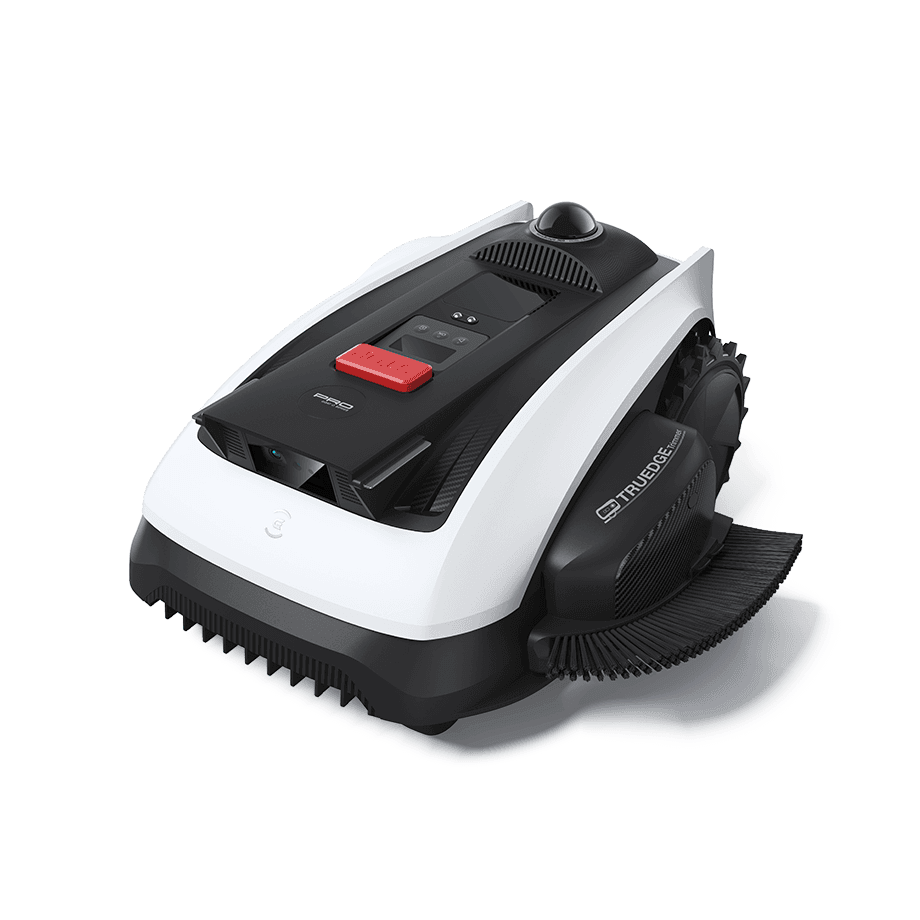
Buy this if your yard is around a quarter acre and flat-to-moderate. The O1000 is the value entry to the GOAT line and the one we'd point most budget buyers to: LiDAR plus AI vision with no antenna, genuinely good edge cutting for the class, and a street price that regularly lands near \$849 — the cheapest honest way to get true tree-cover navigation. It covers up to 0.25 acre, climbs a rated 45% slope, and manages 16 zones. Why it works: LiDAR does the localizing, so partial-to-moderate canopy that would stall an RTK mower is a non-event. The caveats are the family caveats plus a couple of trims — it's RWD, quarter- acre only, and the base model skips 4G and GPS locating, leaning on Wi-Fi and Bluetooth for alerts. For a compact shaded lot where you don't want to spend flagship money, this is the answer. Read the full O1000 review.
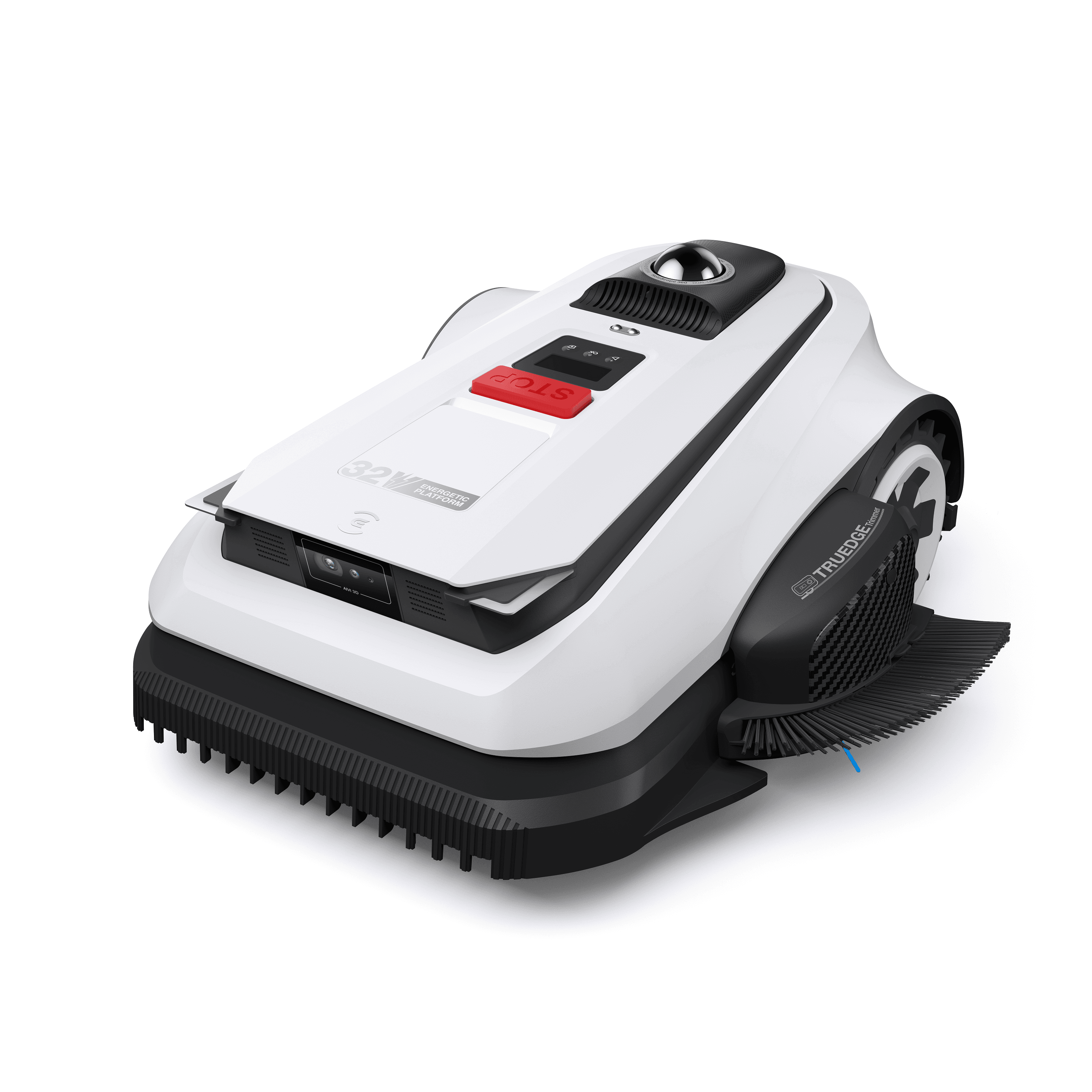
Buy this if your yard is around a half acre. The A2000 is the middle of the ladder and the value pick for a mid-size lawn: it brings dual-LiDAR navigation and TruEdge edge trimming to up to 0.5 acre with a wider 11-inch deck and 10 mapped zones, for about \$1,699 — meaningfully less than the A3000 while delivering the same edges and the same shade-proof mapping. Why size here: if your lawn is comfortably a half acre or less, the A2000 gives you the GOAT line's whole value proposition without paying for capacity you won't use. The caveats: it's RWD with a 45% slope ceiling like the O1000, and the base configuration skips 4G (it keeps GPS locating over Wi-Fi/Bluetooth). For a shaded, flat-to-moderate half acre where clean edges matter, it's the best balance of price and capability in the family. Read the full A2000 review.
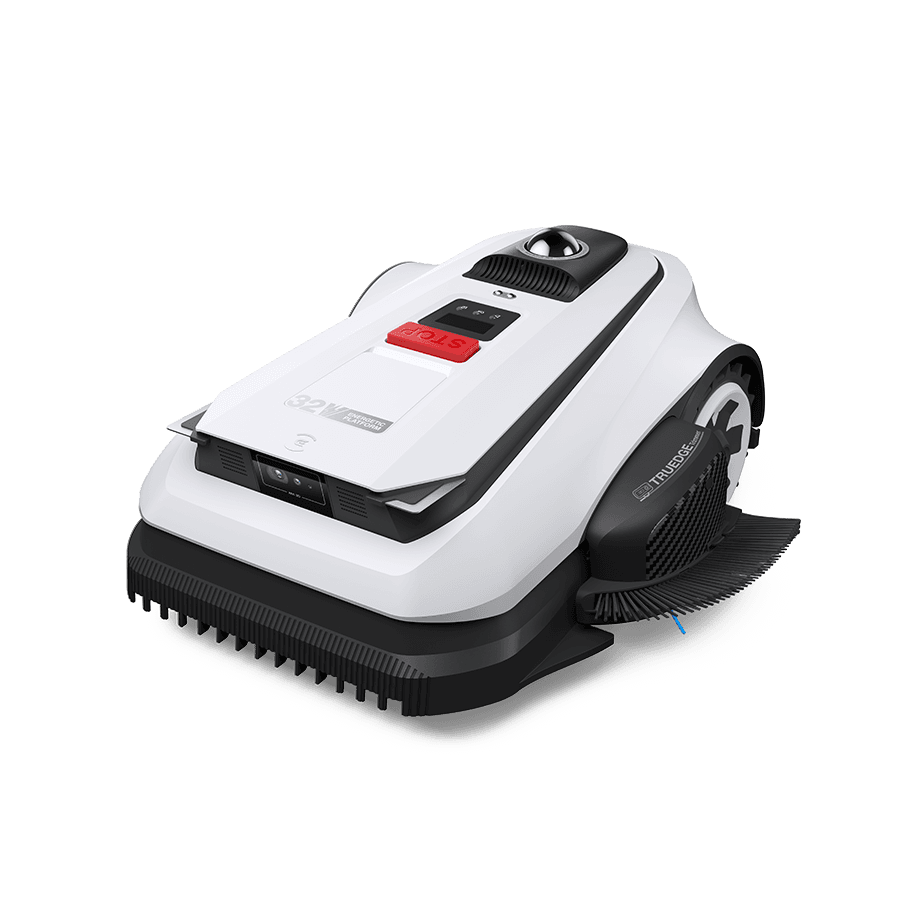
Buy this if your lawn runs from a half acre up to about three-quarters, or you want 4G. The A3000 is the top of the line and the highest-scoring GOAT at 80. It pairs dual-LiDAR mapping with a built-in TruEdge trimmer to get genuinely close to borders across up to 0.75 acre, on a wider 13-inch deck with 12 zones, and it's the only GOAT with onboard 4G for status and theft alerts away from your Wi-Fi. Its slope rating nudges up to 50% — still RWD, still a flat-to-moderate machine, just the family's highest ceiling. Why size here: the extra money mostly buys area and a day's coverage headroom, plus the 4G and a slightly wider deck that finishes open ground a touch faster. The caveats are the honest ones — it's RWD (so not a steep-slope climber) and it's a premium price for the acreage. For a mid-to-large wooded yard where edges and capacity both matter, it's the pick. Read the full A3000 review.
This is the section to read twice, because it's the single thing that most often makes the GOAT line the wrong choice. Every GOAT LiDAR PRO is rear-wheel drive. RWD pushes the mower from behind, which is efficient and quiet on flat-to-moderate lawns but runs short on traction the moment the grade gets steep or the grass gets slick. The rated ceilings — 45% on the O1000 and A2000, 50% on the A3000 — are dry-condition numbers, and real slopes are rarely dry when you most want a mow. Wet morning grass, a shaded bank that stays damp, or a loose, uneven hillside will all cut into those figures.
Crucially, you cannot spend your way out of this inside the GOAT family. Moving up from the O1000 to the A3000 buys you five more points of rated grade (45% to 50%) and a lot more area — but not a fundamentally different drivetrain. If your yard has a genuine hill, the entire GOAT line is the wrong family, no matter which tier you pick. That's not a knock on the mowers; it's a match-the-tool point. LiDAR fixes navigation on a shaded slope, but navigation isn't traction. For steep ground you want all-wheel drive or 4WD — see the next section and our best robot mowers for hills guide. If your lawn rolls gently, ignore all of this: RWD is perfectly happy on flat-to-moderate suburban turf, which is exactly what the GOAT line was built for.
The GOAT line sits in a busy wire-free market, and the trade it makes is consistent: LiDAR-first tree-cover navigation and clean edges, in exchange for RWD. Here's the brief version of how it compares.
grade* and tri-fusion navigation (LiDAR + NetRTK + vision) across 0.75 acre. It out-climbs any GOAT by a wide margin. But its navigation is NetRTK-led and it wants a clear-sky antenna position, so for a genuinely dense, dark canopy the GOAT's LiDAR-first* approach is the more predictable performer — and the A3000 undercuts the LUBA on price. Steep and wooded: LUBA. Flat-to-moderate and wooded with tidy edges: GOAT.
80%** with a wide deck — arguably the GOAT's tech taken upmarket with real slope capability. It's the better buy for a steep wooded lot, but it costs about \$800 more than the A3000, and most flat-to-moderate yards don't need the 4WD.
sky view and stumble under canopy — the exact scenario the GOAT line is built to win. If your yard is open and flat, a Navimow competes on price; if it's shaded, the GOAT is the safer bet.
simple and cheap, but vision needs light, so a dark canopy favors the GOAT's LiDAR. On a compact flat lawn in dappled shade, though, an eufy can be the more economical pick than the A2000.
The pattern: the GOAT line wins on tree cover, edges, and antenna-free simplicity and loses on slope. For the full field, cross-reference best robot mowers for tree cover and best robot mowers for hills.
Strip away the model numbers and the decision is short, because the tiers only really differ by area:
(~\$849). The value pick, and all the GOAT you need for a compact lot.
same edges and shade-proof mapping as the A3000 for \$500 less, as long as you don't need the extra area or 4G.
(~\$2,199). The top tier; the money buys capacity, a slightly wider deck, and cellular connectivity.
Mammotion LUBA 3 AWD or Dreame A3 AWD Pro instead.
Don't overthink the letter-and-number. The GOAT that fits your yard is the one whose max area clears your lawn with a little headroom — buy that tier, not the biggest badge. And because these three are so close on the middle rungs, if you're torn between the A2000 and A3000 specifically, our head-to-head on the A3000 vs A2000 review pages breaks down the \$500 gap in detail.
What's the difference between the O1000, A2000, and A3000? One platform, three sizes. Same LiDAR navigation, same TruEdge-style edges, same RWD, same 1.18–3.15 in cut and 2-year warranty. The O1000 does a quarter acre (~\$849, 45% slope), the A2000 a half acre (~\$1,699, 45%, dual-LiDAR), and the A3000 three-quarters of an acre (~\$2,199, 50%, dual-LiDAR, 4G). Pick by acreage.
Is the A3000's navigation smarter than the O1000's? Only marginally. All three localize with LiDAR and all three work under trees; the A2000/A3000 add dual-LiDAR and the A3000 adds 4G, but the higher number buys area and connectivity, not a better sense of direction.
Do the GOAT mowers work under trees? Yes — every model navigates by LiDAR with no antenna, so shade and canopy that break RTK/GPS mowers don't stop them. See best robot mowers for tree cover.
Can a GOAT climb a steep hill? No. All three are RWD, rated 45–50% in dry conditions, which drops on wet grass. For real slopes choose an AWD/4WD mower — see best robot mowers for hills.
Which GOAT is the best value? The O1000 at ~\$849, if your yard fits a flat-to-moderate quarter acre.
Do they need a boundary wire or antenna? Neither — they're wire-free and antenna-free, using LiDAR plus a guided mapping drive and an included charging base station.
The GOAT tier is really an acreage decision, but your yard is more than one number — slope, tree cover, zones, obstacles, and budget all interact, and a shaded lot is often a sloped or irregular one too. This page resolves the O1000-vs-A2000-vs-A3000 confusion; the configurator resolves whether a GOAT is even the right family for you.
Find your robot mower → answer a few questions about your yard and get your top matches
The configurator screens your exact area, grade, tree cover, and budget against every model we track — so you don't overbuy an A3000 for a quarter-acre lawn, or buy any GOAT for a hill its RWD can't climb. Keep reading: the pillar on how robot mower navigation works, the deep dive on RTK vs LiDAR vs vision, and our roundup of the best robot lawn mowers of 2026.
MowScout is reader-supported and may earn a commission from links on this page. Our picks are spec-verified and data-driven — based on published manufacturer specifications and verified US pricing, not hands-on lab testing. Prices are street estimates as of mid-2026; always confirm the current price before buying. See our full disclosure.
ECOVACS
Dual-LiDAR mapping plus a built-in TruEdge trimmer delivers genuinely clean edges on up to three-quarters of an acre.
ECOVACS
Dual-LiDAR navigation with a TruEdge edge trimmer brings near-zero-edge mowing to a half-acre at a mid-tier price.
ECOVACS
LiDAR navigation, small-yard pricing, and TruEdge-style trimming make it a strong tree-cover value pick.
Brand reputation matters only after the mower fits the lawn. Check the exact acreage, slope rating, navigation system, zone support, warranty, current price, and retailer SKU before using any deal box.
Buyer questions
They are one navigation-and-cutting platform sold at three sizes, so the differences are mostly capacity, price, and a few connectivity extras — not smarter navigation. All three navigate by LiDAR with AI-vision obstacle avoidance, all three include TruEdge-style edge trimming, all three are rear-wheel drive, and all three cut 1.18–3.15 inches tall with a 2-year warranty and no boundary wire or antenna. The O1000 (MowScout Score 75, about $849) covers a quarter acre and climbs a rated 45% slope. The A2000 (Score 76, about $1,699) steps up to a half acre with dual-LiDAR and a wider deck, still rated to 45%. The A3000 (Score 80, about $2,199) reaches three-quarters of an acre, a 50% slope, a wider 13-inch deck, and adds 4G. Pick by acreage. Prices are street estimates as of mid-2026 — verify before buying.
Only marginally, and not in a way that changes whether it can mow your yard. Every GOAT LiDAR PRO localizes with LiDAR, which is why all three work under tree cover with no antenna. The A2000 and A3000 use a dual-LiDAR arrangement that builds a slightly more complete map than the O1000's single-LiDAR-plus-vision setup, and the A3000 adds 4G for status and theft alerts off your home Wi-Fi. But the higher model number does not buy you a mower that finds its way better under the same canopy — the ladder is about area, slope, deck width, and connectivity, not navigation intelligence. Buy the tier that matches your acreage, not the biggest number.
Yes — this is the whole point of the line. Every GOAT LiDAR PRO navigates by LiDAR, which maps the physical world around the mower (trees, beds, fences, the house) and does not need a view of the sky, so canopy that breaks RTK and GPS mowers doesn't stop them. None of them needs an antenna. That makes all three a strong fit for shaded and wooded lots. See our best robot mowers for tree cover guide for how the GOAT line stacks up against the rest of the LiDAR field.
No. Every GOAT is rear-wheel drive, and RWD is the common ceiling across the whole line. The O1000 and A2000 are rated to a 45% grade and the A3000 to 50%, and those are dry-condition numbers that drop on wet or slick grass. If your lawn rolls gently, any GOAT is fine; if it has a real bank, none of them is the right tool. For genuinely steep yards you want an all-wheel-drive or 4WD mower rated to 80%, like the Mammotion LUBA 3 AWD or Dreame A3 AWD Pro — see our best mowers for hills guide.
The GOAT O1000 LiDAR PRO at about $849 (MowScout Score 75) is the value pick and the cheapest honest way into the line's LiDAR-under-trees navigation and good edge cutting. It's a quarter-acre, flat-to-moderate machine, so it only makes sense if your yard fits that envelope — but within it, no other GOAT delivers more capability per dollar. Step up to the A2000 or A3000 only when your acreage genuinely exceeds a quarter acre. Prices are street estimates as of mid-2026 — verify before buying.
Neither. The GOAT LiDAR PRO line is wire-free and antenna-free — you map the yard with a guided setup drive, and LiDAR handles localization from there. What every model does need is the included charging base station, which doubles as the docking and recharge point. So there's no perimeter wire to bury and no clear-sky antenna to mount, which is a large part of why the line suits shaded and irregular yards where satellite mowers struggle.
No, and we're explicit about it. This page is spec-verified and data-driven, not hands-on: every number comes from ECOVACS' published specifications and verified US retail listings, scored with the MowScout Score. We have not run a GOAT unit in your yard, measured its decibels, or timed its battery ourselves. Treat prices as mid-2026 street estimates and confirm the current price and configuration before you buy.