Guide
Are eufy Robot Mowers Worth It? (2026)
An honest, spec-verified verdict on eufy's E15 and E18 robot mowers: worth it for small, flat, open lawns and the simplest setup — overpriced for hard yards.
Find Matching ModelsBy MowScout EditorialUpdated 2026-07-01How we scoreHow we test
Short answer: a eufy robot mower is worth it if your lawn is small, flat, open, and dry — and you want the single simplest setup in the category. For that buyer, the eufy E15 (MowScout Score 67, street ~\$999) and eufy E18 (Score 68, ~\$1,399) are among the easiest robot mowers to recommend. For anyone with slopes, trees, acreage, or frequent wet grass, they're overpriced for what they can actually do — and this guide says exactly where that line falls.
That verdict comes with a standing caveat we won't hide. MowScout is spec-verified and data-driven, not hands-on. Our scores are computed from verified manufacturer and retailer specifications; every real-world behavior note below is manufacturer-published or attributed to a named reviewer — PCWorld, Tom's Guide, and TechRadar — and never presented as our own testing. Prices are mid-2026 street estimates; verify before buying.
Disclosure: MowScout earns a commission if you buy through some of our links, and eufy happens to carry our highest margin. It never changes a score, a ranking, or the honest answer above. See our affiliate disclosure.
The quick verdict: worth it if…
A eufy is worth the money when your situation lines up with what pure-vision navigation is genuinely good at:
- Your lawn is flat to gently sloped — under a 32% (18°) grade — and open to the sky and daylight.
- It's on the small side: up to about 0.2 acre for the E15, up to 0.3 acre for the E18.
- You mow dry, in daylight, and keep the grass under about 3.5 inches tall.
- Simplicity is your top priority — the buried boundary wire and the RTK antenna of other mowers are exactly what's kept you from buying one.
- You're a first-time robot-mower buyer who wants a polished app and doesn't want to think about satellites at all.
Skip a eufy if your yard is steep, heavily wooded, large, frequently wet or mowed in low light, or planted in dense St. Augustine or thick Zoysia. In those cases the value collapses — a cheaper LiDAR mower or an AWD hill machine will simply do more, and we point to both below. Not sure which camp you're in? The configurator filters the field by your exact slope, size, and tree cover, and the pillar guide explains the navigation trade-offs from the ground up.
The one-line take: eufy sells the easiest ownership experience in robot mowing, on the narrowest set of yards. Buy it for the simplicity on an easy lawn — not despite a hard one.
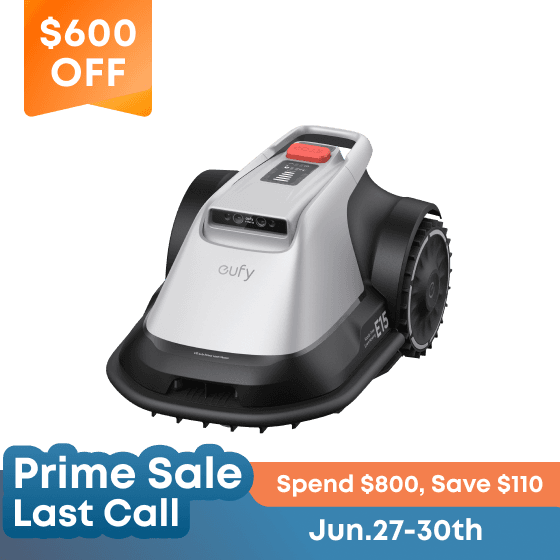
Image: eufy official product photography. MowScout does not shoot original hardware photos; this is the manufacturer's image, used to illustrate the product.
What eufy nails: setup, app, and a margin-friendly package
The setup is the whole pitch, and it delivers. Both eufy models navigate with cameras only — eufy's "Vision" system — with no perimeter wire to trench in and no RTK antenna to mount and aim at open sky. Your hands-on job is essentially: place the charging base, join Wi-Fi in the app, press start. Because vision needs no satellite fix, there's also no signal-loss failure mode from a roofline or a tree. PCWorld's hands-on reviewer logged the entire E18 setup at "less than 30 minutes," and reviewers who've set up many robot mowers describe roughly ten minutes of hands-on effort plus a longer, mostly unattended first mapping run. So the "five-minute setup" describes your effort, not the full clock to a finished map — but the effort really is that low, and that's rare.
The app is a genuine asset, not an afterthought. It's the same mature Anker/eufy platform used across the brand's smart-home line, with scheduling, live view, no-go zones, cut-height and zone management, and firmware updates in one place. Our data rates it 4/5. TechRadar called the E15 "the perfect lawnbot for technophobes," praised its "highly intuitive app," and said it "hasn't put a foot wrong during several weeks of testing." That polish matters most to exactly the buyer eufy targets: someone new to the category who wants finished software, not a beta.
The cut is clean and quiet. Both models run an 8-inch deck with a practical 1.0–3.0-inch height range and mulch clippings back into the lawn. MowScout rates their edge cutting good — near the top of what any robot mower achieves — and reviewers note an even cut and tidy parallel lines. The listed noise figure is about 56 dB (a spec, not a MowScout measurement), in line with the near-silent reputation reviewers give the E-series.
On the margin question, we'll be direct. eufy carries the best affiliate margin in our lineup (Anker/eufy via Impact, ~10% commission). We disclose that because it's the kind of incentive a review site should surface. It does not move the score: the E15's 67 and the E18's 68 come from the same spec-based formula every mower gets, and this guide is as blunt about eufy's limits as any page on the site.
The honest limits: flat, small, dry, and open only
Everything eufy nails comes from the same design choice — a single camera sensor with no backup — and that choice sets hard limits. This is the section to read twice before you buy.
- Slopes: 32% (18°) ceiling, on rear-wheel drive. Gentle undulations and shallow banks are fine; real hills are not. AWD rivals in 2026 are rated 45% to 80%, so eufy sits at the modest end by design. A light ~27 lb RWD chassis also has less climbing traction than a heavier AWD machine — and less on anything damp.
- No night, no glare, no rain. Cameras need light. Both models can't mow in darkness, and PCWorld notes the E18 is hampered by direct sun glare into the lens. eufy marks them as not for wet grass, and Tom's Guide, testing the E15, found its "plasticky wheels lose grip easily on damp or dewy grass." Tom's Guide summed the E15 up as "good, but has a serious navigation problem" on uneven ground.
- Tall or shaggy grass confuses it. Let the lawn get too long and the cameras can misread tall grass or weeds as obstacles — a reason to keep it on a tight schedule, and a weakness Tom's Guide flagged with "longer grass."
- Trees and shade are the real Achilles' heel. Vision works best where boundaries are visually clear and well-lit. Under dense canopy or in deep shade it has less to lock onto, and — unlike a LiDAR mower — there's no second sensor to fall back on.
- Small capacity, warm-season caveat. 0.2–0.3 acre is a small-lawn spec, and eufy explicitly warns these are not ideal for dense St. Augustine or thick Zoysia, whose spongy canopy taxes both the drivetrain and the cameras.
None of this makes a eufy bad — it makes it specialized. On a bright, dry, cleanly-bordered flat lawn it's genuinely excellent. Push it outside those conditions and performance falls off faster than on a redundant multi-sensor mower.
E15 vs E18: which eufy is the better value
Here's the good news: choosing between the two eufy models is easy, because they're the same mower at two sizes. Both use identical pure-vision navigation, the same 32% slope ceiling on RWD, the same 8-inch deck and 1.0–3.0-inch cut, the same Wi-Fi/Bluetooth/4G with anti-theft GPS, the same ~27 lb body, the same 2-year warranty, and the same 4/5 app. The only real differences are capacity, zone count, and price.
| Spec | eufy E15 | eufy E18 |
|---|---|---|
| MowScout Score | 67 / 100 | 68 / 100 |
| Street price | ~\$999 (MSRP \$1,299) | ~\$1,399 (MSRP \$1,599) |
| Max area | 0.2 acre | 0.3 acre |
| Mapped zones | Up to 8 | Up to 10 |
| Navigation | Pure vision (no wire/RTK/antenna) | Pure vision (no wire/RTK/antenna) |
| Drive / max slope | RWD / 32% (18°) | RWD / 32% (18°) |
| Cut width / height | 8 in / 1.0–3.0 in | 8 in / 1.0–3.0 in |
| Connectivity | Wi-Fi, BT, 4G | Wi-Fi, BT, 4G |
| Warranty | 2 years | 2 years |
Figures from MowScout's verified data; prices are mid-2026 street estimates — verify before buying.
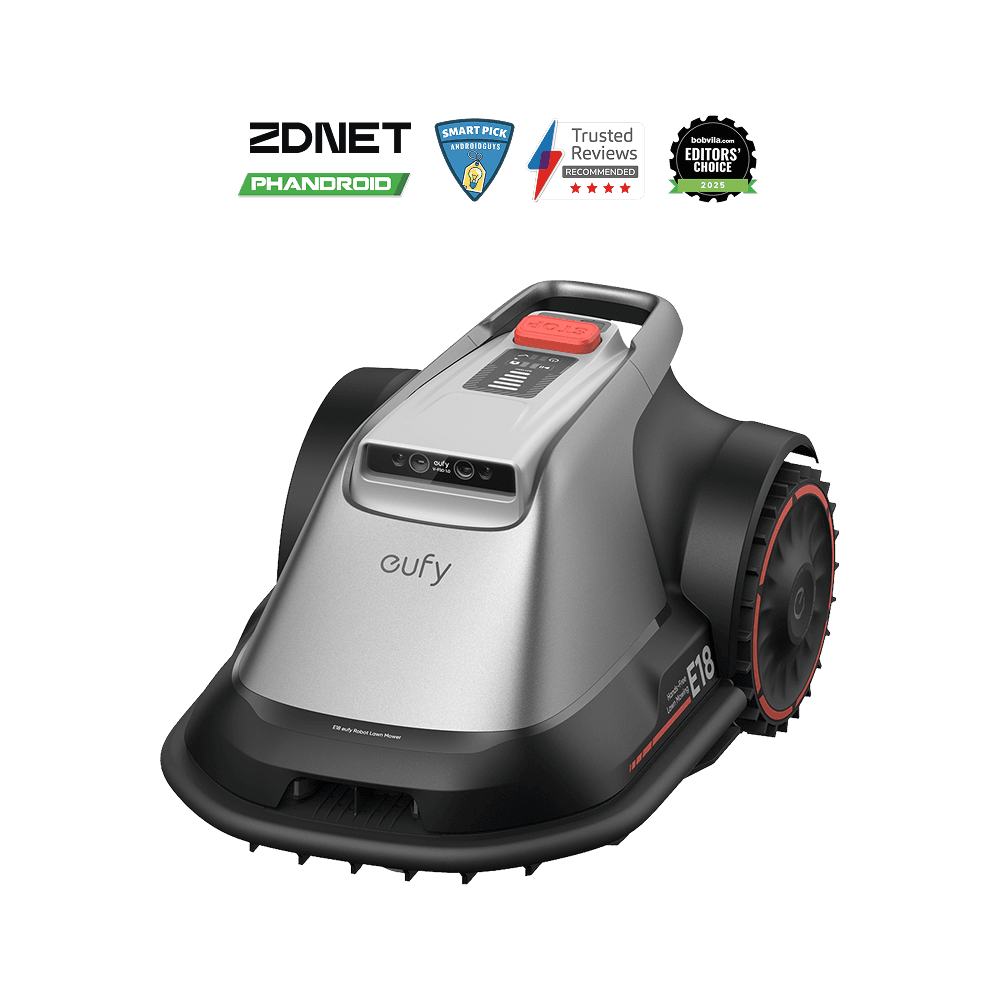
Image: eufy official product photography. The E18 (shown) is the larger-capacity sibling of the E15 pictured above; MowScout does not shoot original hardware photos.
The decision: below about 0.2 acre, the E15 is the smarter spend — the E18's extra capacity would be headroom you never use, and you keep roughly \$400. If your lawn is closer to a third of an acre, or you simply want a buffer so the mower isn't running flat-out at the top of its rating on a fast-growing lawn, the E18 is worth the step up. That's genuinely the whole calculus; for a deeper side-by-side, see the eufy brand guide. Neither model changes the capability story — a bigger eufy is still a flat-yard eufy.
eufy vs cheaper LiDAR rivals: the value question
This is where "worth it" gets interesting, because eufy's most pointed competition is cheaper and more capable on paper. The ECOVACS GOAT O1000 LiDAR PRO (MowScout Score 75) frequently streets around \$849 — under both eufy models — and it out-navigates them where vision is weakest:
- LiDAR maps in the dark and under partial tree cover, holding position in shade where eufy's cameras lose their footing. Night mowing is on the table; for a eufy it never is.
- A 45% slope rating clears more grade than eufy's 32%, and it pairs that with a genuine edge trimmer (TruEdge-class) for cleaner borders.
- It's the value pick for a shaded or cleanly-edged small lot — a quarter acre where you'd otherwise reach for eufy.
So what does eufy's premium actually buy? Simplicity, not capability. The O1000 still asks you to set a base station and live with LiDAR's own quirks; eufy asks nothing beyond Wi-Fi and a button. eufy's app is more refined, and the pure-vision approach is the most fool-proof onboarding in the category for a nervous first-timer. That's a real, worth-paying-for advantage — but only for a buyer who values ease over range. If your yard is open, flat, and sunny, the honest read is that a cheaper LiDAR mower gives you more mower for less money, and eufy has to win you on experience alone.
Where eufy's terrain ceiling is the actual dealbreaker — real slopes or damp banks — the answer isn't the O1000 either; it's an AWD machine. Our reviews point slope-limited buyers to models rated 45–80%, which is a different tier entirely. To understand why LiDAR, RTK, and vision behave so differently on your specific yard, read RTK vs LiDAR vs vision.
Who should buy a eufy — and who should skip it
Buy a eufy if you check most of these boxes: a flat-to-gentle, open, sunny lawn up to 0.2 acre (E15) or 0.3 acre (E18); you mow dry and in daylight; you want the simplest possible setup with no wire and no antenna; you value a polished app; and you're happy to pay a small premium for that ease. This is the classic small-yards buyer and the classic first-timer — and for them, eufy is one of the easiest recommendations we make.
Skip a eufy if any of these describe your yard: meaningful slopes beyond ~32%; heavy tree cover or deep shade; a large lot; frequent wet or low-light mowing; or dense St. Augustine / thick Zoysia turf. For a shaded small lot, the cheaper ECOVACS GOAT O1000 is the better tool. For slopes, look to an AWD model. For the broader "is any robot mower worth it for me" question, start with our worth-it guide. And when in doubt, the configurator will match your exact conditions to models that actually fit — the surest way to avoid turning "worth it" into "returned it."
Five-year cost, warranty, and the disclosure
On paper, a eufy's running costs are typical for the category and low: blades run roughly \$60–\$200 over five years and are owner-replaceable; electricity is pennies per mow; and the battery is the one meaningful wildcard, since lithium packs fade and an out-of-warranty replacement is the biggest single repair risk on any robot mower. eufy's 2-year warranty covers the early window, though some rivals offer three — one of the small reasons the E-series lands mid-pack on value rather than top of it.
The bigger value truth is the one this whole guide circles: at ~\$999 (E15) and ~\$1,399 (E18) street, you're paying a premium sticker for a modest spec, and the thing you're buying is ease. For the right buyer on the right yard, that's worth real money. For a buyer with slopes or acreage, it isn't — and the affiliate margin that makes eufy attractive to us to promote (about 10%) changes none of that math. We disclose it, and we still send slope, shade, and big-yard buyers elsewhere.
The bottom line
Are eufy robot mowers worth it in 2026? Yes — for the small, flat, open, dry lawn they were built for, and for the buyer who prizes the simplest setup in the category. The E15 (67) and E18 (68) remove the boundary wire and the RTK antenna entirely, pair a clean cut with a genuinely polished app, and are about as fool-proof as robot mowing gets. Their honest cost is capability: a 32% slope ceiling, no night or wet mowing, small capacity, and a premium price mean a cheaper LiDAR rival like the GOAT O1000 does more for less on any yard that isn't textbook-easy. Match a eufy to the easy yard and it delights. Ask it to climb, cover ground, or read shade, and you should buy something else.
→ Find the robot mower that actually fits your yard — or compare the two eufy models head-to-head in the eufy brand guide.
---
How we know what we know. MowScout is spec-verified and data-driven, not hands-on: our scores are computed from verified manufacturer and retailer specifications, and we have not tested these units ourselves. Real-world observations are attributed to their sources — the PCWorld eufy Lawnbot E18 review, plus Tom's Guide and TechRadar coverage of the eufy E15 — and never presented as our own testing. Specs verified against the eufy E15 and eufy E18 product pages; the GOAT O1000 comparison uses ECOVACS' product page. The ~56 dB noise figure is a listed spec, not a MowScout measurement. Prices are mid-2026 street estimates; verify current pricing before buying. This guide contains affiliate links, and eufy carries our highest affiliate margin — see our disclosure.
Recommended next step
Use this guide to understand the buying issue, then run the configurator with your exact acreage, slope, tree cover, zones, terrain, obstacles, and budget. The best recommendation should survive both the guide logic and the yard-fit filters. If a brand claim or retailer listing conflicts with the guidance here, trust the measured yard constraints first and recheck the exact model page before buying. Document the final assumptions.
Buyer questions
FAQ
Are eufy robot mowers worth it in 2026?
For the specific yard they're built for — small, flat, open, and dry — yes. The eufy E15 (MowScout Score 67, ~$999) and E18 (Score 68, ~$1,399) deliver the simplest setup in the category: no boundary wire, no RTK antenna, and a roughly five-minute hands-on start. They're worth it for a first-time buyer who wants zero fuss on an easy lawn. They are not worth it for steep, wooded, large, or often-wet yards — vision navigation has hard limits there, and cheaper LiDAR rivals do more. Match the mower to the yard and the answer is yes; ask it to climb or cover acreage and it isn't. Prices are mid-2026 street estimates — verify before buying.
What's the catch with eufy's pure-vision navigation?
The catch is that a camera-only system has no backup layer. eufy removed the wire and the antenna, which makes setup wonderfully simple, but it means the mower can't mow in darkness, dislikes direct sun glare, and is rated only to a 32% (18°) slope on rear-wheel drive. eufy also flags it as not for wet grass and a poor fit for dense St. Augustine or thick Zoysia. On a bright, dry, cleanly-bordered flat lawn that's fine; outside those conditions there's no second sensor to catch it. TechRadar praised the E15's near-silent, tidy cut but noted it 'can't mow at night' and can't handle gradients over 18 degrees.
Should I buy the eufy E15 or the E18?
It's almost purely a size-and-price decision, because the two are the same mower at two capacities. Buy the E15 (up to ~0.2 acre, ~$999) if your lawn is genuinely small and flat, and pocket the roughly $400 difference. Step up to the E18 (up to ~0.3 acre, ~$1,399) if your lawn is closer to a third of an acre or you want headroom so it isn't running at the top of its rating. Both give you the identical wire-free, antenna-free, five-minute setup — you're paying for area, not a better mower.
Is a eufy worth it versus a cheaper LiDAR mower like the GOAT O1000?
It depends on what your yard needs. The ECOVACS GOAT O1000 LiDAR PRO (MowScout Score 75) often streets around $849 — cheaper than either eufy — and its LiDAR maps in the dark and under partial tree cover, with a 45% slope rating and a genuine edge trimmer. On raw capability it beats the eufy for less money. What eufy sells that the O1000 doesn't is setup simplicity and app polish: no antenna to think about at all, and a very refined Anker/eufy app. So eufy's premium buys ease, not capability. If your yard is open and flat, the value case tilts toward the cheaper LiDAR.
Can a eufy mower handle my slopes, trees, or wet grass?
Slopes only up to 32% (18°), and only when dry. Both eufy models are rear-wheel drive with a modest slope ceiling, so real hills are out — AWD rivals are rated to 45–80%. Trees are the bigger problem: vision needs light and clear visual cues, so dense canopy and shade degrade it, where a LiDAR mower would keep its footing. And eufy explicitly marks these as not for wet-grass mowing; Tom's Guide found the E15's wheels 'lose grip easily on damp or dewy grass.' If your yard is steep, wooded, or often wet, a eufy is the wrong tool.
Does MowScout's affiliate margin change this verdict?
No. eufy carries our highest affiliate commission (about 10% via Impact), and we're telling you that plainly because it's exactly the kind of incentive a review site should disclose. It does not move a score or the honest answer: the E15's 67 and the E18's 68 are computed from verified specs by the same formula applied to every mower, and this guide names their flat-only ceiling and middling value as bluntly as any. Where a cheaper rival fits your yard better, we say so.