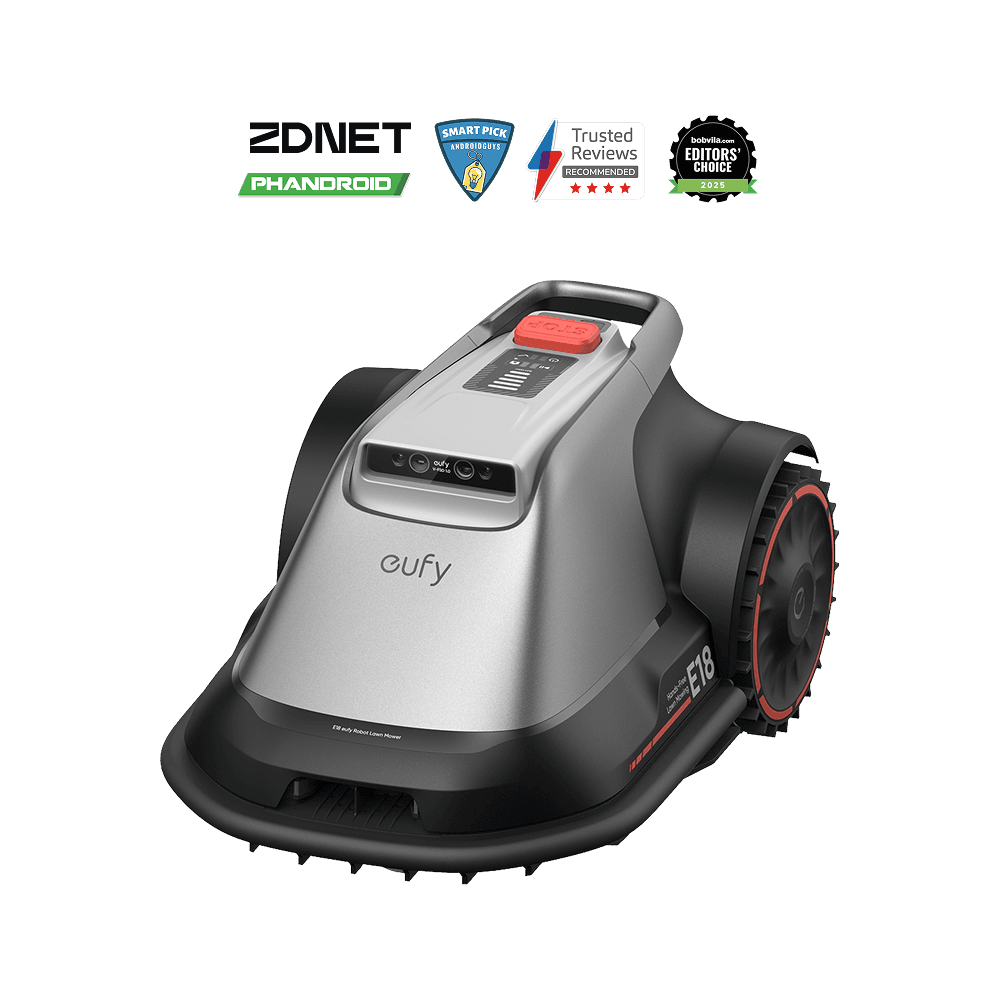
eufy
Robot Lawn Mower E18
Pure vision setup avoids wires, RTK antennas, and satellite signal failures for simple small lawns.
Score68/100
$1,3990.3 acres32% slope
VISIONRWD
ReviewBrand hub
eufy E15 vs E18 (2026): both are pure-vision, wire-free robot mowers for small flat lawns. The whole decision is capacity and price — here's which eufy to buy.
Check Yard FitBy MowScout EditorialUpdated 2026-07-01How we scoreHow we test
Quick verdict: buy the eufy E15 (MowScout Score 67, about $999) if your lawn is genuinely small — up to roughly 0.2 acre — and flat; buy the eufy E18 (Score 68, about $1,399) if your lawn is closer to a third of an acre or you want headroom. These are the same mower at two sizes. They share an identical pure-vision, wire-free, antenna-free platform, the same rear-wheel-drive chassis, the same 32% slope ceiling, the same cut heights, and the same five-minute setup experience. The gap between them buys area capacity and almost nothing else, which makes the E15-versus-E18 choice one of the cleanest decisions in robot mowing: pick by lawn size and budget. This guide is spec-verified and data-driven, not hands-on — we have not run either unit on your lawn, so every number here comes from eufy's specifications and our MowScout Score, and prices are street estimates as of mid-2026 that you should verify before buying.
If you want the wider context on how camera navigation differs from RTK and LiDAR before you pick a eufy, start with the pillar, robot lawn mowers: RTK vs LiDAR vs vision, then come back for the head-to-head. Not sure a eufy fits your yard at all? The configurator will filter by your exact size, slope, and tree cover in under a minute.
eufy is Anker's smart-home brand, and it approaches robot mowing the same way it approached video doorbells and vacuums — by stripping out the setup friction that keeps ordinary buyers away. Where most 2026 robot mowers ask you to either trench a boundary wire around the lawn or mount an RTK antenna with a clear view of the sky, eufy asks for neither. Its mowers navigate by cameras alone. That single design choice is the brand's whole identity: eufy is the "just place it and press start" option, the one you hand to someone who has been scared off robot mowers by talk of buried wires and lost satellite signals.
That positioning is deliberately narrow. eufy is not trying to build the mower that climbs the steepest bank or covers the biggest estate. Both of its current models — the E15 and the E18 — are aimed squarely at small-to-mid, flat, open lawns where camera navigation shines and where the removed setup steps matter most. Within that lane, eufy is one of the easiest brands to recommend: the hardware is polished, the Anker app is mature, and the onboarding genuinely is the fastest in the category. Outside that lane — steep, wooded, or large yards — eufy simply isn't the answer, and the rest of this guide is as honest about that as about the strengths. If a wire-free, ultra-simple setup is the entire reason you're shopping, eufy and the broader simple-setup shortlist are where to start.
Both eufy mowers use cameras only to see and position themselves — the brand markets it as "Vision FSD." There is no boundary wire, no RTK satellite correction, and no antenna. To locate itself, the mower reads the visual scene and, on its early runs, physically maneuvers to learn the yard's shape from what the cameras see, refining the map over repeated passes.
The upside of a single-sensor camera system is radical simplicity. There's no antenna to place under open sky and, crucially, no satellite signal to lose under trees or beside a roofline — the failure mode that pauses or strands pure-RTK mowers doesn't exist here. That's exactly why eufy is the easiest brand in our lineup to set up, and why both models earn their high setup marks.
The downside is that with only one sensor there is no backup layer when vision struggles, and vision struggles in predictable, physics-bound ways that apply equally to the E15 and E18:
None of this makes eufy a bad brand; it makes it specialized. On a bright, dry, cleanly-bordered flat lawn, either eufy is genuinely excellent. Push it into darkness, wet, steep grade, or a shaggy dense canopy and — with no second sensor to catch it — performance falls off faster than on a redundant multi-sensor mower. Buying a eufy means buying into that trade on purpose. For the full explainer on why vision behaves this way versus RTK and LiDAR, see RTK vs LiDAR vs vision.
Here's the part that surprises people: there is very little to compare. The E15 and E18 are not a "good" and "better" pair with different navigation, drivetrains, or feature sets — they are one platform offered in two sizes. Both run the same Vision FSD cameras, the same RWD chassis, the same 32% slope rating, the same 1.0–3.0-inch cut on an 8-inch deck, the same Wi-Fi/Bluetooth/4G stack with anti-theft GPS, the same ~27 lb body, the same 2-year warranty, and the same five-minute hands-on setup. So the head-to-head really comes down to two numbers per model: how much lawn it covers and what it costs.
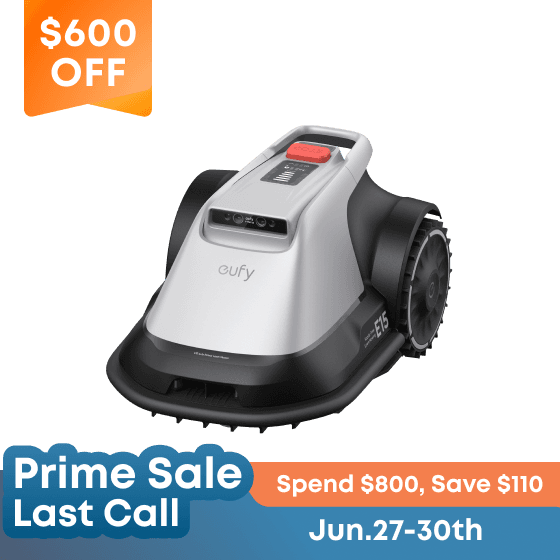
Image: eufy official product photography. MowScout does not shoot original hardware photos; this is the manufacturer's image, used to illustrate the product.
The E15 is the entry point. It covers up to 0.2 acre across 8 mapped zones at a street price around $999 (MSRP $1,299), and it earns a MowScout Score of 67/100. Everything that makes eufy easy is here in full: no wire, no antenna, the polished Anker app, clean edges rated "good," and anti-theft with 4G on a machine that lives outdoors.
Who it's for: the E15 is the smarter spend for a genuinely small, flat, open lawn — think a compact suburban front-and-back that comfortably fits inside a fifth of an acre. If that's your yard, the E18's extra capacity is headroom you'd pay roughly $400 for and never use. It's also the easiest robot mower in our lineup to recommend to a first-time buyer who wants the lowest eufy price without giving up any of the platform's simplicity. Read the full eufy E15 review for the complete spec-verified breakdown, and see where it lands on our best robot mowers for small yards shortlist.
Image: eufy official product photography. MowScout does not shoot original hardware photos; this is the manufacturer's image, used to illustrate the product.
The E18 is the same mower with more coverage. It handles up to 0.3 acre across 10 mapped zones at a street price around $1,399 (MSRP $1,599), for a MowScout Score of 68/100 — a single point above the E15, reflecting the extra capacity and nothing more. The navigation, drivetrain, cut, app, and connectivity are identical to the E15's.
Who it's for: the E18 is the pick when your lawn is closer to a third of an acre, or when it's in between and you want a buffer so the mower isn't constantly running at the very top of its rating on a fast-growing lawn. The two extra zones help if your property is carved into several separate areas — a front, a back, and a side lawn — each wanting its own schedule. Below 0.2 acre, the E18's premium doesn't pay off; above it, the extra capacity is exactly what you're buying. The full eufy E18 review covers the scorecard pillar by pillar.
| Model | Score | Price* | Area | Slope | Setup |
|---|---|---|---|---|---|
| eufy E15 | 67 | ~$999 | 0.2 acre | 32% (18°) | Wire-free, antenna-free, ~5-min hands-on |
| eufy E18 | 68 | ~$1,399 | 0.3 acre | 32% (18°) | Wire-free, antenna-free, ~5-min hands-on |
*Street prices as of mid-2026 (E15 MSRP $1,299; E18 MSRP $1,599) — these move weekly, so verify current pricing before buying. Both models: rear-wheel drive, pure-vision navigation (no wire, no RTK, no antenna), 1.0–3.0-inch cut on an 8-inch deck, Wi-Fi/Bluetooth/4G, anti-theft GPS, ~27 lb, 2-year warranty.
The table makes the point visually: every column except area and price is identical. Score tracks capacity by a single point. Slope, drive, navigation, setup, cut, and warranty don't move at all. This is why the eufy decision is so clean — you are choosing a lawn size, not a better or worse machine.
Buy a eufy if your lawn is flat-to-gentle, open to the sky, and modest in size — up to about 0.3 acre — and simplicity is your top priority. If the buried-wire and antenna-siting steps of other robot mowers are exactly what's kept you from buying one, eufy removes them entirely. It's also a strong pick for a first-time robot-mower buyer who wants a polished app and doesn't want to think about RTK. Within that profile, eufy is one of the easiest recommendations we make, and it anchors both our small-yards and simple-setup shortlists.
Look elsewhere if any of these describe your yard, because they're the conditions eufy is honest about not handling:
If you're in any of those camps, don't talk yourself into a eufy because the setup looks easy — believe the spec sheet. The configurator will point you to a model that actually fits, and the pillar guide explains the navigation trade-offs in plain English.
Here's something most review sites won't tell you: eufy carries the best affiliate margin in our lineup (eufy/Anker via Impact, around a 10% commission). We're stating that plainly because it's exactly the kind of incentive a review site should disclose, and because it would be easy to let it quietly tilt a recommendation.
It does not move our scores. The E15's 67 and the E18's 68 are computed from verified specs by the same formula applied to every mower we cover, and this guide names eufy's flat-only ceiling, its no-night/no-wet limits, and its modest slope rating as bluntly as it names the strengths. When a steeper, shadier, or larger yard needs a different brand, we say so — repeatedly, above. The affiliate rate is a fact about our business, not an input to the analysis. If eufy is the right mower for your lawn, we're glad to earn the commission; if it isn't, we'd rather you buy the machine that fits.
Strip it all the way down and the answer is a single question: how big is your lawn?
Because the two mowers are otherwise identical, there's no "enthusiast's choice" or "get the better one if you can afford it" wrinkle here. Spending more on the E18 buys you area and nothing else. If your yard is small, the E15 is not a compromise — it's the correct tool, and the cheaper one.
What's the difference between the eufy E15 and E18? They are the same mower at two sizes. Both run eufy's pure-vision navigation with no boundary wire, no RTK, and no antenna; both are rear-wheel drive with a 32% (18°) slope ceiling; both cut 1.0–3.0 inches on an 8-inch deck, carry Wi-Fi, Bluetooth and 4G with anti-theft GPS, weigh about 27 lb, and come with a 2-year warranty. The only meaningful differences are capacity and price: the E15 covers up to 0.2 acre across 8 zones for a street price near $999 (MowScout Score 67), and the E18 covers up to 0.3 acre across 10 zones for around $1,399 (Score 68). The decision is almost entirely lawn size and budget. Prices are street estimates as of mid-2026 — verify before buying.
Is eufy a good robot mower brand? For the specific job it's built for — the simplest possible setup on a small, flat, open lawn — eufy is one of the easiest brands to recommend. It's backed by Anker, whose app and support ecosystem is mature, and its pure-vision approach removes the boundary wire and the RTK antenna that scare first-time buyers off. But "good" is conditional: both eufy models are flat-yard machines with a 32% slope ceiling that can't mow at night or in wet grass, and eufy itself flags them as a poor fit for dense St. Augustine or thick Zoysia. On the right yard eufy is excellent; on a steep, wooded, or large one it's the wrong brand entirely.
Should I buy the eufy E15 or the E18? Match the model to your lawn size, because that's the whole decision. If your yard is genuinely small — up to about 0.2 acre — and flat, buy the E15 and pocket the roughly $400 difference; the extra capacity of the E18 would be headroom you never use. If your lawn is closer to a third of an acre, or you simply want a buffer so the mower isn't running at the top of its rating on a fast-growing lawn, step up to the E18. Both give you the identical wire-free, antenna-free, five-minute setup experience, so you are paying only for area, not for a better mower.
Can eufy robot mowers handle slopes or hills? Only gentle ones. Both the E15 and E18 are rated for an 18-degree slope — about a 32% grade — on rear-wheel drive, which covers shallow banks and gentle undulations but not real hills. That rating is also a dry-condition ceiling, and eufy doesn't recommend wet-grass mowing, so traction drops further on damp turf. By 2026 standards a 32% ceiling is modest: all-wheel-drive rivals are rated from 45% up to 80%. If your yard has meaningful grade, neither eufy is the right tool — you want an AWD machine instead.
Do eufy robot mowers need a boundary wire or an antenna? No to both, and that's the entire point of the brand. eufy's E15 and E18 navigate by cameras only — the brand calls it Vision FSD — so there's no perimeter wire to trench in around your lawn and no RTK antenna to mount and aim at open sky. Because vision needs no satellite fix, there's also no signal-loss failure mode when the mower passes a roofline or a tree. Your hands-on setup is essentially: place the charging base, connect to Wi-Fi in the eufy app, and press start. The first mapping run still takes real (mostly unattended) time, but the effort is minimal.
Can eufy mowers mow at night or in wet grass? No on both, and this is inherent to pure-vision navigation rather than a defect. The cameras need light, so neither eufy can mow in darkness, and direct sun glare into the lens can hamper them too. eufy also marks both models as not for wet-grass mowing, and the rear-wheel-drive chassis loses grip on damp or dewy turf. Let the lawn get too tall and the cameras can even misread shaggy grass or weeds as obstacles. The rule for both models is simple: mow dry, in daylight, on a regular schedule that keeps the grass under about 3.5 inches.
eufy is the simplest-to-own robot mower brand for small, flat, open lawns, and the E15-versus-E18 choice is one of the cleanest in the category: same platform, same navigation, same drivetrain, same setup — the only variables are area and price. Buy the eufy E15 (~$999) if your lawn is up to about 0.2 acre, and the eufy E18 (~$1,399) if it's closer to 0.3 acre or you want headroom. If your yard is steep, wooded, large, or dense warm-season turf, buy neither — eufy is honest about not being built for those, and so are we. Still weighing it? Start with the configurator to match your exact yard, read the pillar guide for how vision compares to RTK and LiDAR, and check the small-yards and simple-setup shortlists to see how eufy stacks up against the field.
→ Find your match with the MowScout configurator
---
How we know what we know. MowScout is spec-verified and data-driven, not hands-on: our scores are computed from verified manufacturer and retailer specifications, and we have not tested these units ourselves. Every spec here comes from eufy's product pages — the eufy E15 and eufy E18 — and our MowScout Scores. Prices are street estimates as of mid-2026 and move weekly; verify current pricing before buying. This guide contains affiliate links, and eufy carries our highest affiliate margin — see our disclosure.
eufy
Pure vision setup avoids wires, RTK antennas, and satellite signal failures for simple small lawns.
eufy
The smaller eufy model keeps the same no-RTK setup story for compact flat lawns.
Brand reputation matters only after the mower fits the lawn. Check the exact acreage, slope rating, navigation system, zone support, warranty, current price, and retailer SKU before using any deal box.
Buyer questions
They are the same mower at two sizes. Both run eufy's pure-vision navigation with no boundary wire, no RTK, and no antenna; both are rear-wheel drive with a 32% (18°) slope ceiling; both cut 1.0–3.0 inches on an 8-inch deck, carry Wi-Fi, Bluetooth and 4G with anti-theft GPS, weigh about 27 lb, and come with a 2-year warranty. The only meaningful differences are capacity and price: the E15 covers up to 0.2 acre across 8 zones for a street price near $999 (MowScout Score 67), and the E18 covers up to 0.3 acre across 10 zones for around $1,399 (Score 68). The decision is almost entirely lawn size and budget. Prices are street estimates as of mid-2026 — verify before buying.
For the specific job it's built for — the simplest possible setup on a small, flat, open lawn — eufy is one of the easiest brands to recommend. It's backed by Anker, whose app and support ecosystem is mature, and its pure-vision approach removes the boundary wire and the RTK antenna that scare first-time buyers off. But 'good' is conditional: both eufy models are flat-yard machines with a 32% slope ceiling that can't mow at night or in wet grass, and eufy itself flags them as a poor fit for dense St. Augustine or thick Zoysia. On the right yard eufy is excellent; on a steep, wooded, or large one it's the wrong brand entirely.
Match the model to your lawn size, because that's the whole decision. If your yard is genuinely small — up to about 0.2 acre — and flat, buy the E15 and pocket the roughly $400 difference; the extra capacity of the E18 would be headroom you never use. If your lawn is closer to a third of an acre, or you simply want a buffer so the mower isn't running at the top of its rating on a fast-growing lawn, step up to the E18. Both give you the identical wire-free, antenna-free, five-minute setup experience, so you are paying only for area, not for a better mower.
Only gentle ones. Both the E15 and E18 are rated for an 18-degree slope — about a 32% grade — on rear-wheel drive, which covers shallow banks and gentle undulations but not real hills. That rating is also a dry-condition ceiling, and eufy doesn't recommend wet-grass mowing, so traction drops further on damp turf. By 2026 standards a 32% ceiling is modest: all-wheel-drive rivals are rated from 45% up to 80%. If your yard has meaningful grade, neither eufy is the right tool — you want an AWD machine instead.
No to both, and that's the entire point of the brand. eufy's E15 and E18 navigate by cameras only — the brand calls it Vision FSD — so there's no perimeter wire to trench in around your lawn and no RTK antenna to mount and aim at open sky. Because vision needs no satellite fix, there's also no signal-loss failure mode when the mower passes a roofline or a tree. Your hands-on setup is essentially: place the charging base, connect to Wi-Fi in the eufy app, and press start. The first mapping run still takes real (mostly unattended) time, but the effort is minimal.
No on both, and this is inherent to pure-vision navigation rather than a defect. The cameras need light, so neither eufy can mow in darkness, and direct sun glare into the lens can hamper them too. eufy also marks both models as not for wet-grass mowing, and the rear-wheel-drive chassis loses grip on damp or dewy turf. Let the lawn get too tall and the cameras can even misread shaggy grass or weeds as obstacles. The rule for both models is simple: mow dry, in daylight, on a regular schedule that keeps the grass under about 3.5 inches.