Guide
ECOVACS GOAT Problems & Reliability: What Owners Report (2026)
ECOVACS GOAT problems owners report in 2026: LiDAR map-lost on open lawns, RWD slope and wet-grass limits, edge and app quirks, plus fixes and the right model.
Find Matching ModelsBy MowScout EditorialUpdated 2026-07-01How we scoreHow we test
ECOVACS GOAT problems and reliability: what owners report (2026)
The most-reported ECOVACS GOAT problems are LiDAR mapping and "relocalization" hiccups on wide-open or featureless lawns (LiDAR needs nearby objects to see by), a first-map setup drive with occasional Bluetooth drops, rear-wheel-drive traction that fades on wet or steep ground, a TruEdge trimmer that gets close but not perfect, and the odd false obstacle stop on tall tufts. Almost all of them trace to two design choices — LiDAR navigation and RWD — and most are managed with placement, settings, and firmware updates. Everything below is the owner-sourced detail behind that summary, plus honest guidance on which yards the GOAT line suits and which it doesn't.
A quick, honest disclosure on how to read this page: MowScout is spec-verified and data-driven, not a hands-on test lab. We have not run a GOAT on our own lawn. Every problem described here is attributed to the owners, reviewers, and ECOVACS support documents who reported it, and the underlying specs come from our verified data record. Where we say "owners report" or "reviewers noted," that is exactly what we mean — we're not passing off anyone else's testing as our own, and we're not inventing faults. This is a pre-purchase reality check for a genuinely strong value line, not a hit piece. For the wider category context, start at the pillar: robot lawn mowers.
<em>Disclosure: MowScout may earn a commission from links on this page. It never changes our verdicts — we cite our sources and name the trade-offs.</em>
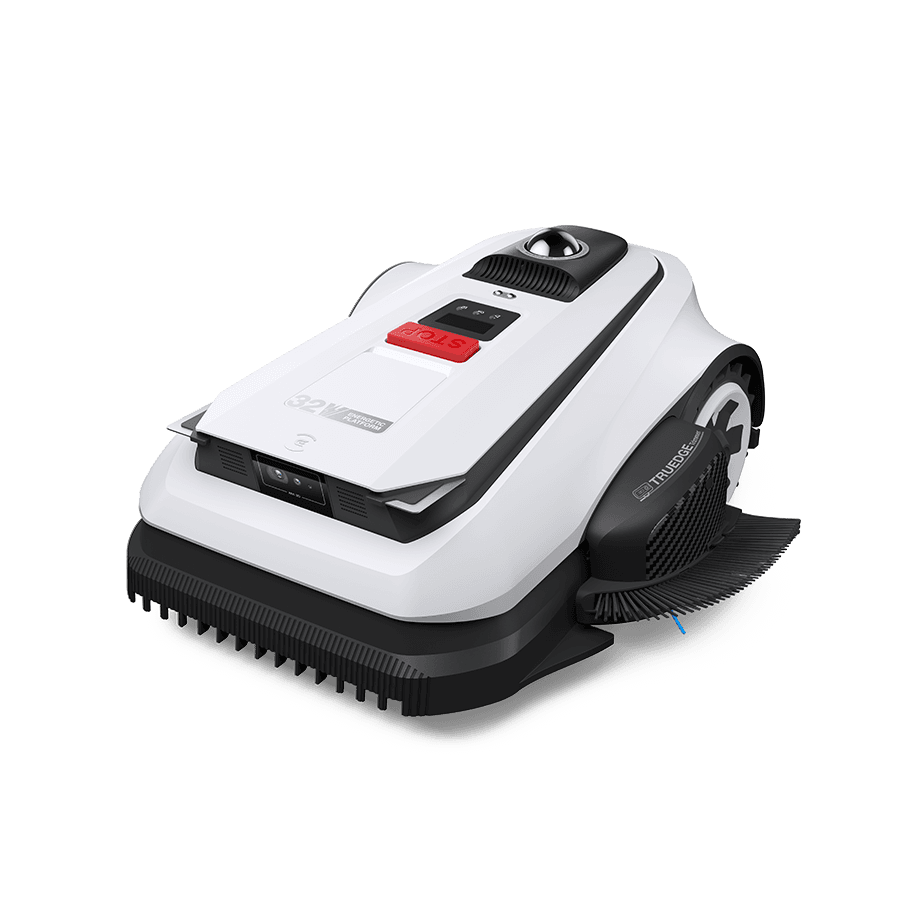
Image: ECOVACS official product photography. MowScout does not shoot original hardware photos; this is the manufacturer's image, used to illustrate the product.
Quick answer: how reliable is the GOAT, really?
The ECOVACS GOAT LiDAR PRO line is one of the strongest value stories in wire-free mowing: LiDAR navigation with no antenna and no clear-sky requirement, a genuine side-mounted TruEdge trimmer that most rivals lack, and quiet operation (roughly 60–61 dB). For the right yard it earns its reputation, and the complaints are real but concentrated — they mostly come down to the physics of LiDAR and the limits of rear-wheel drive, not build quality.
Here's the honest reliability picture from owners and reviewers:
- Shaded, tree-lined, object-rich yards: This is the GOAT's home turf. Because LiDAR references nearby structures instead of the sky, canopy that breaks RTK mowers doesn't faze it. Reviewers describe clean, striped, hands-off cuts once mapped.
- Wide-open or featureless lawns: This is the one architectural soft spot. LiDAR needs things to see by, so a big empty field can trigger mapping failures or "location on the map is not the actual location" errors.
- Wet or steep terrain: Every GOAT is RWD, rated to 45–50%. Reviewers report the "typical problems rear-wheel-drive models encounter" near the limits; slick grass compounds it.
- Edges and obstacles: TruEdge is excellent but not flawless, and the AI can occasionally stop for a tall tuft it reads as an obstacle.
- Software: A minority report Bluetooth/app friction, mostly during first-map setup — improved on the newer Pro units and via firmware.
Net verdict: excellent value for flat-to-moderate, shaded or tree-heavy yards; RWD and open-lawn LiDAR are the honest limits. MowScout's spec-verified MowScout Score reflects a strong, well-liked line — 75/100 for the GOAT O1000, 76 for the GOAT A2000, and 80 for the GOAT A3000. The problems below are the friction you should walk in expecting — not signs of a bad machine. For the family overview, see the ECOVACS GOAT brand guide.
The most-reported GOAT problems (and the fix for each)
Here is each recurring complaint with what owners and reviewers actually report and the fix or mitigation, cited. The two biggest — LiDAR mapping and RWD traction — get their own deep-dive sections after this.
1. LiDAR mapping / "relocalization" errors. What's reported: the map fails to build, or the app shows the mower in the wrong spot. ECOVACS' own support states "moving the device will cause mapping failure," and that dragging the mower "will not immediately trigger relocation, and the APP map will still display the position of GOAT before it was dragged." The fix: map in daylight without rain, don't lift or drag mid-task, keep the LiDAR sensor clean, and rebuild the map if it's corrupted (full detail below).
2. Open, featureless lawns confuse LiDAR. What's reported: mapping simply won't generate on a big empty lawn. ECOVACS is explicit: "if there are no structures or tall plants within 60m of GOAT, mapping cannot be generated." The fix: this is architectural — LiDAR needs reference objects, so a wide-open field is the wrong yard for a LiDAR-only mower. Object-rich, tree-lined lots are where it thrives.
3. RWD traction on wet or steep ground. What's reported: reviewers note the mower shows "only the typical problems rear-wheel-drive models encounter," and that its "modest slope handling" trails AWD rivals. The fix: stay within the 45–50% rating with dry-condition headroom, and buy AWD if your yard is genuinely steep (below).
4. TruEdge doesn't fully replace a trimmer. What's reported: the side trimmer "replaces 75-90% of manual trimming" but "still struggles with some tight corners or steep vertical edging" and "has not eliminated the string trimmer entirely." The fix: accept a few minutes of touch-up trimming; TruEdge still gets far closer than a mower without one.
5. False obstacle stops on tall grass. What's reported: the AIVI vision system can read a tall tuft as an obstacle — "if your grass is too tall, it just won't cut," leaving "several tufts of grass it just refused to cut," per one reviewer whose lawn crossed the ~7.9-inch obstacle-avoidance height limit. The fix: mow more frequently so grass never gets tall, and tune the obstacle-avoidance sensitivity in the app.
6. First-map setup learning curve. What's reported: the "initial mapping process still requires the user to physically guide the mower around the lawn's perimeter," and one reviewer's Bluetooth "disconnect[ed] dozens of times" during the ~30-minute mapping drive on the original unit. The fix: stay close to the mower during setup, map on a charged battery, and update firmware first. See our robot lawn mower buyer's guide for setup expectations across the category.
LiDAR mapping and relocalization: the open-lawn deep-dive
If you read only one section, read this one, because it's the GOAT's defining trade-off. Every GOAT LiDAR PRO navigates with a 360° rotating LiDAR plus a 3D-ToF solid-state LiDAR and AIVI vision — it maps the physical world around the mower rather than the sky. That's the whole reason it works under trees where RTK and GPS mowers fail: LiDAR doesn't need satellites. But it has the mirror-image requirement — it needs objects to see by.
ECOVACS says so directly. Its map-creation FAQ lists the causes of a failed map: "moving the device will cause mapping failure," insufficient daylight or rain during mapping, an unclosed perimeter route, and — the important one — "if there are no structures or tall plants within 60m of GOAT, mapping cannot be generated." Independent LiDAR guidance explains why: LiDAR "does not provide absolute positioning like GNSS-based systems," which "creates drift issues, particularly in open areas where LiDAR has limited environmental features to reference." In plain terms: a featureless open field gives the LiDAR nothing to lock onto, so the map won't build or the mower's sense of "where am I" drifts.
The related symptom is relocalization — the app shows the mower somewhere it isn't. ECOVACS' support explains that "dragging GOAT will not immediately trigger relocation, and the APP map will still display the position of GOAT before it was dragged," and that after starting a task away from the base, "the GOAT location may not be displayed on the APP" until it re-establishes its position. One professional reviewer also found the auto-generated map "too sensitive to 'passable' obstructions such as overgrowth," and that the mower "struggled when navigating through the tight spots in my yard that are just a bit wider than the mower itself."
The fixes owners are pointed to:
- Give the LiDAR something to see. Object-rich, tree-lined, or fenced yards map beautifully. If a large stretch is truly open, expect trouble — this is the wrong architecture for an open field.
- Map in the right conditions. ECOVACS wants daylight, no rain, and a closed perimeter loop. Keep the mower moving under its own power (don't carry it) during mapping.
- Don't drag or lift it mid-task. If you do, re-dock and restart so it can relocalize; the app position won't update until it does.
- Clean the LiDAR and rebuild if needed. ECOVACS' relocation fix is to check the sensor is clean, confirm weather is suitable, and — if the map is corrupted — delete and rebuild it.
For the broader "what do these error messages mean" reference, see our robot mower error codes guide.
RWD traction: slopes, wet grass, and getting stuck
The second-most-reported theme is drive traction. Every GOAT LiDAR PRO is rear-wheel drive with front casters, rated to 45% for the O1000 and A2000 and 50% for the A3000. That's a respectable ceiling on paper, but reviewers are candid that RWD has limits an all-wheel-drive mower doesn't.
What's reported: testing found the A3000 "performed well overall, exhibiting only the typical problems rear-wheel-drive models encounter," and reviewers note the "rear-wheel drive and modest slope handling keep it from running away with the category compared to AWD rivals," explicitly recommending AWD "for yards that need to climb hills." Traction fades most on wet or slick grass near the rated grade — the same slope the mower climbs dry can defeat it wet. One HowToGeek reviewer on a bumpy, dog-dug yard also reported "one fairly deep hole that the Goat consistently got stuck in," requiring a manual rescue.
The fixes:
- Buy slope headroom. Rated grades are dry-condition maximums. If your hill is near 45–50%, you're at the edge; an AWD mower is the safer choice. Slope-first buyers should compare drive types in our buyer's guide.
- Mow when it's drier. Schedule around wet mornings; RWD plus wet warm-season turf is the classic slip scenario.
- Map out the traps. Draw a no-go zone around any hole, root hump, or slick clay patch that repeatedly snags the mower, and level known ruts before the season.
- Keep wheels and blade disc clear of wound-up grass so the drive wheels bite.
To be fair to the line: on flat-to-moderate lawns — its intended terrain — RWD is a non-issue, and the low, quiet, well-mannered chassis is part of why owners like it. RWD is a ceiling, not a daily complaint.
Edges and obstacle stops: TruEdge and false positives
Two more physical realities show up in reviews, and both deserve honest expectation-setting.
Edges. TruEdge — a side-mounted trimmer that reaches past the wheels toward the true border — is the GOAT line's headline feature and a real advantage over mowers that leave a fixed uncut strip. But it isn't magic. Reviewers found it "replaces 75-90% of manual trimming in real-world testing," while it "still struggles with some tight corners or steep vertical edging" and "has not eliminated the string trimmer entirely." Because the mower is a box shape, one reviewer noted it "can't always get flush up against the boundary" on tight curves, and the trimmer "couldn't reach several curved edges along walls." The honest read: TruEdge turns a full-perimeter trimming chore into chasing a few missed spots — excellent, not perfect. Our data rates GOAT edge cutting "good" for the class, and edge-priority buyers can compare picks in best robot mower for edges.
Obstacle false stops. The AIVI vision system detects 200-plus obstacle types, which is great for safety but can be over-cautious. The clearest owner report: "if your grass is too tall, it just won't cut" — the obstacle-avoidance system reads tall tufts as objects, and with the height limit around 7.9 inches, one reviewer was left with "several tufts of grass it just refused to cut." ECOVACS itself notes "AI recognition in the app may occasionally result in false obstacle avoidances," and one reviewer found the auto-map "too sensitive to 'passable' obstructions such as overgrowth." The fix: mow on a tighter schedule so grass never towers, tune obstacle-avoidance sensitivity down for open turf, and clear small debris the vision system might flag.
App, connectivity, and firmware quirks
Most owners find the GOAT app well-designed — adjustable cut heights, scheduling, manual control, multi-zone management (our data rates app quality 4/5). But a real minority report software friction, and it's fair to name it.
What's reported: the sharpest complaint is Bluetooth during setup. On the original A3000, one reviewer's "Bluetooth connection to my smartphone was unstable, disconnecting dozens of times over the 30 or so minutes it needed to map the yard," and emphasized that "steady Bluetooth connectivity, so essential during setup and initial mapping, is crucial." An earlier ECOVACS mower's app was criticized for refreshing "every time you unlocked your phone, sending you back to the main screen." On Trustpilot, one owner of a cheaper GOAT reported it "kept crossing the set boundaries and getting stuck," with support replies that "felt like pre-prepared answers." ECOVACS also documents narrow quirks like manual-mode trimming reporting "the distance does not meet requirements" so the blades won't turn on.
The good news — and the fixes: the newer Pro units are reported to have "solid connection with better Bluetooth" and to have "connected flawlessly and [been] mowing within 5 minutes of unboxing." ECOVACS ships firmware through the app (recent builds like v1.13.31), so quirks get patched. Practical steps: stay physically close to the mower during Bluetooth setup and mapping, update firmware before first mapping, keep the base within solid Wi-Fi range, and power-cycle the mower and force-close the app before assuming a hardware fault. Navigation runs onboard, so a dropped Wi-Fi connection mainly affects setup, mapping, updates, and alerts — not a mid-lawn mow.
Which GOAT avoids which problems
Not every GOAT carries every issue to the same degree. Matching the model to the yard dodges most complaints. All three share the same core DNA — LiDAR navigation, no antenna, TruEdge trimming, RWD — so the LiDAR-mapping and RWD themes above apply across the board. What changes is acreage, slope, connectivity, and tracking.
| Model | Score | Street | Max area | Slope | Cut width | 4G / GPS track | Best-fit yard | Main watch-item |
|---|---|---|---|---|---|---|---|---|
| GOAT O1000 | 75 | ~$849 | 0.25 ac | 45% | 8.66 in | No / No | Shaded quarter acre on a budget | Wi-Fi/BT only; no GPS anti-theft tracking |
| GOAT A2000 | 76 | ~$1,699 | 0.5 ac | 45% | 11 in | No / Yes | Half-acre value sweet spot | No 4G; RWD on any real slope |
| GOAT A3000 | 80 | ~$2,199 | 0.75 ac | 50% | 13 in | Yes / Yes | Up to 3/4 acre, cleanest edges | Premium price; still RWD |
The takeaways: the O1000 is the value entry point for a small, shaded, object-rich lot, but it's Wi-Fi/Bluetooth-only and lacks GPS tracking, so keep it near the router and lean on the physical anti-theft alarm. The A2000 is the half-acre sweet spot and adds GPS tracking, but there's no 4G on the base config. The A3000 is the flagship — widest 13-inch cut, best 50% slope rating, dual-LiDAR, plus 4G and GPS tracking — but it's a premium price for a half-to-three-quarter-acre yard, and it's still RWD, so it doesn't escape the slope ceiling. None of them is the right pick for a wide-open, featureless field or a genuinely steep, frequently-wet hill.
How ECOVACS mitigates the problems
It's easy to list faults; it's fairer to explain why the GOAT handles hard yards better than most despite them. Three structural mitigations matter.
First, dual-navigation redundancy. The GOAT doesn't rely on a single sensor — it fuses 360° rotating LiDAR, 3D-ToF solid-state LiDAR, and AIVI vision (200-plus obstacle types, detection from as close as ~2 inches). That's precisely why a shaded, tree-lined yard that would defeat a satellite-only mower is the GOAT's strong suit — the weakness of one architecture (RTK needing sky) is exactly the strength of another (LiDAR referencing objects). See how that trade-off plays out for canopy in best robot mower for under trees.
Second, an actively updated platform. ECOVACS pushes firmware through the app (recent builds like v1.13.31), and reviewers note the newer Pro units markedly improved the Bluetooth/setup friction that dogged early units. The machine you buy tends to get better, not stale.
Third, hardware that shrugs off weather and theft-proofs sensibly. The IPX6 rating means you can hose the deck clean, and the anti-theft alarm (plus GPS tracking on the A2000/A3000) covers the outdoor-electronics worry. None of that erases the open-lawn LiDAR limit or the RWD ceiling — but it does mean most of the friction above is manageable, not fatal.
Who should buy a GOAT — and who should look elsewhere
Buy a GOAT if:
- Your yard is flat-to-moderate and shaded, tree-heavy, or object-rich — this is LiDAR's home, and canopy that breaks RTK mowers won't stop it.
- You want a genuine edge trimmer (TruEdge) to cut down on string-trimming, and you'll accept chasing a few missed spots.
- You want wire-free and antenna-free setup with quiet operation, and you'll do a one-time first-map drive.
- Your lawn fits a tier: the O1000 for a shaded quarter acre on a budget, the A2000 for a half acre, the A3000 for up to 3/4 acre with 4G.
Look elsewhere if:
- Your lawn is a wide-open, featureless field — LiDAR needs structures within ~60m to map; a satellite/RTK mower fits open sky better.
- You have steep, slick, or frequently-wet slopes near the 45–50% limit — buy AWD headroom instead.
- You want flawless factory edges with zero trimming — even TruEdge leaves a few spots; nothing fully replaces a human on tight curves.
- You won't tolerate any setup-day app friction — most owners are fine, but a minority hit Bluetooth hiccups during first mapping.
Honest bottom line: the GOAT line isn't a lemon and it isn't magic. It's a strong-value LiDAR family whose weaknesses are entirely predictable from its architecture — LiDAR wants objects, RWD wants firm dry ground. Match it to a shaded, tree-lined, flat-to-moderate yard and most of the "problems" above never show up. Ask it to cross an open field or climb a wet hill and you'll meet them.
FAQ
Are ECOVACS GOAT mowers reliable? For the yard they're designed for — flat-to-moderate, shaded or tree-heavy, open-sky-optional — owners and reviewers generally report dependable, quiet, hands-off mowing and one of the best value stories in LiDAR. The complaints are real but concentrated: LiDAR that wants nearby structures to localize against (so wide-open featureless lawns can throw mapping or "lost" errors), a first-map setup drive, rear-wheel-drive traction that fades on wet or steep ground, an edge trimmer that gets close but not perfect, and occasional Bluetooth/app friction during setup. None are catastrophic, and ECOVACS ships firmware updates plus dual LiDAR-plus-vision navigation to mitigate them. MowScout's spec-verified read is 75/100 for the O1000, 76 for the A2000, and 80 for the A3000.
Why does my GOAT say "map creation failed" or show the wrong location? The GOAT localizes with LiDAR, which needs physical reference points. ECOVACS' own support says "if there are no structures or tall plants within 60m of GOAT, mapping cannot be generated," and that "moving the device will cause mapping failure." A separate FAQ notes that dragging the mower "will not immediately trigger relocation, and the APP map will still display the position of GOAT before it was dragged." Fixes owners are pointed to: map only in daylight without rain, keep structures/plantings in view, don't lift or drag mid-task, clean the LiDAR sensor, and if the map is corrupted, delete and rebuild it.
Does the GOAT struggle on open, featureless lawns? That's its one architectural soft spot. Unlike RTK mowers that need clear sky, LiDAR needs the opposite — nearby objects (fences, beds, the house, trees) to reference. Independent LiDAR guidance notes that without absolute positioning it "creates drift issues, particularly in open areas where LiDAR has limited environmental features to reference," and ECOVACS requires structures or tall plants within 60m to map at all. A big open field is the wrong job for a LiDAR-only mower; a shaded, tree-lined, or object-rich yard is exactly where it shines.
Can a GOAT handle hills and wet grass? Only to a point. Every GOAT LiDAR PRO is rear-wheel drive, rated to 45% (O1000/A2000) or 50% (A3000). Reviewers describe "only the typical problems rear-wheel-drive models encounter," and note the RWD and "modest slope handling keep it from running away with the category compared to AWD rivals," recommending AWD for genuinely steep yards. Wet or slick grass near the rated limit is where RWD traction fades. For flat-to-moderate lawns it's fine; for steep or frequently-wet slopes, an all-wheel-drive mower is the safer buy.
How good are the GOAT's TruEdge edges, really? Better than most, not perfect. The side-mounted TruEdge trimmer is the line's headline feature, and reviewers found it "replaces 75-90% of manual trimming in real-world testing," though it "still struggles with some tight corners or steep vertical edging" and "has not eliminated the string trimmer entirely." Because the mower is a box shape, one reviewer noted it "can't always get flush up against the boundary" on tight curves. Plan on chasing a few missed spots rather than trimming a full perimeter band.
Do the GOAT mowers have app or firmware problems? A minority of owners report friction, mostly around setup. On the original A3000, one reviewer's "Bluetooth connection to my smartphone was unstable, disconnecting dozens of times over the 30 or so minutes it needed to map the yard" — a pain point ECOVACS has improved on the Pro units, which reviewers say "connected flawlessly." ECOVACS pushes firmware updates through the app (recent builds like v1.13.31), and documents fixes for specific quirks such as manual-mode trimming reporting "the distance does not meet requirements." Keep firmware current and stay close to the mower during Bluetooth setup.
The bottom line
The ECOVACS GOAT line's "problems" are, almost without exception, the honest limits of LiDAR navigation and rear-wheel drive — not signs of a bad machine. Owners and reviewers who match it to a shaded, tree-lined, flat-to-moderate, object-rich yard describe one of the best value stories in wire-free mowing, with a TruEdge trimmer few rivals match; the ones who fight it are usually asking a LiDAR sensor to map an open field or an RWD chassis to climb a wet hill. Keep structures in view for the LiDAR, mow before the grass towers, stay dry and within the slope rating, keep firmware current, and give setup a careful afternoon — do that, and the recurring complaints on this page mostly evaporate. It earns its 75 (O1000), 76 (A2000), and 80 (A3000) MowScout Scores.
Not sure whether your yard is object-rich and gentle enough for a GOAT — or whether you should go AWD or RTK instead? The configurator asks about shade, size, slope, and edges and returns the three models that actually fit:
Find your robot mower → answer a few questions, get your top 3
Keep reading: the family overview in the ECOVACS GOAT brand guide, the canopy picks in best robot mower for under trees, and setup expectations in the robot lawn mower buyer's guide. Different brand giving you trouble? Compare with Segway Navimow problems.
---
Sources
- ECOVACS Support — Why did the map creation fail? (needs structures/tall plants within 60m; moving the device causes mapping failure)
- ECOVACS Support — The location of GOAT on the map is not the actual location (relocalization after dragging; clean LiDAR, rebuild map)
- ECOVACS Support — GOAT A3000 LiDAR PRO product support hub (firmware, obstacle avoidance, edge trimming FAQs)
- ECOVACS US — GOAT A3000 LiDAR PRO product page (360° + 3D-ToF LiDAR, AIVI vision, TruEdge, 50% slope, IPX6)
- HowToGeek — ECOVACS Goat A3000 LiDAR Pro review (struggles with imperfect lawns, stuck in a hole, tall-grass refusal, box-shape edge reach; 7/10)
- PCWorld — Ecovacs Goat A3000 review: "isn't Greatest of all Time" (Bluetooth dropping dozens of times, tight-space and map-sensitivity issues)
- YardGears — ECOVACS Goat A2000 LiDAR PRO review (perimeter-drive first mapping, app/Wi-Fi dependence, tight-turn limits)
- FreshlyCharged — ECOVACS GOAT A3000 LiDAR PRO review (TruEdge replaces 75-90% of trimming; RWD vs AWD; Pro-unit connection improvements)
- 9to5Google — Review: Ecovacs' best robot mower has a weed eater now (app/UX notes, TruEdge behavior)
- AnthBot — LiDAR Robot Mower guide (LiDAR needs surrounding objects; drift in open, featureless areas without absolute positioning)
- Trustpilot — ECOVACS customer reviews (boundary-crossing/stuck and support complaints on a lower-tier GOAT)
Disclosure: MowScout is spec-verified and data-driven, not a hands-on test lab. Problems on this page are attributed to the owners, reviewers, and manufacturer support documents cited above, not to our own testing. We may earn a commission on purchases made through some links, at no cost to you; this never affects our verdicts. Prices and specs were current at the last update and can change — verify before buying.
Recommended next step
Use this guide to understand the buying issue, then run the configurator with your exact acreage, slope, tree cover, zones, terrain, obstacles, and budget. The best recommendation should survive both the guide logic and the yard-fit filters. If a brand claim or retailer listing conflicts with the guidance here, trust the measured yard constraints first and recheck the exact model page before buying. Document the final assumptions.
Buyer questions
FAQ
Are ECOVACS GOAT mowers reliable?
For the yard they're designed for — flat-to-moderate, shaded or tree-heavy, open-sky-optional — owners and reviewers generally report dependable, quiet, hands-off mowing and one of the best value stories in LiDAR. The complaints are real but concentrated: LiDAR that wants nearby structures to localize against (so wide-open featureless lawns can throw mapping or 'lost' errors), a first-map setup drive, rear-wheel-drive traction that fades on wet or steep ground, an edge trimmer that gets close but not perfect, and occasional Bluetooth/app friction during setup. None are catastrophic, and ECOVACS ships firmware updates plus dual LiDAR-plus-vision navigation to mitigate them. MowScout's spec-verified read is 75/100 for the O1000, 76 for the A2000, and 80 for the A3000.
Why does my GOAT say 'map creation failed' or show the wrong location?
The GOAT localizes with LiDAR, which needs physical reference points. ECOVACS' own support says 'if there are no structures or tall plants within 60m of GOAT, mapping cannot be generated,' and that 'moving the device will cause mapping failure.' A separate FAQ notes that dragging the mower 'will not immediately trigger relocation, and the APP map will still display the position of GOAT before it was dragged.' Fixes owners are pointed to: map only in daylight without rain, keep structures/plantings in view, don't lift or drag mid-task, clean the LiDAR sensor, and if the map is corrupted, delete and rebuild it.
Does the GOAT struggle on open, featureless lawns?
That's its one architectural soft spot. Unlike RTK mowers that need clear sky, LiDAR needs the opposite — nearby objects (fences, beds, the house, trees) to reference. Independent LiDAR guidance notes that without absolute positioning it 'creates drift issues, particularly in open areas where LiDAR has limited environmental features to reference,' and ECOVACS requires structures or tall plants within 60m to map at all. A big open field is the wrong job for a LiDAR-only mower; a shaded, tree-lined, or object-rich yard is exactly where it shines.
Can a GOAT handle hills and wet grass?
Only to a point. Every GOAT LiDAR PRO is rear-wheel drive, rated to 45% (O1000/A2000) or 50% (A3000). Reviewers describe 'only the typical problems rear-wheel-drive models encounter,' and note the RWD and 'modest slope handling keep it from running away with the category compared to AWD rivals,' recommending AWD for genuinely steep yards. Wet or slick grass near the rated limit is where RWD traction fades. For flat-to-moderate lawns it's fine; for steep or frequently-wet slopes, an all-wheel-drive mower is the safer buy.
How good are the GOAT's TruEdge edges, really?
Better than most, not perfect. The side-mounted TruEdge trimmer is the line's headline feature, and reviewers found it 'replaces 75-90% of manual trimming in real-world testing,' though it 'still struggles with some tight corners or steep vertical edging' and 'has not eliminated the string trimmer entirely.' Because the mower is a box shape, one reviewer noted it 'can't always get flush up against the boundary' on tight curves. Plan on chasing a few missed spots rather than trimming a full perimeter band.
Do the GOAT mowers have app or firmware problems?
A minority of owners report friction, mostly around setup. On the original A3000, one reviewer's 'Bluetooth connection to my smartphone was unstable, disconnecting dozens of times over the 30 or so minutes it needed to map the yard' — a pain point ECOVACS has improved on the Pro units, which reviewers say 'connected flawlessly.' ECOVACS pushes firmware updates through the app (recent builds like v1.13.31), and documents fixes for specific quirks such as manual-mode trimming reporting 'the distance does not meet requirements.' Keep firmware current and stay close to the mower during Bluetooth setup.