Mammotion LUBA mini AWD vs Segway Navimow i110N (2026)
Mammotion LUBA mini AWD vs Segway Navimow i110N: a spec-verified 2026 comparison of MowScout Scores, 80% vs 30% slope, AWD vs RWD, price, setup, and value.
Affiliate disclosure: MowScout may earn a commission when you buy through our links. Recommendations are based on yard fit, verified specs, and score methodology; commission can only break close ties among genuine fits.
Two compact, wire-free robot mowers, roughly $500 apart, aimed at very different yards. The Mammotion LUBA mini AWD (MowScout Score 83, about $1,499) is a small-bodied all-wheel-drive climber rated to an 80% grade. The Segway Navimow i110N (MowScout Score 64, about $999) is a rear-wheel-drive quarter-acre mower built for flat, open lawns and painless setup. This comparison is spec-verified and data-driven, not hands-on — we have not put either unit on your grass, so every number here comes from manufacturer specifications and the MowScout Score, and we flag ratings as ratings rather than measurements. Prices are street estimates as of mid-2026; verify the current price before you buy, because this category discounts constantly.
The headline is simple: these two mowers barely compete. They overlap on price bracket and body size, then diverge on the one spec that decides most robot-mower purchases — how steep your lawn is. Below we break down the verdict, the specs, and exactly which yard each one is built for.
Quick verdict: which one wins for whom
There is no single winner — there is a winner for your yard.
Choose the LUBA mini AWD if your lawn has any real slope, is closer to a third of an acre than a
quarter, splits into several zones, or has tree cover. Its 80% AWD rating and LiDAR-plus-vision-plus-RTK fusion do things the i110N physically cannot, and its higher MowScout Score (83 vs 64) reflects that extra headroom. It is the more capable machine, and the more future-proof one.
Choose the Navimow i110N if your lawn is flat-to-gentle (under about 30% grade), a quarter acre or
smaller, mostly open to the sky, and you want the lowest price and the simplest setup. It saves you roughly $500 and skips the antenna chore entirely. On the yard it is designed for, that money buys nothing extra — so don't spend it.
Put bluntly: slope decides this. If you have a hill, the decision is made for you — the LUBA mini is the only one of the two that climbs. If your yard is flat and small, the i110N is the smarter spend. The rest of this page is about confirming which description fits your lawn. If you're not sure, our configurator screens your exact grade, area, and tree cover against every model we track.
At a glance: LUBA mini AWD vs Navimow i110N
Every figure below is a manufacturer specification verified against a retail listing, paired with the MowScout Score. Slope numbers are dry-condition ceilings.
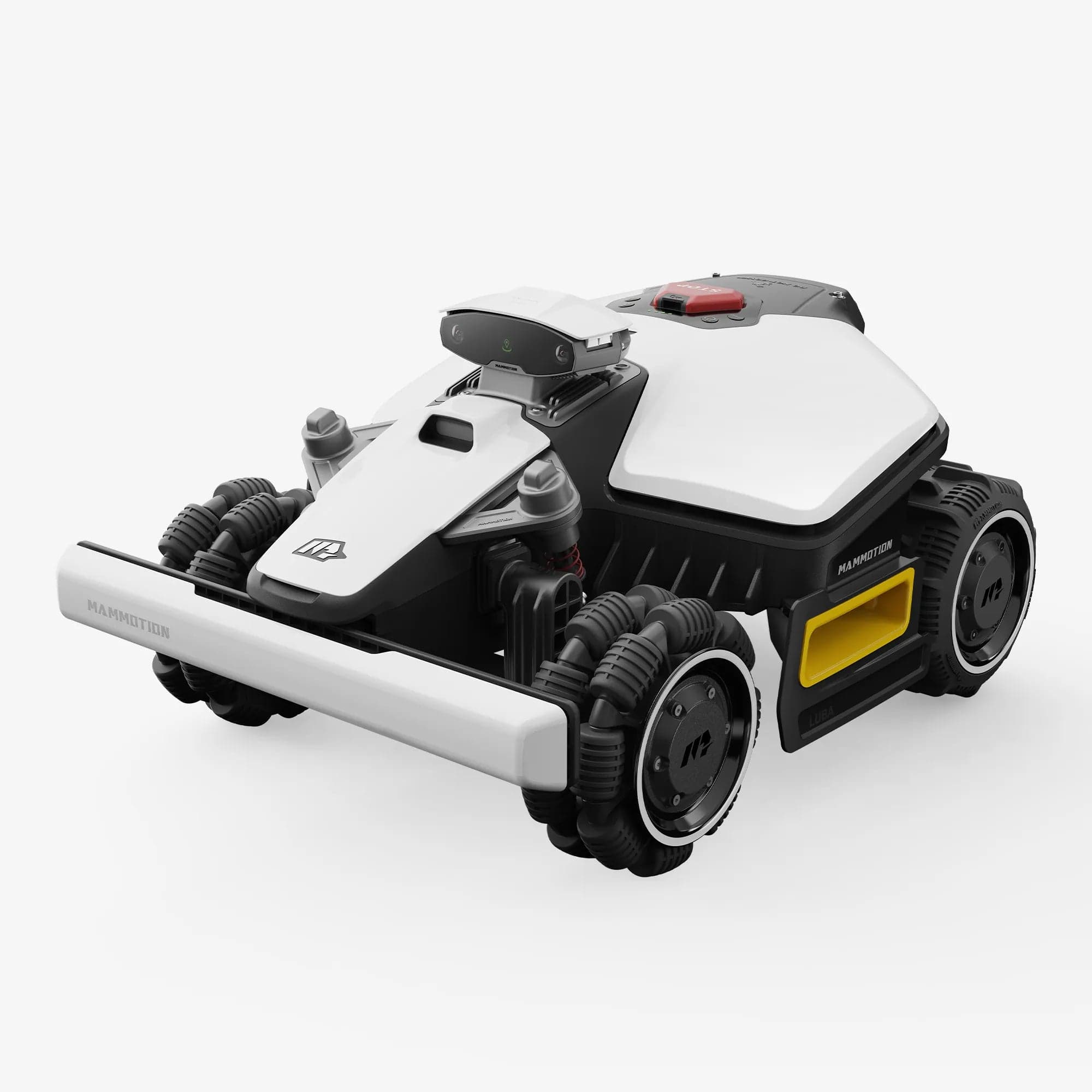
The LUBA mini AWD is Mammotion's answer to a specific problem: a yard that is small but steep. It packs genuine all-wheel drive rated to an 80% grade and the brand's sensor-fusion navigation (LiDAR + dual-camera vision + RTK) into a compact 0.37-acre body — the cheapest way in our database to reach the top of the slope ladder. It maps up to 20 zones, carries AI-vision obstacle avoidance, anti-theft with GPS tracking, and a 2.2–4.0-inch cut-height range on a 7.9-inch deck. It is a real climber that happens to be small, not a small mower with a slope badge. Its trade-offs are honest: capacity is modest for the money, edges are rated only "ok," and its street price sits close to larger models — so confirm the current price before you buy.
Segway Navimow i110N
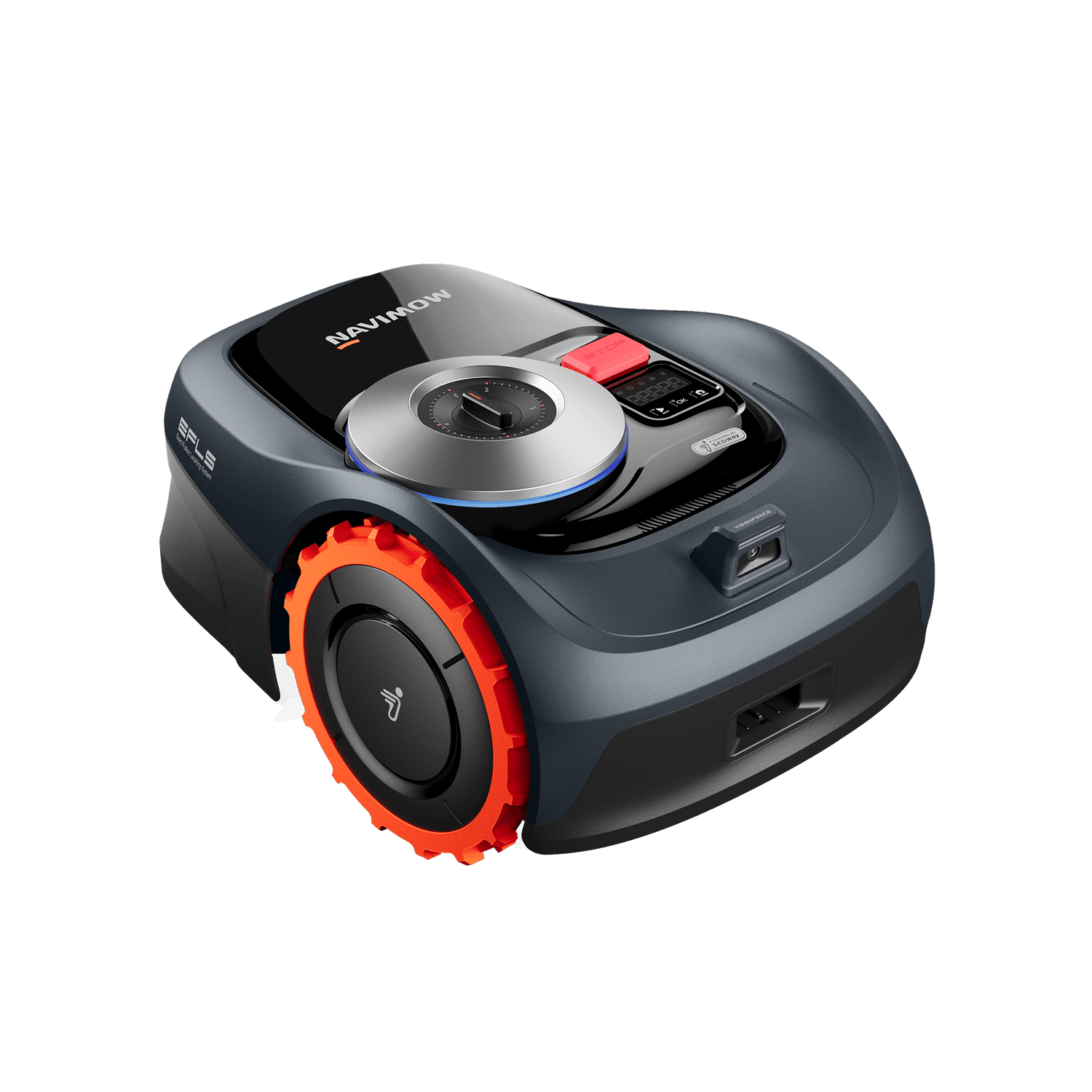
Segway Navimow i110N robot lawn mower
The Navimow i110N is the quarter-acre pick from Segway's value line. Its calling card is wire-free simplicity: NetRTK positioning plus vision means no boundary wire and no local antenna to plant, which makes it one of the easier mowers here to get running on a small, open lawn. It covers up to 0.25 acre across 5 zones, runs quietly at about 58 dB, and includes AI VisionFence obstacle avoidance, anti-theft, and GPS tracking. It cuts 1.2–2.4 inches on a 7.1-inch deck — a lower range that suits closely-kept lawns. The limits are the flip side of the price: rear-wheel drive and a 30% slope ceiling keep it on flatter yards, and its edges, like the LUBA mini's, are rated "ok."
Navigation head-to-head: fusion vs NetRTK
Both mowers are wire-free, but they find their way very differently, and the difference matters most under trees.
The LUBA mini AWD runs Mammotion's sensor fusion: onboard LiDAR builds a live 3-D picture of the yard, dual cameras add AI vision, and RTK supplies centimeter-grade positioning. Because three systems cross-check each other, the mower can hold its location even when one of them is degraded — near a fence line, a structure, or partial tree canopy. That redundancy is a big reason it earns a higher MowScout Score, and it is the right approach for a yard that is not perfectly open to the sky. If you want the full explainer on how these systems differ, our guide RTK vs LiDAR vs vision walks through the trade-offs.
The Navimow i110N uses NetRTK plus vision. NetRTK (network RTK) pulls its correction signal from a cellular network rather than a local antenna you mount yourself, which is what makes setup so clean — there is no mast to place and align. The catch is that network-RTK-plus-vision positioning leans on a clear view of the sky and a good signal. Under a dense canopy or in a tight, obstructed lot it has less to fall back on than the LUBA mini's LiDAR. For an open lawn that is exactly the right trade — less hardware, less fuss. For a wooded one, the fusion system is the safer bet.
Neither approach requires a buried wire, and both include AI-vision obstacle avoidance so they can see and steer around toys, hoses, and pets during a run. The gap is redundancy, not the presence or absence of a single feature.
Slopes and terrain: the decisive 80% vs 30% gap
This is the section that decides the purchase, so we will be blunt about it.
The LUBA mini AWD is rated to an 80% grade — roughly 39° — on genuine all-wheel drive. The Navimow i110N is rated to 30% — roughly 17° — on rear-wheel drive. That is not a small margin; it is the difference between a mower that can climb a real bank and one that is designed to stay on level ground. Percent grade is not the same as degrees (a 100% grade is 45°, not vertical), but the practical takeaway is unmissable: the LUBA mini's ceiling is more than twice the i110N's.
Why the gap? Climbing grade is a traction problem, and traction comes from how many wheels drive and how much torque reaches them. All-wheel drive puts power to every wheel, and Mammotion tunes the LUBA line specifically for steep hill capability. Rear-wheel drive, which the i110N uses, tops out around 30% across our data because the front wheels are just along for the ride and lose grip as the pitch increases. This is the same reason the i110N appears on our flat-yard shortlist and the LUBA mini appears on our best mowers for hills list.
Two honest caveats apply to both:
Every slope rating is a dry-condition number. Dew, rain, slick clippings, and loose soil all lower the
real ceiling. Leave 10–20% of headroom over your measured grade and schedule runs to avoid heavy rain. Traction, not water resistance, is the limiting factor — both mowers list wet-grass operation as OK, but that is about getting the job done, not about defying a slick hill.
Measure before you decide. Divide the vertical rise by the horizontal run and multiply by 100 for
percent grade: a 12-inch rise over 24 inches is 50%. If your steepest section reads above ~30%, the i110N is out and the LUBA mini is in. If it reads well under 30%, you may be paying the LUBA mini's premium for climbing ability you will never use.
If slope is your only hard constraint, the decision is already made. If it is one of several, keep reading — capacity and setup can still swing a close call.
Capacity and coverage: 0.37 vs 0.25 acre
The LUBA mini AWD covers up to 0.37 acre; the i110N covers up to 0.25 acre. On paper that is a third-of-an-acre mower versus a quarter-acre mower — a meaningful gap if your lawn sits near the top of the i110N's range.
Zones matter as much as raw area here. The LUBA mini maps up to 20 zones, the i110N up to 5. If your property is a single open rectangle, five zones is plenty and the difference is academic. But if your lawn is carved up by a driveway, beds, a side yard, and a back section, 20 zones gives you the flexibility to define and schedule each area independently. The LUBA mini is built to handle a more complicated map; the i110N is built to keep a simple one simple.
Cutting width tracks the same story: the LUBA mini's 7.9-inch deck is slightly wider than the i110N's 7.1-inch deck, so it clears a bit more grass per pass. Neither is a wide-deck speed demon — these are compact mowers — but on a larger, busier map the wider deck and higher zone count add up to less time re-covering ground. If your yard is genuinely small and one-piece, that advantage is one you will not notice; size the mower to the lawn, not the spec sheet.
Setup and ease of living with it
Here the value mower earns a point back. Both are wire-free, but the Navimow i110N is the simpler start. NetRTK positioning means there is no antenna to mount and align, and its five-zone, quarter-acre scope keeps the initial mapping short. For a first-time robot-mower buyer with a small, open lawn, it is one of the lowest-friction ways into the category — and it runs quietly at about 58 dB, so daytime or evening mowing is unobtrusive.
The LUBA mini AWD asks a little more of you up front. More sensors means more to satisfy during mapping, and 20 zones is more to define than five — though, crucially, it also does not require a separately mounted antenna, so it avoids the biggest setup chore that dogs some RTK mowers. The extra effort buys the redundancy and slope capability described above. It is the classic trade: a simpler tool for a simple yard, or a more capable tool that takes slightly longer to teach.
Both share the practical comforts: Wi-Fi, Bluetooth, and 4G connectivity, app control rated 4/5, anti-theft with GPS tracking, and a 2-year warranty. Living with either day to day is similar — you are choosing between them on capability and price, not on app polish or connectivity. For the bigger picture of what ownership actually involves, see how robot lawn mowers work.
Value for money: $1,499 vs $999
At about $999, the Navimow i110N is roughly $500 cheaper than the LUBA mini AWD's ~$1,499 street price. Whether that gap is a bargain or a false economy depends entirely on your yard.
For a flat, open quarter acre, the i110N is the better value, full stop. Every dollar of the LUBA mini's premium goes toward AWD, sensor fusion, more zones, and more capacity — and on that yard, all four are capability you will never touch. Paying $500 for an 80% slope rating on a flat lawn is like buying a truck to haul groceries.
For a sloped, larger, or complex yard, the equation flips. The i110N's lower price is no bargain if the mower physically cannot climb your hill or cover your acreage — you would be buying a tool that does not fit, which is the most expensive kind of cheap. Here the LUBA mini's premium is the price of a mower that actually works on your property, and its higher MowScout Score (83 vs 64) reflects real, usable capability rather than paper features.
The honest asterisk on both: street prices move weekly. The LUBA mini in particular is noted for sitting close to larger models, so a sale can narrow or widen this gap significantly. Confirm both current prices before you commit, and weigh the total against what your yard actually demands. Our roundup of budget picks under $1,000 is a useful reality check if the i110N is at the top of your budget.
Who should choose which
Choose the LUBA mini AWD if…
Any meaningful part of your lawn is a slope (above ~30% grade) — this is the deciding factor.
Your yard runs closer to 0.37 acre than 0.25, or splits into several separated zones.
You have tree cover or an obstructed lot where sensor-fusion redundancy beats sky-dependent positioning.
You want the more capable, higher-scoring, more future-proof machine and will pay ~$500 for it.
Choose the Navimow i110N if…
Your lawn is flat-to-gentle — under about 30% grade — and stays that way.
It is a quarter acre or smaller, mostly open to the sky, in one or two simple pieces.
You want the lowest price and the simplest, antenna-free setup.
You value quiet operation (~58 dB) and don't need slope or capacity headroom you'll never use.
Full spec comparison
Manufacturer specifications verified against retail listings, paired with the MowScout Score. Slope figures are dry-condition ceilings; prices are mid-2026 street estimates — verify before purchase.
Spec
LUBA mini AWD
Navimow i110N
MowScout Score
83
64
Street price*
~$1,499
~$999
MSRP
$1,799
$1,299
Max area
0.37 acre
0.25 acre
Max slope
80% (~39°)
30% (~17°)
Drive
AWD
RWD
Navigation
LiDAR + vision + RTK fusion
NetRTK + vision
Boundary wire
None (base station)
None (NetRTK)
Local antenna
Not required
Not required
Mapped zones
20
5
Cutting width
7.9 in
7.1 in
Cut height
2.2–4.0 in
1.2–2.4 in
Obstacle avoidance
AI vision
AI vision (VisionFence)
Anti-theft / GPS
Yes / Yes
Yes / Yes
Noise
Not listed
~58 dB
Connectivity
Wi-Fi, BT, 4G
Wi-Fi, BT, 4G
App quality
4 / 5
4 / 5
Warranty
2 years
2 years
\*Street estimates as of mid-2026 — verify before purchase.
Frequently asked questions
Is the Mammotion LUBA mini AWD or the Segway Navimow i110N better for a sloped yard? The LUBA mini AWD, decisively. It is rated to an 80% grade (about 39°) on genuine all-wheel drive, while the RWD Navimow i110N is rated to 30% (about 17°). If any part of your lawn is a real slope, the LUBA mini is the only one of the two that can climb it. The i110N is a flat-to-gentle-yard mower — above roughly 30% grade it is out of its depth no matter how good the rest of the package is.
Why does the LUBA mini AWD cost about $500 more than the Navimow i110N? You are paying for drivetrain and navigation. The LUBA mini adds all-wheel drive tuned to 80% slopes, LiDAR-plus-vision-plus-RTK sensor fusion, a wider 7.9-inch deck, 20 mapped zones, and 0.37-acre capacity. The i110N (about $999 street) uses rear-wheel drive, NetRTK-plus-vision positioning, a 7.1-inch deck, 5 zones, and 0.25-acre capacity. On a flat quarter acre those extras are wasted money; on a steep or larger yard they are the whole point. Both prices are street estimates — verify before you buy.
Do either of these robot mowers need a boundary wire? No. Both are fully wire-free — that is one of the few things they share. The LUBA mini AWD uses a charging base station plus onboard LiDAR, cameras, and RTK to hold its position, with no antenna mast to plant. The i110N uses network RTK (NetRTK) plus vision, so it skips both the boundary wire and a local antenna. Neither requires you to bury or pin down perimeter wire, which is a large part of why both are easier to install than older wire-guided mowers. See our guide to going wire-free.
Which one is easier to set up, the LUBA mini or the i110N? The Navimow i110N is the simpler of the two on paper: NetRTK positioning means there is no antenna to place and less sky-view fussing, and its 5-zone, quarter-acre scope keeps mapping short. The LUBA mini AWD asks a bit more of you — more sensors to satisfy and more zones to map — but it does not need a separately mounted antenna either. For a small, simple, open lawn the i110N is the faster start; for a complex or sloped yard the LUBA mini's extra mapping earns its keep.
Can the Navimow i110N handle the same size yard as the LUBA mini AWD? Not quite. The i110N is rated for up to 0.25 acre and 5 zones; the LUBA mini AWD is rated for up to 0.37 acre and 20 zones. If your lawn is a tidy quarter acre in one or two pieces, the i110N fits. If it runs closer to a third of an acre, is split into several separated areas, or you expect it to grow into the space, the LUBA mini has the headroom the i110N does not.
Is the MowScout Score gap (83 vs 64) mostly about slopes? Slope and drivetrain are the biggest single driver, but not the only one. The LUBA mini AWD's Score of 83 reflects its 80% AWD terrain capability, richer sensor-fusion navigation, larger capacity, and more zones. The Navimow i110N's 64 reflects a solid, affordable, wire-free small-yard mower that is capped by RWD, a 30% slope limit, a quarter-acre ceiling, and fewer zones. The Score is a composite, so the i110N is not a bad mower — it is a narrower one. For the wider question of whether either is worth it, see are robot mowers worth it in 2026.
Find your match
Slope and size decide most of this matchup, but your yard is more specific than any two-way comparison. Tree cover, zone count, budget, and how the lawn is shaped all interact — and the right mower might not be either of these two.
The configurator screens your exact grade, area, tree cover, and budget against every model we track, so you don't overbuy an 80% climber for a flat lawn — or under-buy a 30% mower for a hill it can't handle. For the full landscape of how these systems work and what to prioritize, start with our pillar guide, robot lawn mowers: RTK vs LiDAR vs vision, then compare the two contenders directly in the LUBA mini AWD review and the Navimow i110N review.
Quick winner
Mammotion LUBA mini AWD 1500H leads this comparison.
The winner is based on current MowScout Score and the yard-fit specs that matter for Mammotion LUBA mini AWD vs Segway Navimow i110N: a spec-verified 2026 comparison of MowScout Scores, 80% vs 30% slope, AWD vs RWD, price, setup, and value.. That does not mean every buyer should choose it. A lower-scoring mower can still be the smarter purchase if it fits your lawn size, tree cover, slope, budget, or setup tolerance better. Treat this page as a structured decision guide, then run the configurator before buying.
The score gap is 19 points and the current street-price gap is $500. Those two numbers matter together. A small score gap with a large price gap may favor value; a large score gap may justify paying more if the added capability addresses your yard's hardest constraint.
True AWD to 80% slopes with LiDAR plus dual-camera vision in a compact 0.37-acre body — steep-yard capability without a full-size LUBA.
Score83/100
It is the higher-scoring mower in this matchup, so buyers should start here when its strengths match the yard. For Mammotion LUBA mini AWD vs Segway Navimow i110N: a spec-verified 2026 comparison of MowScout Scores, 80% vs 30% slope, AWD vs RWD, price, setup, and value., the important specs are 0.37 acres of rated area, 80% slope support, HYBRID navigation, AWD drive, and 20 supported zones. Because this model avoids an external antenna, the setup path may be easier for buyers who want fewer install variables. The practical question is whether those strengths solve your hardest yard constraint or simply add capability you will not use.
Wire-free NetRTK plus vision covers up to a quarter acre with no boundary wire and no local antenna.
Score64/100
It trails the comparison winner on the current score, but it can still be the smarter buy for the right lawn. For Mammotion LUBA mini AWD vs Segway Navimow i110N: a spec-verified 2026 comparison of MowScout Scores, 80% vs 30% slope, AWD vs RWD, price, setup, and value., the important specs are 0.25 acres of rated area, 30% slope support, NETRTK navigation, RWD drive, and 5 supported zones. Because this model avoids an external antenna, the setup path may be easier for buyers who want fewer install variables. The practical question is whether those strengths solve your hardest yard constraint or simply add capability you will not use.
Specs do not replace yard fit, but they show which compromises are real. Pay special attention to the rows that match the constraint that brought you to this comparison.
Spec
Mammotion LUBA mini AWD 1500H
Segway Navimow i110N
MowScout Score
83
64
Street price
$1,499
$999
Max area
0.37 acres
0.25 acres
Daily coverage
0.37 acres
0.25 acres
Max slope
80%
30%
Navigation
HYBRID
NETRTK
Drive
AWD
RWD
Obstacle avoidance
ai vision
ai vision
Cut height
2.2-4 in
1.2-2.4 in
Cut width
7.9 in
7.1 in
Zones
20
5
Warranty
2 years
2 years
Where each mower wins
Mammotion LUBA mini AWD 1500H is the higher-scoring choice overall. It should be the first model you evaluate if the extra capability directly addresses your yard's limiting factor.
Segway Navimow i110N stays in the conversation when its price, setup path, navigation style, or size class better matches the lawn. A lower score is not an automatic rejection if the use case is narrower than the full MowScout formula.
The cheaper model is Segway Navimow i110N. The higher-capacity model is Mammotion LUBA mini AWD 1500H. The stronger listed slope rating belongs to Mammotion LUBA mini AWD 1500H. Those three checks often decide close comparisons faster than marketing claims.
Navigation and setup
Mammotion LUBA mini AWD 1500H uses HYBRID navigation while Segway Navimow i110N uses NETRTK navigation. That difference matters most around trees, fences, houses, open-sky requirements, and the first mapping session. If your yard has heavy trees, enclosed side yards, or houses close to the boundary, do not buy only from a spec table. Read the robot lawn mower guide and run the configurator with your sky-view setting.
Terrain and cutting
Terrain is where paper winners can change. Mammotion LUBA mini AWD 1500H uses AWD drive and is rated for 80% slopes; Segway Navimow i110N uses RWD drive and is rated for 30% slopes. Also compare cut-height range, edge behavior, and whether the mower has enough weight and traction margin for wet turns or rooty turf.
Cost and ownership
Current street prices put Mammotion LUBA mini AWD 1500H at $1,499 and Segway Navimow i110N at $999. The purchase price is only the first line item. Add blades, dock protection, antenna hardware if required, battery risk, and the value of avoided mowing time in the five-year cost calculator.
Next checks
Use the table above to decide which mower fits on paper, then run the configurator with your actual acreage, slope, tree cover, zones, terrain, obstacles, and budget before opening a retailer page.
Is the Mammotion LUBA mini AWD or the Segway Navimow i110N better for a sloped yard?
The LUBA mini AWD, decisively. It is rated to an 80% grade (about 39°) on genuine all-wheel drive, while the RWD Navimow i110N is rated to 30% (about 17°). If any part of your lawn is a real slope, the LUBA mini is the only one of the two that can climb it. The i110N is a flat-to-gentle-yard mower — above roughly 30% grade it is out of its depth no matter how good the rest of the package is.
Why does the LUBA mini AWD cost about $500 more than the Navimow i110N?
You are paying for drivetrain and navigation. The LUBA mini adds all-wheel drive tuned to 80% slopes, LiDAR-plus-vision-plus-RTK sensor fusion, a wider 7.9-inch deck, 20 mapped zones, and 0.37-acre capacity. The i110N (about $999 street) uses rear-wheel drive, NetRTK-plus-vision positioning, a 7.1-inch deck, 5 zones, and 0.25-acre capacity. On a flat quarter acre those extras are wasted money; on a steep or larger yard they are the whole point. Both prices are street estimates — verify before you buy.
Do either of these robot mowers need a boundary wire?
No. Both are fully wire-free — that is one of the few things they share. The LUBA mini AWD uses a charging base station plus onboard LiDAR, cameras, and RTK to hold its position, with no antenna mast to plant. The i110N uses network RTK (NetRTK) plus vision, so it skips both the boundary wire and a local antenna. Neither requires you to bury or pin down perimeter wire, which is a large part of why both are easier to install than older wire-guided mowers.
Which one is easier to set up, the LUBA mini or the i110N?
The Navimow i110N is the simpler of the two on paper: NetRTK positioning means there is no antenna to place and less sky-view fussing, and its 5-zone, quarter-acre scope keeps mapping short. The LUBA mini AWD asks a bit more of you — more sensors to satisfy and more zones to map — but it does not need a separately mounted antenna either. For a small, simple, open lawn the i110N is the faster start; for a complex or sloped yard the LUBA mini's extra mapping earns its keep.
Can the Navimow i110N handle the same size yard as the LUBA mini AWD?
Not quite. The i110N is rated for up to 0.25 acre and 5 zones; the LUBA mini AWD is rated for up to 0.37 acre and 20 zones. If your lawn is a tidy quarter acre in one or two pieces, the i110N fits. If it runs closer to a third of an acre, is split into several separated areas, or you expect it to grow into the space, the LUBA mini has the headroom the i110N does not.
Is the MowScout Score gap (83 vs 64) mostly about slopes?
Slope and drivetrain are the biggest single driver, but not the only one. The LUBA mini AWD's Score of 83 reflects its 80% AWD terrain capability, richer sensor-fusion navigation, larger capacity, and more zones. The Navimow i110N's 64 reflects a solid, affordable, wire-free small-yard mower that is capped by RWD, a 30% slope limit, a quarter-acre ceiling, and fewer zones. The Score is a composite, so the i110N is not a bad mower — it is a narrower one.
Which is better: Mammotion LUBA mini AWD 1500H or Segway Navimow i110N?
Mammotion LUBA mini AWD 1500H leads by current MowScout Score, but the better buy depends on your yard size, slope, tree cover, zones, and budget.
Is there one universal winner?
No. A mower can win this comparison overall but still be the wrong fit for dense trees, steep wet slopes, narrow passages, or a tight budget.
How is the winner chosen?
This page uses current MowScout Scores and key yard-fit specs. The configurator is more specific because it uses your yard inputs.
Should I buy from the deal box immediately?
Use the deal box after confirming fit. Prices and availability can change, so verify the current retailer page before purchase.